
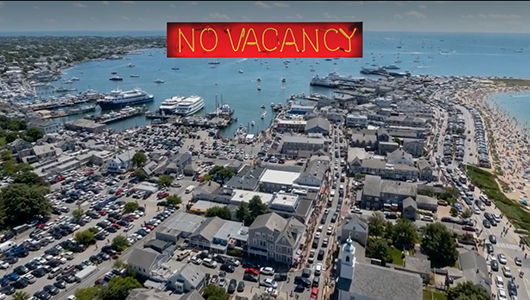
During a recent Unscripted conversation, Andy Lowell recalled once being told that “nobody on this planet is qualified to put a capacity on the island of Nantucket.” It was a striking line because it points to a question the island has long circled but rarely asked directly: what is the capacity of Nantucket?
||| FROM BELOW DECK | NANTUCKET |||
At some point, every island has to confront the question: how much can it hold?
For Nantucket, that question has usually been asked indirectly. It appears in debates over housing, traffic, sewer expansion, beach erosion, ferry reservations, short-term rentals, public safety, conservation, and the crowds of July and August. It sits beneath arguments about growth, affordability, tourism, and quality of life. It surfaces whenever residents talk about the island feeling full, strained, overbuilt, or changed beyond recognition.
But the question itself is rarely asked plainly. What is the capacity of Nantucket?
The answer is not as simple as a single number. Nantucket is not a restaurant, theater, ferry, or yacht club, where a fire-code capacity can be posted near the door. An island has no one occupancy placard. Its limits are layered across land, water, roads, housing, ferries, parking, public safety, wastewater, conservation, and the fragile ecology that makes the place valuable in the first place. Still, that does not mean the question is impossible. It means the answer has to be built differently.
Nantucket does have capacities. There is the number of people who can be physically present on a peak summer day. There is the number who can sleep legally and practically in homes, inns, hotels, guesthouses, boats, and workforce housing. There is the number of cars that can be imported, parked, stored, and moved without producing gridlock or breakdown. There is the load that water and sewer systems can handle. There is the strain police, fire, and emergency medical services can absorb. And there is the amount of development the island can still accommodate given conservation land, zoning, infrastructure, and climate risk.
Each of these limits matters, yet none alone tells the whole story. Taken together, they reveal something important: Nantucket may not have one official maximum, but it is already operating close to several practical limits during the height of summer.
The most defensible answer is this: under the current built environment, Nantucket appears capable of functioning at routine high-summer daytime population levels somewhere in the range of roughly 50,000 to the low 70,000s, with overnight presence likely in the mid-40,000s to around 60,000. The Town’s own public-facing materials have long suggested that summer population can swell to about 80,000, but that figure is better understood as an outer-edge spike than as a comfortable daily operating level.
For planning purposes, the more useful question is not how many people Nantucket can physically absorb for a few strained days. It is how many people the island can sustain without pushing its systems into red-line conditions.
On that basis, a prudent working range may be closer to 55,000 to 65,000 people present on a peak summer day. That’s not an adopted Town threshold, it is an analytical estimate drawn from housing stock, ferry and air throughput, public water production, wastewater constraints, parking inventory, emergency-service load, and protected land. It is also a warning.
Capacity Is Not One Number
The first mistake in talking about Nantucket’s capacity is treating the island as if it has one master limit. It does not.
A restaurant has a posted occupancy because the relevant question is narrow: how many people can safely occupy a defined interior space at one time? Nantucket is a living system. Its limits are spread across different networks, some physical and some political. The island may be able to host more people than its roads can comfortably move, more people than its downtown can park, more people than its workforce can serve, and more people than its ponds, harbor, and aquifer can absorb without long-term damage. That’s why the capacity question cannot be answered by acreage alone.
The deeper truth is that Nantucket’s capacity is no longer primarily a question of open land. Nearly half the island is permanently protected as open space through the combined work of conservation organizations and public entities. That choice has helped preserve the island’s character and ecology, but it also means future growth is not a simple matter of finding more empty land.
The island’s modern capacity is land plus infrastructure plus climate exposure plus political tolerance. It’s the ability of the whole system to function under seasonal stress.
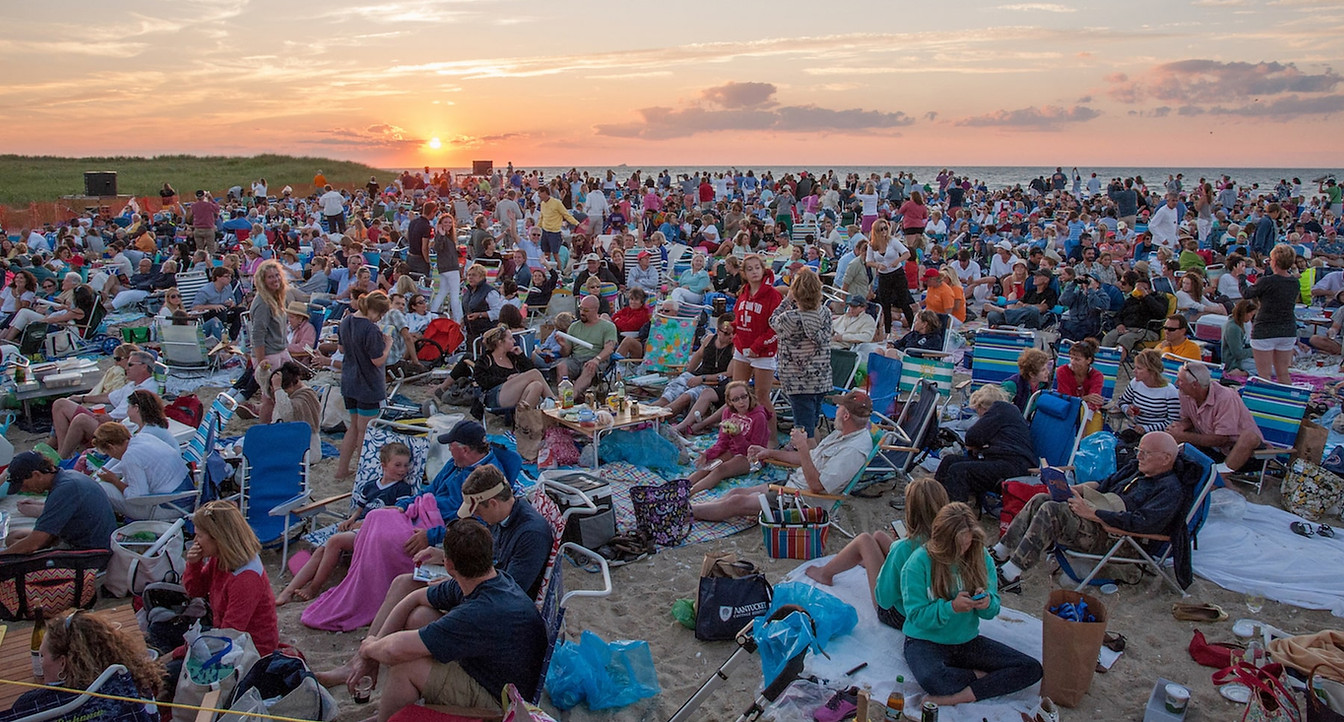
Kris Kinsley Hancock
Thousands fill Jetties Beach during the annual Boston Pops concert. Nantucket has become remarkably efficient at absorbing seasonal surges of people, vehicles, and activity. The question is no longer whether the island can do it, but how much more it can absorb before one of its critical systems reaches its limit.
The Summer Island Is Several Islands at Once
Nantucket’s official year-round population is a little under 15,000. That number is real, but in summer it becomes almost misleading.
The island that exists in January is not the same operational place that exists in late July. In winter, roads, restaurants, schools, police, fire, sewer, water, and grocery stores are serving one scale of community. By midsummer, they are serving something several times larger, made up of year-round residents, seasonal homeowners, renters, hotel guests, day-trippers, seasonal workers, boaters, and contractors moving through a compressed geography.
The housing stock is the central driver. Nantucket’s overnight capacity is not primarily created by hotels. It is created by houses. Official housing studies have described the island as having roughly 11,650 housing units, with about 64 percent seasonal. Census materials from the late 2010s similarly showed roughly 7,677 units designated for seasonal, recreational, or occasional use. Even using conservative occupancy assumptions, that housing base can hold tens of thousands of people during peak season.
If roughly 7,500 seasonal-use dwellings are occupied by an average of 3.5 to 5 people at peak, those units alone could account for approximately 26,000 to 38,500 people. Add the year-round resident base, hotel and inn guests, seasonal workers housed on-island, and limited marine overnight use, and the routine peak overnight population plausibly lands somewhere between 44,000 and 60,000. That’s before adding day-trippers and same-day off-island workers.
Once passenger ferries and air arrivals are included, daytime population can climb much higher. A routine peak daytime range of roughly 49,000 to 72,000 people is defensible under current conditions. On especially intense days, with heavy ferry traffic, events, beach weather, boat activity, and short-stay visitors layered on top of the overnight population, the Town’s broad figure of about 80,000 becomes plausible as an upper-end summer spike.
The Real Hotel Is the Housing Stock
Traditional lodging matters, but it’s not the primary engine of Nantucket’s summer capacity.
Hotels, inns, and guesthouses are visible, regulated, and central to the visitor economy. But they are small compared with the island’s seasonal dwelling base. We found no current, consolidated official inventory of every hotel bed or lodging room on the island, but Town permit data showed 29 guest-house and hotel parking permits in FY2025. Even if those properties averaged 10 to 20 rooms each with two guests per room, that would suggest perhaps 580 to 1,160 guests as a floor estimate. That’s meaningful, but it’s not what makes Nantucket swell.
The true scale comes from private homes, second homes, seasonal rentals, family compounds, guest cottages, converted basements, accessory units, and informal arrangements that expand the number of people sleeping on-island during summer. Some of that is formally tracked, much of it is not. Some is legal and visible, and some is tucked into the gray areas of seasonal life.
This is why debates about short-term rentals, workforce housing, subdivision, accessory dwelling units, and year-round affordability are really debates about island capacity. They’re not just housing policy questions, they determine how many people the island can host, who those people are, where they sleep, and how much pressure they place on water, sewer, roads, beaches, and emergency services. The lodging capacity of Nantucket is, in practical terms, a housing-capacity question.


Nantucket Data Platform//Shawn Miller/CoStar
Capacity is not a single number. It is the combined ability of ferries, roads, housing, utilities, emergency services, and natural resources to function under peak demand. On Nantucket, every arriving passenger and every arriving vehicle becomes part of that calculation.
People Can Arrive Faster Than Cars Can
If Nantucket’s people capacity is large, its vehicle capacity is much more constrained.
Passenger throughput to the island is substantial. The Steamship Authority, HyLine, Seastreak, Freedom Cruise Line, and commercial air service together can move thousands of people to Nantucket in a single peak-season day. Even without fully counting Steamship Authority passenger capacity, the known non-SSA arrivals from Hy-Line, Seastreak, Freedom, and average August commercial air can reach roughly 5,000 to 6,200 one-way arrivals on a peak day.
That’s enough to create major same-day churn. People can come for the day, work a shift, attend an event, visit family, go to the beach, eat dinner, and leave.
Cars are different. Because only the Steamship Authority carries automobiles to Nantucket, vehicle import capacity is deliberately bottlenecked, measured in dozens of vehicles per sailing and likely in the low hundreds per day overall, not in thousands. Nantucket can move large numbers of people without importing a matching number of cars. But once vehicles are on-island, they must be stored, parked, circulated, and tolerated by a street network never designed for modern peak-season volume.
Downtown makes the point plainly. Town parking-management materials described roughly 309 public on-street spaces plus 100 public parking-lot spaces in the managed downtown program area. A paid-parking pilot estimated the core area at about 276 spaces. The long-range policy goal is not to fill those spaces to 100 percent, it is to manage them closer to 85 percent occupancy, preserving turnover and preventing saturation.
Full parking is not success, it’s a failure disguised as demand. The island’s vehicle capacity is therefore not defined by how many cars can technically fit somewhere on Nantucket, it’s defined by whether cars can arrive, circulate, park, and leave without degrading the basic function of the place. By that standard, cars are one of the island’s tightest limits.
The Water System Shows the Surge
Water is one of the clearest physical indicators of Nantucket’s seasonal load. In FY2025, the combined annual production of Wannacomet and Siasconset totaled 812.7 million gallons. The Water Department described FY2025 as one of the highest production years on record. Wannacomet alone reached a peak day of 4.36 million gallons on July 27, 2024. Siasconset’s highest daily production was 590,000 gallons on August 13, 2024.
Those two peaks did not occur on the same day, so they cannot simply be added as one islandwide maximum. But together they show the scale of summer demand. Nantucket’s water system is not merely serving a small town with a seasonal bump, but rather an island that, for a few months, behaves like a much larger municipality compressed onto a fragile aquifer.
Water use is also not evenly distributed. Peak demand is driven by people, irrigation, pools, restaurants, hotels, cleaning, construction, landscaping, laundry, and the daily churn of summer life. A large house with extensive landscaping can consume water very differently from a year-round household. A crowded rental can place a different load on the system than a seasonal home occupied only occasionally. That makes water capacity both a population issue and a land-use issue.
The fact that the system is already reaching very high peak-day production does not prove Nantucket is out of water, but it does show that any future increase in people, housing, seasonal occupancy, or irrigation demand has to be measured against a system already under significant summer pressure. Annual averages will not answer the question. Peak days will.
Wastewater Is the Other Side of the Same Problem
What comes onto the island as water eventually leaves as wastewater, stormwater, septage, runoff, or environmental pressure. Nantucket’s sewer system includes two wastewater treatment facilities, 17 pump stations, and more than 85 miles of sewer mains. FY2025 reporting showed continued compliance with state discharge limits, ongoing rehabilitation under the CMOM program, and continued work on the comprehensive wastewater management plan.
That sounds orderly, and in many ways it is. But the underlying message is that the system requires constant management.
The Town Manager’s report has also referenced the need to ensure that the sewer system has the capacity to avoid crises like the one experienced in 2018, when a catastrophic force-main failure near the Sea Street pump station forced the Town to divert untreated sewage into Nantucket Harbor during a major winter storm. Wastewater is not a theoretical constraint, it’s a real operating risk.
Wastewater capacity is especially important because growth on Nantucket is often discussed as if new housing can be added through zoning alone. But zoning does not treat wastewater, repair pump stations, nor remove inflow and infiltration during storms. Zoning does not protect ponds from nitrogen loading. Zoning can allow more units, but infrastructure determines whether those units can be responsibly supported. That is why development capacity cannot be separated from sewer capacity.
The question is not simply how many more homes Nantucket can permit. It is how many more people, toilets, showers, restaurants, laundries, and seasonal surges the island can support without shifting the cost onto public systems and environmental quality.


Maggie Janick//Getty
The capacity of Nantucket’s environment is shaped by both natural and human forces. The recently elevated West Jetty reflects efforts to prepare for rising seas and stronger storms, while water-quality challenges in the island’s ponds and estuaries highlight the ecological limits that growth and development must respect.
Public Safety Has Its Own Capacity
An island can feel crowded before it fails. Emergency systems reveal that strain more clearly than almost anything else.
In FY2025, Nantucket’s Fire Department had 41 firefighters and six paramedics. Emergency calls were up roughly 3 percent from the previous fiscal year. Police reported 14,898 other calls for service, 529 motor-vehicle crash reports, and 3,581 motor-vehicle stops. The Town also processed large volumes of permitting tied to parking, marine activity, rental cars, and seasonal operations.
None of those numbers alone proves a breakdown. But taken together, they show a public-safety system working under a substantial seasonal load.
Capacity here is not just staffing, it’s response time, road access, ferry dependence, hospital capacity, weather, crowding, event load, beach rescues, marine incidents, late-night activity, traffic crashes, medical transports, and the reality that Nantucket cannot rely on immediate neighboring-town backup the way mainland communities can.
When something goes wrong on an island, geography becomes part of the emergency. This is why population estimates matter. A summer population of 60,000 or 70,000 is not simply a tourism statistic, it’s a public-safety planning assumption. It affects ambulance demand, police coverage, fire response, emergency sheltering, evacuation planning, and the ability to handle overlapping incidents during peak periods. An island that does not know its true peak population is planning partly in the dark.


Fox News/NFD
Capacity is not just about roads and ferries. It is also measured by the ability of Nantucket’s police officers, firefighters, EMTs, and public safety personnel to respond when the island is at its busiest and the stakes are highest.
Conservation Protects the Island and Limits It
Nantucket has made one of its most consequential capacity decisions already. Nearly half the island is permanently protected open space through the work of the Nantucket Land Bank and other conservation organizations. This is one of the central reasons Nantucket has not become something unrecognizable. Conservation has protected moors, wetlands, trails, shorelines, habitat, viewsheds, and the open character that defines much of the island.
But conservation also changes the development equation. If nearly half the land is off the table, future growth must happen through infill, redevelopment, density, conversion, accessory units, public sites, and already-served corridors. That does not make growth impossible. It makes it more concentrated, more expensive, and more politically contested.
It also means the island cannot think of capacity as a blank-map exercise. Nantucket is not deciding how many people could theoretically fit on 47.8 square miles. It is deciding how many people can fit within the portion of the island not protected, not flood-prone, not environmentally constrained, not already built out, and not beyond the reach of water, sewer, roads, and emergency services. That’s a much smaller and more complicated question.
Conservation has preserved Nantucket. It has also forced Nantucket to be honest about where growth can still go.
Ecology Sets a Different Limit
Even if housing, water, and sewer systems can be expanded, the island’s ecological carrying capacity may not expand with them.
Nantucket’s ponds, harbor, beaches, wetlands, dunes, groundwater, and coastal habitats are not abstractions. They are working systems, and many are most vulnerable at the same time the island is most crowded. Summer is when population peaks, traffic peaks, irrigation peaks, restaurant activity peaks, boating peaks, waste generation peaks, and water quality often reaches its most stressed conditions. That seasonal overlap is the heart of the capacity problem.
A winter population of 15,000 and a summer population of 70,000 are not just different population counts, they are different ecological events. The summer island draws more water, produces more wastewater, generates more trash, sends more cars onto roads, places more boats in the harbor, and concentrates more people along beaches and ponds.
That’s why ecological capacity cannot be measured only by whether the island can physically host more people. It has to be measured by what happens to water quality, habitat, erosion, flooding, groundwater, nitrogen loading, and the long-term health of the systems that make Nantucket viable. The island may be able to accommodate more people in the short term while degrading the very conditions that allow it to function in the long term. That’s not capacity; that’s liquidation.
Climate Change Shrinks the Map
Nantucket’s future capacity will also be shaped by water moving in from the edges. Coastal-resilience planning has warned that by 2070 nearly 30 miles of roadway could be exposed to regular high-tide inundation of more than six inches. Not just a coastal-property issue, as roads are part of the island’s carrying system connecting workers to jobs, ambulances to patients, pump stations to maintenance crews, groceries to stores, contractors to job sites, and residents to daily life. When roads flood more often, practical capacity declines.
A road can exist on a map and still become unreliable. A neighborhood can be zoned for use and still become harder to serve. A house can remain standing while the infrastructure around it becomes more expensive, more fragile, and less dependable.
Climate exposure therefore changes the meaning of buildout. The island may have parcels that appear developable under zoning but become questionable when viewed through the combined lens of flood risk, access, utilities, and emergency response
This is where capacity becomes temporal. Nantucket’s capacity in 2026 is not the same as its capacity in 2050 or 2070. A system that feels strained now may have less room later, even if no one changes the zoning map. The island’s future limit may not be how much land remains. It may be how much serviceable land remains.


More than half of Nantucket is permanently protected from development through conservation ownership, easements, and open-space restrictions. Those preserved landscapes help define the island’s character, but they also establish a practical limit on where future growth can occur.
Nantucket Conservation Foundation
How Much More Can Be Built?
We could not source a current Town-adopted parcel-by-parcel buildout analysis, which means any development-capacity estimate must be treated cautiously. Still, broad scenarios can be drawn from the known constraints.
A conservative scenario might add 300 to 500 housing units, enough to address much of the long-identified affordable-housing shortfall through public sites, accessory units, reuse, and modest infill in already-served areas. At the Census average of 2.71 persons per household, that would represent roughly 800 to 1,350 additional people.
A moderate scenario might add 800 to 1,200 units through more meaningful zoning reform, mixed-use housing, workforce housing, conversion controls, and targeted sewer and water upgrades. That could support roughly 2,200 to 3,250 additional residents or occupants.
A maximal scenario under current environmental realities might add 1,500 to 2,000 units, but only with broad upzoning, major infrastructure investment, active climate adaptation, and political acceptance of much more intensive growth in limited corridors. That could mean roughly 4,000 to 5,400 additional people.
Those numbers are not large when compared with the scale of summer population. They show that Nantucket’s development problem is not simply how to house more people, it’s how to house the right people, in the right places, without worsening the systems that are already strained.
Growth is most plausible in Town, mid-island, selected public sites, accessory units, reuse of existing structures, and workforce housing near existing services. Large-scale greenfield expansion is constrained by conservation, infrastructure, cost, politics, and climate risk. The island can still build. But the easy version of growth is gone.

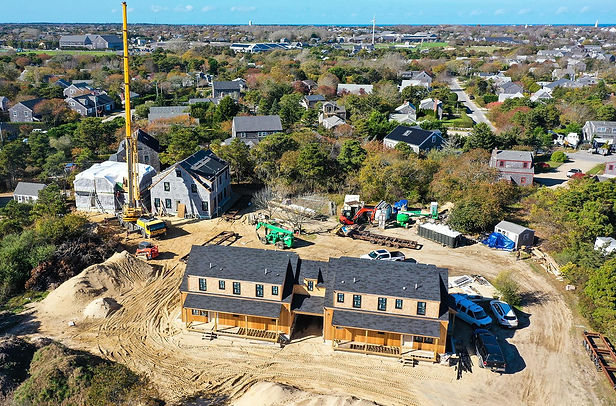
Expanding Nantucket’s housing supply requires overcoming challenges rarely faced on the mainland. The affordable housing development at left consisted of 44 buildings constructed from 455 modular units, each shipped to the island by barge. With roughly $70 million committed to housing initiatives since 2019, Nantucket continues to invest heavily in addressing housing needs while balancing the broader capacity limits of the island’s infrastructure, environment, and public services.
Modular.org//Town of Nantucket
The Missing Dashboard
One reason Nantucket argues about capacity without resolving it is that the island does not appear to maintain a single public capacity dashboard.
The pieces exist across departments. Water production is tracked. Sewer systems are monitored. Ferry schedules are public. Airport enplanements are reported. Parking permits are issued. Police and fire calls are counted. Housing studies exist. Conservation acreage is known. Coastal-resilience planning has mapped future exposure.
But the data are not integrated into one public-facing framework that answers the central question: how close is Nantucket to its functional limits during peak season?
A serious island-capacity dashboard would track peak-day population estimates, peak-day water production, peak-day wastewater flows, inflow and infiltration events, daily vehicle arrivals by ferry, downtown parking occupancy, commuter-lot occupancy, emergency incidents per 1,000 people present, solid-waste tonnage, short-term rental activity, hotel occupancy, seasonal versus year-round housing counts, and climate-exposed infrastructure.
That would not end political disagreement. It would improve the argument. Instead of debating whether Nantucket feels full, officials and residents could ask which systems are nearing capacity, which still have room, and what policies would relieve the most pressure. The island doesn’t need a single magic number. It needs a common operating picture.
The Capacity of Nantucket
If the question is how many people the island can physically host during a summer surge, the answer is probably somewhere between 55,000 and 80,000 people, depending on how capacity is defined and which systems are being measured. But the larger conclusion is more important than the exact figure.
Nantucket’s capacity is determined by the collective ability of dozens of interconnected systems to function during the busiest days of the year. The island’s true carrying capacity is only as strong as its weakest link. And those links are already revealing themselves.
Traffic congestion, seasonal housing shortages, rising water demand, wastewater constraints, crowded ferries, emergency-service pressures, and environmental concerns are not isolated issues. They are indicators of a community approaching the limits of what its existing systems were designed to support.
The island can still operate at an extraordinary seasonal scale. Every summer it absorbs tens of thousands of visitors, workers, homeowners, day-trippers, deliveries, vehicles, and boats with remarkable resilience. But resilience should not be mistaken for unlimited capacity.
Nantucket is not running out of land, it’s running into limits. Some of those limits are physical. Others are environmental, financial, operational, or social. Together, they form the carrying capacity of an island that has spent decades growing without ever fully defining how much growth its systems can absorb.
The question is no longer whether Nantucket can accommodate one more house, one more hotel room, one more summer visitor, or one more vehicle, it is what happens when thousands of individual decisions collectively push beyond the capacity of the systems that make island life possible.
What is the capacity of Nantucket?
For an island that regulates nearly everything, it may be the most important number it has never tried to calculate.

**If you are reading theOrcasonian for free, thank your fellow islanders. If you would like to support theOrcasonian CLICK HERE to set your modestly-priced, voluntary subscription. Otherwise, no worries; we’re happy to share with you.**







Regarding
“The question is no longer whether Nantucket can accommodate one more house, one more hotel room, one more summer visitor, or one more vehicle, it is what happens when thousands of individual decisions collectively push beyond the capacity of the systems that make island life possible.”
the interested reader is invited to read “on the ecology of micromotives”
(from google: “Thomas C. Schelling’s “On the Ecology of Micromotives” (first published in The Public Interest in 1971 …is a foundational text in complexity theory and behavioral economics. It explores how collective, large-scale social patterns (macrobehavior) naturally emerge from the localized, individual decisions and preferences (micromotives) of individual actors.Schelling’s work reveals that when individuals interact, their combined behaviors often defy simple intuition. His core arguments and examples in the essay include…”)
He discusses challenges that emerge from the “don’t know” and “don’t care” attitudes of many (the majority?) of folks.
Both of those perspectives are barriers to solving problems like Nantucket, like San Juan County.
The article above ends “For an island that regulates nearly everything, it may be the most important number it has never tried to calculate.”
For SJC, a county that regulates nothing of serious impact, calculating “capacity” may be the most important number it has never tried to calculate and indeed has refused to calculate regardless of procedural asks for over 25 years and regardless of the intention and expressed wishes of the residents in the comp plan’s Vision Statement along with GMA compliance requirements.
How this impacts taxes, services, and the experience of living here can be viewed at “https://www.islandstewards.org/the-big-picture”
If you TL;DR it, you’re removing your hand from the only lever you have: your voice.
Joe Symons