||| FROM THE OFFICE OF U.S. REP. RICK LARSEN |||
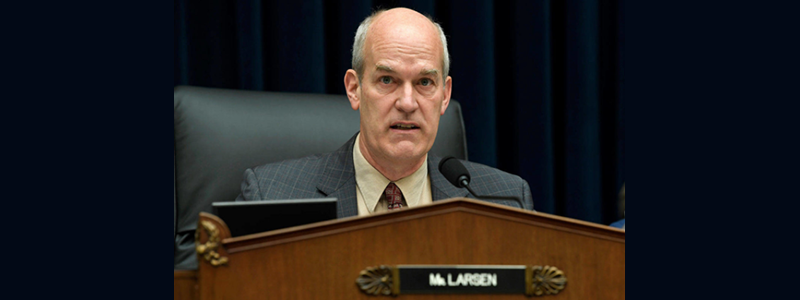
WASHINGTON, D.C. – Today, U.S. Representative Rick Larsen (WA-02), top Democrat on the Transportation and Infrastructure Committee, sent a letter to Admiral Kevin E. Lunday, Commandant of the United States Coast Guard, to insist that the Coast Guard review and update its oil spill preparedness plans in light of a proposed new Canadian oil pipeline that will increase oil tanker traffic in the Salish Sea.
“Section 7407 of the National Defense Authorization Act for Fiscal Year 2026 required the Coast Guard to coordinate with other federal agencies to review and update the Canada-United States Joint Maritime Pollution Contingency Plan, no later than 180 days after passage,” wrote Rep. Larsen. “I am concerned that the deadline has passed without Congress receiving an update on the Coast Guard’s efforts.”
On July 2, the Government of Alberta announced a proposed new oil pipeline from Alberta to the Pacific Ocean that would transport 1 million barrels per day to an export terminal at Roberts Banks in British Columbia. The new pipeline will increase tanker traffic in Haro Strait and Boundary Bay in the Salish Sea, and with it the risk of catastrophic oil spills. The Coast Guard’s Canada-United States Joint Maritime Pollution Contingency Plan outlines and facilitates coordination between the U.S. and Canadian governments to prepare for oil spills that would impact marine ecosystems and environments in both nations.
“The Canada-United States Joint Maritime Pollution Contingency Plan is particularly important in light of the proposed energy infrastructure developments on the Pacific Coast of Canada,” continued Rep. Larsen. “A strong partnership between the United States and Canada is key to effective protection of shared waterways and responding to maritime emergencies… I am requesting an update on implementation of Section 7407 by August 31, 2026.”
The Transportation and Infrastructure Committee has oversight authority of the U.S. Coast Guard. At a roundtable discussion with Coast Guard officers on maritime safety last week, Rep. Larsen pressed Coast Guard officials on their awareness of the new Canadian pipeline and how it would implicate existing oil spill prevention plans. Following the roundtable, he released a statement vowing to keep pressing for answers from the Coast Guard on their oil spill prevention and response mission in the Pacific Northwest.
The full text of Rep. Larsen’s letter to Admiral Kevin E. Lunday can be read here and below:
Admiral Kevin E. Lunday
Commandant, United States Coast Guard
United States Coast Guard Headquarters
2703 Martin Luther King Jr Ave. SE
Washington, D.C. 20593
Dear Admiral Lunday:
I am writing regarding implementation of Section 7407 of the National Defense Authorization Act for Fiscal Year 2026 which required the Coast Guard to coordinate with other federal agencies to review and update the Canada-United States Joint Maritime Pollution Contingency Plan, no later than 180 days after passage. I am concerned that the deadline has passed without Congress receiving an update on the Coast Guard’s efforts.
This plan is particularly important in light of the proposed energy infrastructure developments on the Pacific Coast of Canada that could substantially increase crude oil tanker traffic through waters adjacent to the United States in the Salish Sea, including the Strait of Juan de Fuca, Haro Strait, Boundary Pass, and approaches to Puget Sound. The potential increase in petroleum vessel traffic directly impacts the Coast Guard, which is responsible for maritime safety, pollution preparedness and response, waterways management and protection of critical maritime infrastructure.
I am requesting an update on implementation of Section 7407 by August 31, 2026. In addition, please provide an update on the status of the coordination efforts with all relevant Canadian partners. A strong partnership between the United States and Canada is key to effective protection of shared waterways and responding to maritime emergencies. Expeditious implementation of Section 7407 will help ensure both nations remain prepared for evolving risks to navigation safety, environmental protection, and regional maritime security.

**If you are reading theOrcasonian for free, thank your fellow islanders. If you would like to support theOrcasonian CLICK HERE to set your modestly-priced, voluntary subscription. Otherwise, no worries; we’re happy to share with you.**



Reasonable request by Rep. Larsen, but anyone who listened to the roundtable discussion last week with the Coast Guard top management and all the U.S. maritime interests couldn’t help but realize the significant number of issues the Coast Guard is being asked to manage. Keep, modify, or eliminate the Jones Act? The hot button issue seemed to be autonomous vessels … of course the maritime unions appear dead set against any and all autonomous vessels, and that conflict got verbally heated. And of course there is drug interdiction, border security (our vessel was stopped four times just coming back from Canada three weeks ago … twice Canadian and twice by the U.S. Coast Guard … World Cup was still going on.
There are already multiple effective agreements for the territorial waterways between the Salish Sea and the Pacific Ocean and well monitored traffic separation lanes, military area restriction areas, whale no-go zones, etc. New outbound tankers on Pacific Ocean routes would be in Canadian controlled waters, and I suspect most of that type oil will be headed to Western Pacific.
There never has been a serious tanker spill in this corridor, and the tanker routes are deep water and relatively wide.
The new pipeline is still a project proposal, and the requested vessel update from all the two nations relevant parties when the United States President is continuing political havoc with Canada by the end of this August is rather absurd, but it’s election season and it’s a popular political request. Eventually the Coast Guard will comply. I’m guessing this is likely a two to three year project for the Coast Guard, and I suspect other than continuing tanker tug escorts and double bottom hulls, not much is actually going change.
Canada should fund a dedicated Emergency Rescue Towing Vessel stationed near Turn Point at Boundary Pass.
Should a large vessel, such as an oil tanker (or any large ship that carries millions of gallons of propulsion fuel) become disabled due to engine nor steering failure, there is significant risk of a major oil spill.
Think Exxon Valdez.
“Turn Point at Boundary Pass is a high-risk marine hazard area due to a blind right-angle turn, strong tidal currents, and heavy commercial traffic.
Navigational challenges include:
Blind Corner: Vessels must negotiate an abrupt change in course near Turn Point Light on Stuart Island, limiting early visual contact with oncoming traffic.
Tidal Dynamics: Severe currents generate turbulent tide rips, whirlpools, and upwellings that can displace small or disabled watercraft.
Special Operating Area (SOA): A designated Vessel Traffic Service (VTS) precautionary zone governs movements for commercial shipping and deep-draft vessels.
Drift Grounding Risk: Disabled ships near Turn Point have limited drift times (under 1 hour in severe wind/current scenarios) before grounding on rocky shorelines.”