
||| FROM LINWOOD LAUGHY |||
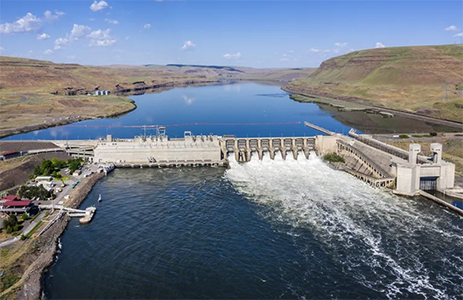
Cracks in the four lower Snake River dams? Not literally, but metaphorically weakening and widening.
Over the past five years, according to Army Corps of Engineers’ data, these dams combined generated an average of just 669 Megawatts (MW) each year, a decline of 29% compared to average annual production over the previous twenty-one years. Of the total Pacific Northwest’s 26,145 MW power load, each dam now produces about six-tenths of one percent (.6%).
Bonneville Power Administration’s (BPA) 2026-2028 wholesale price for electricity the agency sells to Pacific Northwest public utility districts is $40/Megawatt hour.
Over the past fifteen years, the cost of utility-scale solar energy has plummeted 85%. The Berkeley National Laboratory reports Power Purchase Agreements in the West (excluding California) provide power at around $24/Megawatt hour.
Over the past decade, the cost of utility-scale battery storage has declined even more than that of solar energy. In some states, battery storage is now replacing natural gas-powered turbines as the preferred means of addressing peak electricity demand. Further, new hybrid installations combine solar with battery back-up, which negates the argument that solar energy cannot provide firm power.
The U.S. Energy Administration reports that the Pacific Northwest has witnessed the slowest growth in solar energy of any region in the U.S. In a state-by-state comparison of the rate of renewable energy growth between the decades 2005-2014 and 2015-2024, the state of Washington comes in dead last.
Consider this as an explanation: BPA owns 75% of the Pacific Northwest’s transmission capacity, providing a near monopoly on transmission services. Since 2015, the developers of 469 large alternative energy projects have sought access to BPA’s transmission grid. Only one received approval. Clearing Up/news data reports the number of proposed projects in BPA’s interconnection request queue represents 61,000 MW of renewable energy. If just 15% of these projects were developed, the resulting generation capacity would equal that of twelve lower Snake River dams.
In 2026, the state of Washington established a transmission authority with a mandate to expand Washington’s power transmission capabilities. State officials recognize the potential for tapping into cheap solar energy from the Southwest, wind energy from the Mountain West, as well as homegrown wind and solar. The state of Oregon is considering similar action.
Meanwhile, threatened and endangered Snake River salmon and steelhead numbers continue to fall. The Nez Perce Tribe’s Fisheries Department warns that a growing number of these fish stocks are approaching quasi-extinction. The states of Washington, Oregon, four tribal nations and a number of conservation organizations are now back in federal court. Ordering extended spill as a preliminary measure, U.S. District Judge Michael Simon notes that wild salmon are “disappearing from the landscape.”
In a world with less snow, earlier runoffs, falling fish numbers and cheap solar energy, dark clouds have gathered over the Bonneville Power Administration. BPA’s costs of production are rising, while power output is falling. Solar energy, less and less intermittent, has become the West’s cheapest power source, with utility-scale prices well below BPA’s wholesale rate. The agency’s near monopoly on transmission appears to be slipping away.
A notable fish scientist, Dr. Rick Williams, recently opined “The lower Snake River dams will never be breached for biological reasons; they will only be breached for economic reasons.”
Like cracks in a dam, those economic reasons have arrived.
Citations:
1. 669 MW of power NWD US Army Corps of Engineers Power Summary Reports https://www.nwd-wc.usace.army.
2. 26,145 MW PNW power load Bonneville Power Administration 2024 Pacific Northwest Loads and Resources Study https://www.bpa.gov/-/media/Ae
3. BPA Power Rates https://www.bpa.gov/energy-and
4. Power Purchase Agreements at $24/MWh Berkeley Lab https://emp.lbl.gov/news/explo
5. Utility-scale battery prices BloombergNEF Record Lows for Battery Prices https://emp.lbl.gov/news/explo
6. Washington dead last in alternative energy growth U.S Energy Information Administration embedded in Oregon Public Broadcasting How the Pacific Northwest’s dream of green energy fell apart, https:/www.opb.org/article/202
7. BPA 75% PNW transmission capacity What the Bonneville Power Administration is and does https://www.opb.org/article/20
8. 61,000 MW Renewable energy in queue. Clearing Up/ news data: Hairston Stepping Down at BPA. https://www.newsdata.com/clear
9. Washington Transmission Authority https://www.catf.us/2026/03/wa
10. Nez Perce Tribe’s quasi-extinction report: Snake Basin Chinook and Steelhead Quasi-extinction Threshold Alarm and Call to Action, https://www.nwcouncil.org/site

**If you are reading theOrcasonian for free, thank your fellow islanders. If you would like to support theOrcasonian CLICK HERE to set your modestly-priced, voluntary subscription. Otherwise, no worries; we’re happy to share with you.**






The article is factually grounded with citations that check out, but it frames the data to build a case for economic obsolescence and breaching (quoting Dr. Rick Williams). It underplays:
The dams’ value for grid reliability, reserves, and flexibility (not just average MW).
Hydropower’s role as firm, carbon-free baseload with unique operational benefits.
Challenges of replacing seasonal hydro with variable solar + storage at scale in the PNW.
Recent low generation reflects hydrology/climate patterns (earlier runoff, drier summers), not inherent failure. Replacement discussions are active, but costs, reliability, and transmission limits remain complex. The “cracks” metaphor is rhetorical—the dams are structurally sound; the debate is economic/environmental/policy-driven.
Who was it that once said, “He who owns the track owns the railroad.”
What MJ says.
No one mentions the one word that could change everything: Conserve. The other word we need to ponder: Water.
In the push for all-electric, what are we doing in our own communities and in banding together with other communities in our state to fight the development and deployment of mega AI data centers?
https://anastasiintech.substack.com/p/new-colossus-2-the-worlds-largest
https://www.lincolninst.edu/publications/land-lines-magazine/articles/land-water-impacts-data-centers/
I find it interesting that much debate on almost everything stems from, “not in MY back yard.” Unfortunately, until it gets personal, people are not moved to ACT.
It’s also interesting that the article in the News Briefs calling for support for the Southern Resident Killer Whales as they keep dying due to starvation, is also talking about the challenges at THIS end… our salt water environment in which they must swim and raise their young. It’s all connected. We’re all connected.
https://www.idausa.org/campaign/cetacean-advocacy/latest-news/southern-resident-killer-whales-are-running-out-of-time/
I’ll take economic hardship over the current trajectory. The current trajectory is heading us there much faster since the whole corrupt system of profiteering over the environment and quality of life for humans and other living beings is fundamentally flawed and corrupt. Humans are a lot more resourceful when they have to be.
Although the transportation impact consultants study of dam removal (Lewiston ID would no longer be a Pacific Ocean seaport) is still a work in progress, the cost of removing the four lower dams years ago estimate was in the $34 BILLION dollar range. Given inflation, it would likely be considerably more. today.
There are more chinook salmon in the Columbia River now than before the dams were constructed. Fish hatcheries were constructed as mitigation measures for the expected loss of Snake River upstream salmon. Orcas aren’t staving because of lack of Columbia River chinook salmon. Virtually all non-dammed NW rivers (US and Canada) are experiencing declining salmon populations. Overfishing and climate changes are likely the two key causes.
There is no guarantee Snake River salmon populations will significantly increase if the dams are removed. It’s a different climate situation and still changing warmer winter temperatures and less winter snowpack. Chinook salmon’s survival temps are below 68ºF … 64ºF is start of their lethal temperature range. Hells Canyon is not named that because of cool temperatures as anyone who has been there in summer months knows.
And who will financially benefit from removal of the power four dams? A few dozen fishing outfitters and maybe a handful of tribal members, assuming the money fish populations in fact increase.
Virtually everyone is in agreement the PNW will need more electrical power, AI centers or not. Fossil fuels are not the long term answer. Additionally, more PNW power is likely to be diverted south to meet additional SW power demands. Almost every new power source is subject to opposition and years of regulatory reviews and litigation. Dam removal might eventually happen, but common logic say build the electrical capacity first and then decide if the enormous cost of dam removal is logical.
Finally ehe concept of the United State going back in time and to using less energy is a worthy discussion idea, but about as likely to actually happen as eliminating both poverty and wars.
The primary diet of Southern Resident orcas (fish-eating orcas) is salmon, particularly Chinook. Salmon accumulate PCBs and other persistent organic pollutants as they migrate when they swim up river. These toxins build up in the orcas’ blubber over time.
When female orcas nurse their calves, a significant portion of these stored toxins is transferred through the high-fat milk. Calves have immature immune and detoxification systems, making them especially vulnerable. This toxin transfer is believed to contribute to high rates of calf mortality, reproductive problems, and overall population stress.
Ironically, increasing salmon numbers—could potentially increase toxin exposure for the orcas in the short term if those salmon carry significant pollutant loads. In contrast, transient (Bigg’s) orcas, primarily eat marine mammals like seals and sea lions rather than salmon, show different contaminant profiles and their populations in the region are generally stable or increasing.
Regarding the idea of performing a form of liposuction on female orcas to remove contaminated blubber, filter the toxins, and return the cleaned fat: It’s a creative, outside-the-box suggestion. Orcas are mammals, so in theory some form of medical fat removal and processing might be conceivable, similar to procedures done in human medicine. The logistical, safety, ethical, and welfare challenges of sedating and surgically treating wild orcas at sea would be enormous. Marine mammal experts generally view it as impractical but that’s what they said about electric cars years ago.
Sea World could do the procedure – they have the isolation tanks. Transport the female in for the procedure and take her back to her pod. 3- 5 days?
A helpful and succinct portrayal of now. It appears as though a strong El Nino setting up through the end of next year will underline the dying capacity of existing BPA hydro power as regional population grows significantly and our little Cooperative prepares to renegotiate a contract with our monopoly provider in 2028. As numbers shift dramatically and we get a glimpse into the future of our region’s climate shift given this past winter and an expected hotter drier summer with a greater potential for heat domes our options will become clearer. In no way rosier, but more stark. Our local situation is as Bailey points to has everything to do with conservation and great improvements in batter storage and lowered costs. The NIMBY problem here is great given our demographics and single family homes on acreage delusion of maintaining rural character so new solar grid production sites will likely result in wasteful legal challenges.
The County Council must step in with more attention and “oversite” to help OPALCO overcome its tendency for self-inflicted wounds and mis-steps. The tiered rate schedule should be made steeper and more costly for big users. There are few more important infrastructure issues for us electrical power.
The idea about lab liposuction for reducing pollutant loads in female SKRW, an endangered sub group, is certainly outside the box of common sense possibilities and would seriously endanger the health and well-being of every animal captured while the source of said pollutants is not removed.