||| I’M NOT THE CHURCH LADY by ROSIE KUHN |||
The other night, I was lying in bed ruminating about a conflict with a friend. You know how that goes—the conversation that isn’t actually happening is happening brilliantly in my head. What I could say. What I’m afraid to say. What I might say. What he might say if I say what I might say.
Round and round. Then something in me said, “I’m really tired of this.”
It wasn’t a thought. It was my body itself declaring the physical exhaustion of carrying this particular way of being.
In that moment, words disappeared. The story, the conflict, the friend, all disappeared. There was simply the felt experience of deeply unbearable exhaustion. It wasn’t despair or despondency. It was truth. Something had reached its expiration date.
The question that came later was: What am I living inside of that’s creating this experience I’m so tired of? There was no requirement to go searching for an answer. I trusted that something would inevitably rise to the surface on its own.
I’m Sick of Being Afraid
Within a few days of my moment of exhaustion, my client Carla said something profound, though I don’t think she heard it for herself: “I’m sick of being afraid.”
Carla has been living with cancer for the past four years. Fear, especially fear of dying, has been a significant part of her journey. Over the years I’ve known her, things have shifted. Carla admits to becoming less afraid of dying. Interestingly, her cancer-related numbers are also improving.
I don’t know what relationship, if any, exists between Carla’s changing relationship with fear and what’s happening in her body. What I do know is that something unmistakable has changed in the way she is living. She looks radiant. She more engaged in life, and she is no longer
organizing every moment around the possibility of dying.
So when Carla said, “I’m sick of being afraid,” I heard something beyond wanting fear to go away. I heard the possibility of a different relationship with fear. It’s similar to me declaring, “I’m really tired of this.” It’s different from conquering the conflict or the fear. Fear can still come along. Cancer can still be cancer. Life can still be uncertain, frustrating, exhausting. But perhaps fear and powerlessness no longer get to decide how life is lived.
My Life Is My Sentence, So I Live It
My friend Michael has what appears to me to be a surreal level of serenity. Things go wrong. He gets disappointed. Plans fall apart. Life hands him lemons just as it does the rest of us. Yet somehow Michael makes delicious lemonade.
I once told him how much his way of living inspires me. He simple replied, “My life is my sentence, so I live it,” a lyric from a song by Canibus. That line has been working me. If life is my sentence, how am I living it?
And then my client, Evelyn, brought Sisyphus into the room.
Sisyphus Is Everyone
Evelyn told me that sometimes she feels like Sisyphus. Push the rock up the hill. Watch it roll down. Repeat. Day after day. Same ol’, same ol’.
I’ve spoken of Evelyn before and the little experiment she’s conducting. For six months, she committed to bringing a cake or cookies to her recovery meeting. She can bake them or buy them. Three months in, something unexpected is happening.
At first, Evelyn noticed how attached she was to people acknowledging what she brought. She would put down her beautiful creation and then watch. Did they notice? Did they like it? Did anyone say anything? It exposed a lifelong pattern of performing, presenting, proving and improving—and then waiting for applause.
So, Evelyn began experimenting with something else. She brings the cake. She puts it down. And she doesn’t look back. That alone is a huge practice.
Evelyn has also long believed she doesn’t know what brings her joy. She’s actually adamant about this. Much of her life has been lived through obligation, so initially baking for her meetings was simply another obligation.
Then she found a recipe and experienced an “Ooo!” A little blip on the delight monitor. She began enjoying shopping for the ingredients. Another blip. Arranging everything on the counter. Sifting the flour. Watching the cake come together. Blip. Blip. Blip. Nothing monumental. Just little moments of delight inside something she was already doing.
Then Evelyn told me she had started praying while she baked. She prayed that she would bring love and kindness into what she made and that the food might somehow nourish the people who ate it. Then she said something that stopped me: “The baking itself is becoming a prayer.”
HUGE!!!!
Because something has changed here. Evelyn began by praying while baking. There was Evelyn. There was the cake. There was prayer. There were the people who would eat it. And presumably there was God, Source, Life, the Universe—Someone or Something receiving the prayer.
But now: The baking itself is becoming a prayer. WHAT????
Back to Sisyphus
What if we’ve misunderstood Sisyphus’s punishment? We’re told his eternal punishment is the unending relationship with the rock. Push it up. Watch it fall. Do it again. Over and over.
But what if the suffering isn’t his sentence? What if it’s his relationship with his sentence? Poor me. I shouldn’t have to do this. My life is wretched and there is no end.
What if somewhere in all that pushing something becomes available that wasn’t available before? Hey, wait a minute. Perhaps I can see this another way.
Suddenly my “I’m really tired of this” enters the room. Michael’s lemonade. Carla’s “I’m sick of being afraid.” Evelyn’s “The baking itself is becoming a prayer.” It’s all here.
What if circumstances don’t have to change for my experience of the circumstances to change?
Yeowee!
Carla doesn’t have to wait for cancer to disappear before she thrives. Michael doesn’t require life to stop handing him lemons. Evelyn doesn’t need to discover her Grand Passion before something sacred appears while she sifts flour. And Sisyphus? His rock-pushing doesn’t have to
stop.
Nothing to Lose. Nothing to Gain.
In Rasha’s book, one of the teachings in Oneness that has stayed with me is the idea of reaching the place where there is nothing to lose and nothing to gain. It also speaks of a Divine Foundation underlying the whole experience we call life, and of adversity within the experience
of separation.
Maybe these circumstances are opportunities through which Divinity can be recognized in ways we’d never been privy to before?
I think Sisyphus may be the perfect guy for this.
There’s no promotion at the top of the hill. No certificate of completion. No gold watch. No moment when he wipes his hands together and says, “Well, glad THAT’S done.” This is his sentence. Rock. Hill. Push. Repeat.
For those of us curious about who we are and how we came to be living the life we’ve been given, there’s a point when the whole transactional structure begins to collapse. I’ll do this so that… I’ll endure this until… I’ll become this in order to… If I do this correctly, then perhaps I’ll
finally….
It stops making sense.
And perhaps this is where something entirely different becomes possible. Not because adversity is good. Not because suffering should be celebrated. Not because God gave Sisyphus a penance to teach him a lesson. But because we stop seeing life as a sentence to be served as punishment, something merely to be endured. We begin opening to a different relationship with our rock, our cancer, our exhaustion, our lemons, our creations.
That changes Sisyphus for me. The rock isn’t keeping him from the Joy because the rock is not outside the Joy. Neither is the hill. Neither is his exhaustion. Neither is his resentment. Neither is that moment when he thinks, I am really fucking tired of this.
Even this is not outside of Joy.
I know. This is an entirely different perspective that the one handed down to me too! With. In. As.
For years, much of my spiritual inquiry has been about learning how to be with what is. How do I stay? How do I stop escaping? How do I remain with the Unknown? How do I abide with myself? But lately I’m noticing that even the Big Fat Be-With contains two. There is me, and there is whatever I’m learning to be with.
What if the movement continues from I am with, to I am in, to I am as?
With → In → As.
That’s quite a trajectory.
When I arrive at as, even prayer begins to change. Prayer is no longer necessarily something I do to get. Faith is no longer confidence that things will turn out the way I hope. Faith becomes allowing the Unknown to be the unfolder, the unfoldment—and the unfoldee. Jeesh! Evelyn isn’t over here praying to God over there about a cake. There is flour. Hands. Cake. Giving. Receiving. Evelyn. Life. Prayer. Perhaps these aren’t separate pieces assembled into a spiritual experience. Perhaps the whole thing is the experience.
For Sisyphus, there he is, with the rock, the hill, the pushing, the exhaustion, the breath, the rest, the Unknown. And perhaps all of it is prayer. There is no Sisyphus praying. There is no rock becoming the prayer. There is no hill upon which the prayer takes place. There is only the
unfolding. And perhaps that is what prayer is.
Wherever You Go, There You Are
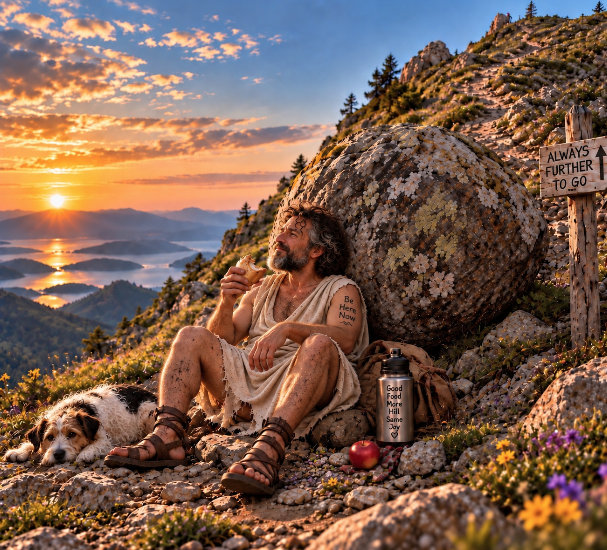
Initially, I saw Sisyphus in eternal effort, pushing the rock uphill. Now I see him sitting partway up the hill with his back resting against that rock, which was his nemesis. He’s taking is time, eating something nourishing and delicious. There’s nowhere to go!
The rock hasn’t disappeared. He hasn’t reached the summit. He hasn’t transcended his sentence. He’s having lunch, just like a farmer with thousands of acres still left to cut, who stops to eat a sandwich. Just like someone at a desk surrounded by unfinished work who pauses for coffee.
Like a mother sitting down for five blessed minutes in the middle of all the momming.
Nothing is finished. Nothing has been conquered. And for this moment, nothing needs to be. Maybe that is what Michael knows when he says, “My life is my sentence, so I live it.” Maybe that is what Carla is discovering when she says, “I’m sick of being afraid.” Maybe that is what Evelyn stumbled into while sifting flour: “The baking itself is becoming a prayer.”
And maybe that’s what I’m touching into for one exhausted moment in the middle of the night when something deeper than thought finally says, “I’m really tired of this.” And I listen as if it is an answer to a prayer.
It isn’t an instruction to get rid of something. Perhaps it’s the moment I become present enough to feel the exhaustion of pushing against my rock up my hill.
And maybe I don’t have to get rid of my rock. Maybe I can sit down against it for a while. The hill is still here. The rock is still here. I’m still here. Life is still unfolding.
Always further to go. And nowhere else I’d rather be.

**If you are reading theOrcasonian for free, thank your fellow islanders. If you would like to support theOrcasonian CLICK HERE to set your modestly-priced, voluntary subscription. Otherwise, no worries; we’re happy to share with you.**