||| FROM BILL SYMES and ELAINA THOMPSON for ISLANDS OIL SPILL ASSOCIATION |||
On the morning of May 13, ten volunteers gathered at Rosario Marina on Orcas Island with a training mission: find a boat leaking diesel into the marina and contain it before it spreads. Time is of the essence in oil spill mitigation, and the right equipment must be deployed in the right way. Thus, response training is a major focus of Islands’ Oil Spill Association (IOSA) activity.
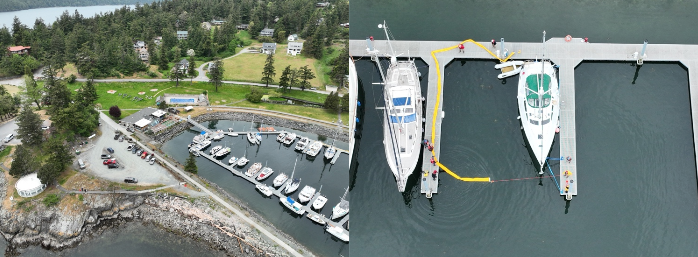
The central element of the May 13 training session was this scenario: one of the moored boats was pumping diesel-contaminated water from its bilge. This fictional accident is similar to real events that have occurred in recent years and are likely to occur again. The setup emulated common features of real responses: the location of the boat was not known at the outset, just an approximate description, and the reported severity of the spill was uncertain.
IOSA deploys into action in response to a request from the US Coast Guard or WA State Department of Ecology, conveyed to Executive Director Elaina Thompson. The scenario presumed this request had been received, and that the marina management was in the loop (of course, it was, for the training session).
A group of ten volunteers, along with Thompson and Deputy Director Rick Winings, tackled this fictional disaster-in-the-making. One of the IOSA equipment trailers, towed by “Ol’ Red,” IOSA’s pickup stationed on Orcas for response towing needs, arrived with the volunteers.
After some trailer-backing practice, the group divided into two teams, communicating by VHF radiotelephone. The three-member assessment team walked the docks and located the boat, described its situation and the severity of the spill, confirmed the hazard was indeed diesel (and not gasoline, which would yield an entirely different response), and then relayed the recommended action: floating containment boom should be deployed to surround the “leaking” boat.
The response team unloaded a 100-foot length of 10-inch (“harbor”) containment boom from the trailer and snaked it down to the boat’s slip. Surrounding the boat involved spanning the 50-foot gap at the slip opening: Xoe Chue of Orcas Island demonstrated an admirable throwing arm by tossing a light line across the gap, getting it close enough that another volunteer could grasp the end with a boathook on the other side. The line was then tied to the end of the boom and used to pull it across. Various other pieces of equipment were used or discussed, including a sort of float necklace that can be tied around a piling and serve as a boom attachment point at water level, rising and falling with the tide. The single length of boom was clearly insufficient. In a real response, the team would have fetched at least two more lengths to be hooked together for a proper surround. Also, sorbent materials in various forms would also be used, to pick up whatever oil could be recovered.
After a picnic lunch, the group reviewed the experience, going over the good and what was learned throughout the exercise. The main error in the deployment was twisted boom, which got into the water before it was noticed. Twisted boom isn’t effective at corralling oil. In a live deployment, it would have already been contaminated, so couldn’t be hauled out and untwisted. The only remedy would have been yet another boom surrounding the defective one.
The takeaways: Watch carefully and get the boom straight before it goes in the water, typical Rosario slips will need 300’ of boom for a good wrap, and grab the boat hook and shackles in advance. To cap the day off, Rick Winings showed the group one of the new IOSA drones, which he had flown overhead during the work on the dock. This equipment represents a quantum leap in observational capability – among other uses, oil slicks are far more visible from overhead than from shore or boat. With its live streaming ability and long flight time, this instrument will greatly enhance response effectiveness and communication to agency partners.
All in all, another successful training session at a local marina. IOSA trains on the three major islands, generally once a month, and intentionally rotates marinas and locations to grow local knowledge and connection. Many sessions, like the one just described, involve perhaps a dozen volunteers along with staff.
Others are much larger: last June, IOSA organized and led a joint two-day drill involving more than a dozen organizations – including the Coast Guard, state and county agencies, and tribal groups – and more than fifty participants. IOSA is one of very few community-based, non-profit spill response organizations in the nation, a distinction that makes this kind of local, relationship-driven training even more essential. The aim of all this activity is the same: when a pollution emergency strikes, IOSA will be ready to respond quickly and effectively.
Islands’ Oil Spill Association has protected the San Juan Island marine environment for more than forty years. For more information, visit www.iosaonline.org. If you see oil in the water, report it to WA State at 1-800-OILS-911, and the USCG National Response Center at 1-800-424-8802. Both agencies call on IOSA for initial response within San Juan County.

**If you are reading theOrcasonian for free, thank your fellow islanders. If you would like to support theOrcasonian CLICK HERE to set your modestly-priced, voluntary subscription. Otherwise, no worries; we’re happy to share with you.**




What a compelling account of this valuable work! I hope that islanders continue to support this remarkable organization with their time or financial support! What a great example of islanders solving island problems!
Thanks for sharing the IOSA training experience with us. We need and appreciate you all!