Students from Orcas Island Middle School discover green crab molt while on a field trip
||| FROM WASHINGTON SEA GRANT CRAB TEAM |||
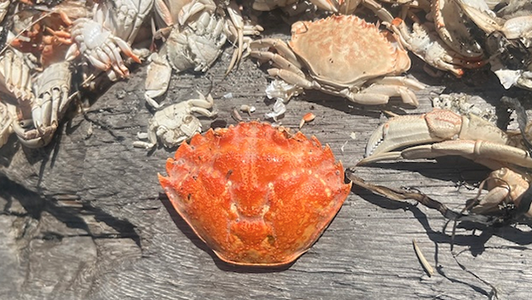
Evidence of invasive European green crab was detected for the first time on Orcas Island in May, when a Washington Sea Grant (WSG) Crab Team volunteer monitor and science teacher Amy Sprenger reported one of the distinctive five-pointed shells on Crescent Beach in Eastsound. Last week, follow up trapping efforts by Washington Department of Fish and Wildlife (WDFW) captured one live crab at a different site on the island.
While the harmful crabs have been detected in the San Juan Islands previously, with the first detection in 2016, the find by Sprenger’s class and WDFW’s capture was the first time they’ve been confirmed on Orcas Island.
Students turn a “mock hunt” into a real discovery
Sprenger teaches science at Orcas Island Middle School, including a marine science exploratory class. In early May, 24 marine science students learned about green crab and got a chance to participate in an early detection search on their island by looking for the shells the crabs shed as they grow (molts). This is similar to protocols used to search for crab shells by two Crab Team participatory science programs: the monitoring network and Molt Search – the latter a collaborative effort with WSU Extension. State, federal, and tribal agencies can then follow-up on detections with additional assessments, rapid response trapping, ongoing efforts to suppress established populations, or other management actions.
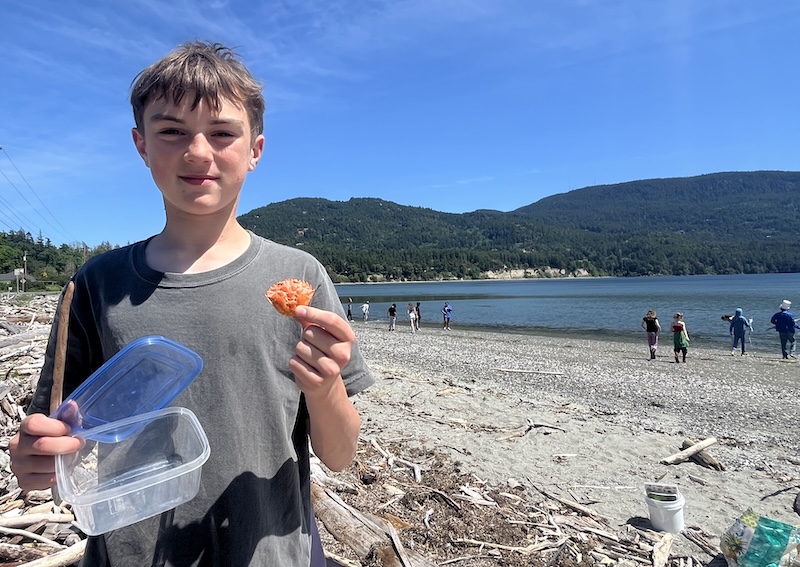
Paxton Erwin, seventh grader at Orcas Island Middle School, holds the green crab molt he found at Crescent Beach in May. Photo: Amy Sprenger
Sprenger brought students to Crescent Beach and created what she thought would be a “mock hunt,” not expecting to encounter any evidence of green crabs. But the practice quickly turned into a textbook case of opportunity meeting preparation.
On their field trip, students spread out across the beach and collected as many crab shells as they could in two minutes. Right away, seventh grader Paxton Erwin noticed a molt that was different from the others and together, the class identified it as a European green crab molt. Sprenger reported the detection to WSG Crab Team later that day.
Of finding the molt, Paxton said, “I was thinking it was a bummer to find it because they’re bad for our environment but also kinda good that we know they’re here.”
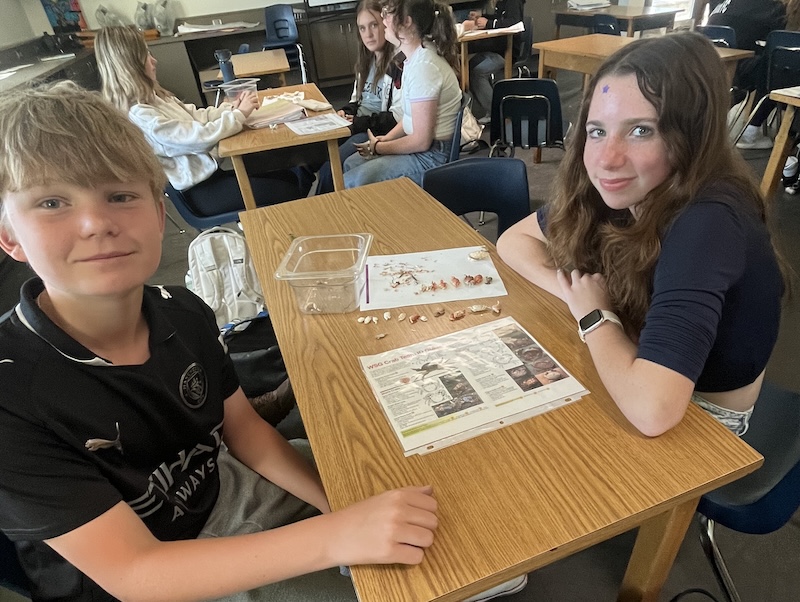
Simon Carlson (l) and Layla Calahan (r) sift through the molts collected at Crescent Beach, making sure no additional green crab shells were among the collected species. Photo: Amy Sprenger
Sprenger then brought the “real world” experience back into her three regular middle school science classes, all of which had previously learned about invasive species. The following day, she restructured teaching plans and had each science class learn specifically about green crabs, and practice distinguishing between green crabs and native crab species with the same WSG Crab Team learning resources that all volunteers and monitors use. Students then worked in pairs to sift through the molts collected at Crescent Beach the day before. Luckily no more green crab molts were found.
Reflecting on the opportunity to engage students at the intersection of exploration, science and management, Sprenger says, “It was great exposure to real science for my students. They know they can meaningfully participate in the effort to understand and protect our local marine ecosystem. Students were regularly asking for updates on the WDFW trapping efforts around our island and will be interested to hear about where green crabs were and were not found around Orcas.”
Follow up trapping reveals further evidence of green crabs
In response to the detection, WDFW was quick to pivot trapping plans for the season. Last week, a team of technicians deployed 208 traps at three sites on Orcas: two in East Sound, including Crescent Beach, and Deer Harbor, a muddy estuary on the western part of the island. Two nights of trap deployment resulted in the capture of a single 87mm male green crab at Deer Harbor. The very large size of that crab indicates it has been present at the site for at least three or more years, but evaded traps set in that location set by WDFW in 2025. Both the geographic distance and the size difference make it clear that the molt found by Paxton Erwin at Crescent Beach came from a different crab than was captured by WDFW at Deer Harbor.
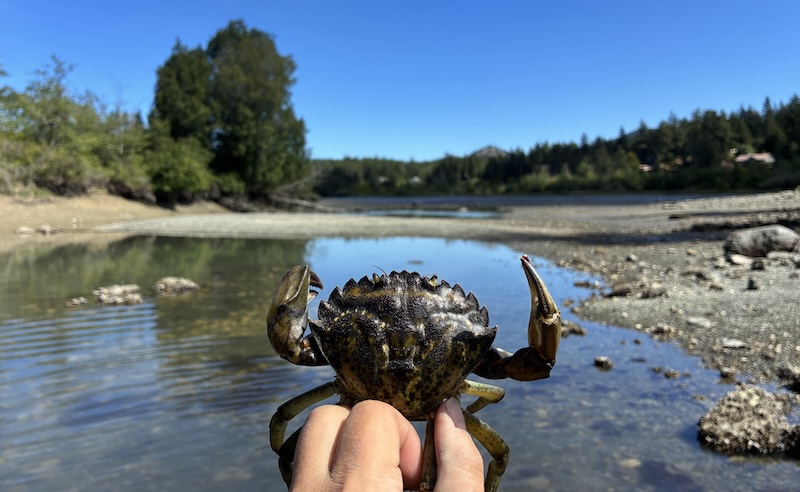
This adult male European green crab is the first captured on Orcas Island. The crab was trapped in Deer Harbor. Photo: WDFW
Prior to this detection, the only location in San Juan county where green crabs had been found was in very small numbers on San Juan Island. In 2016, the first capture of European green crab along the Salish Sea portion of Washington shorelines was made in Westcott Bay, but substantial continued efforts have only yielded a total of five additional individual crabs at that site in the following decade. Last year, students from Friday Harbor Labs engaged in green crab research as part of their Novel Ecosystems class found a green crab shell at a new site on San Juan, False Bay. This led to a few dozen captures made by WDFW in follow up assessment trapping.
In False Bay, the size of all green crabs captured in 2025 pointed to an arrival associated with the most recent strong El Niño conditions in 2024. El Niño conditions are associated with successful survival and dispersal of green crabs, a pattern that was observed across Washington shorelines after 2024. While the size of the molt found on Orcas in May was consistent with this burst of dispersal from just a few years ago, the capture of a large, much older crab, indicates that green crabs have arrived at sites on Orcas during multiple dispersal events. This year’s forecast for strong El Niño conditions could mean we again see this spread pattern later this summer.
Salish Sea Molt Blitz coming Friday June 26
Ongoing monitoring will continue across the San Juan Islands, a necessary part of helping find green crab populations while they are still small enough to manage efficiently. The Crab Team monitoring network includes six sites across the San Juan Islands (two each on San Juan and Lopez, one each on Shaw and Orcas) that are surveyed monthly with trapping and molt hunts April through September, annually.
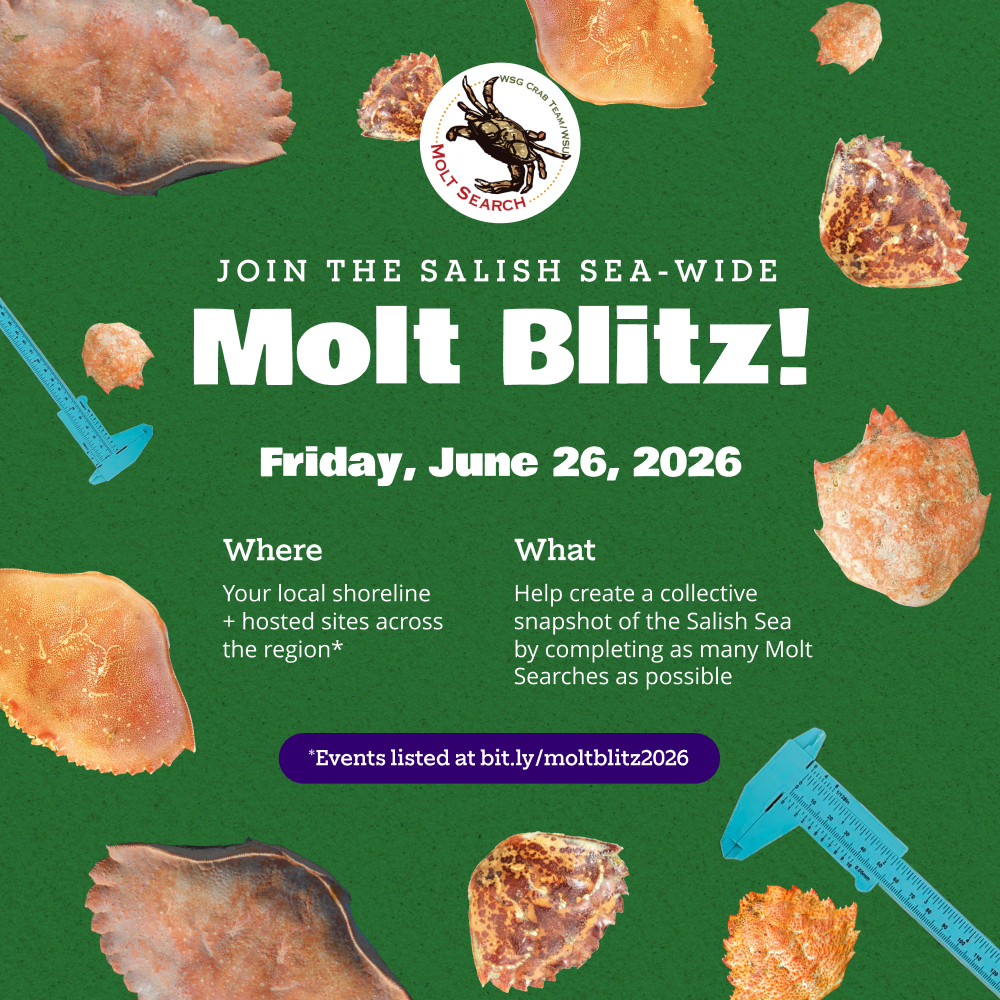
Building on these trapping efforts, the Molt Search program provides anyone who spends time at the beach with a chance to further contribute to finding green crab populations while they are still small. Anyone interested in helping cover more beach by looking for green crab shells can join in the annual Salish Sea Molt Blitz on Friday June 26. This is an annual one-day effort to search as many beaches as possible within the Washington portion of the Salish Sea for evidence of green crab. A virtual training event will be held on June 24 at noon. Register here.
As Amy Sprenger’s teaching experience goes to show, all searches for green crabs can be “real”. Even searches that fail to turn up evidence of green crabs are valuable submissions to the Molt Search program because it helps managers know where searches have and haven’t been done. A strong local partnership with the Friends of the San Juans has resulted in 125 Molt Searches throughout the county over the last year, a dataset that will hopefully grow even larger with participants just like students at Orcas Island Middle School. The local enthusiasm for protecting shorelines from green crab is critically important, given how much coast there is to cover in the county. For those interested in combing the shores of Orcas Island, Friends of the San Juans will be hosting a Molt Search training workshop 2-4pm on June 26 at Eastshore Park (more info here).
Additional crab identification guides and other European green crab resources are available from WDFW. Regular updates are also published on the WDFW’s green crab species webpage and EGC online hub.
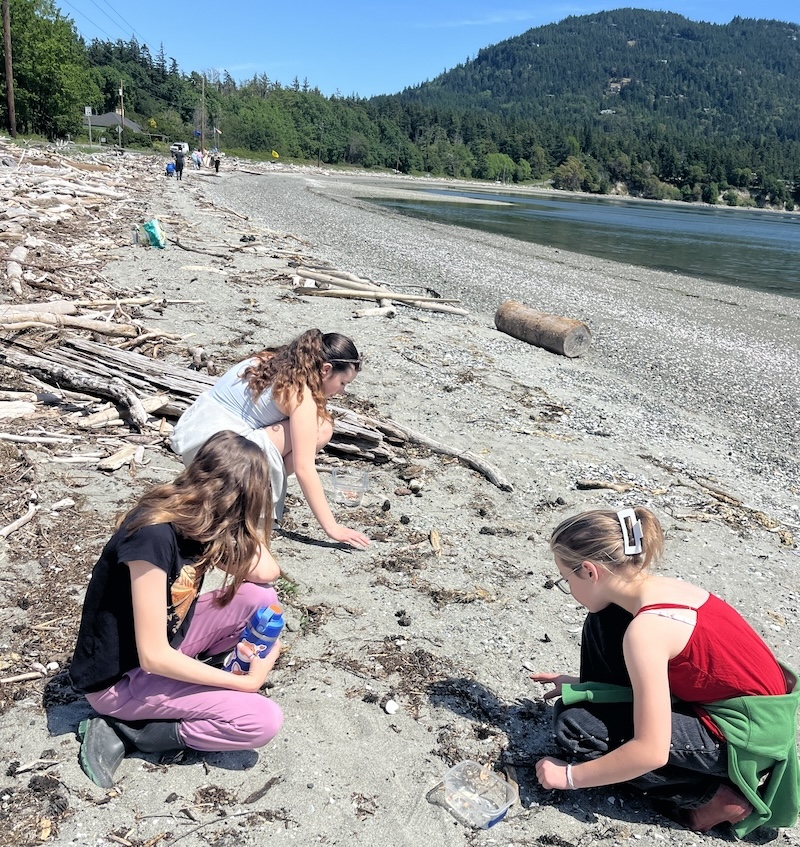
Students in the Orcas Island exploratory marine science class comb Crescent Beach, on Orcas Island, searching for crab molts. Photo: Amy Sprenger

**If you are reading theOrcasonian for free, thank your fellow islanders. If you would like to support theOrcasonian CLICK HERE to set your modestly-priced, voluntary subscription. Otherwise, no worries; we’re happy to share with you.**