||| FROM THE CENTER FOR WHALE RESEARCH |||
|
Full Encounter Report |
|
ObservBegin: 02:48 PM ObservEnd: 05:07 PM Vessel: Mike 1 Staff: Mark Malleson, Joe Zelwietro Pods: J, L IDsEncountered: All Js LocationDescr: Becher Bay – Victoria’s waterfront |
|
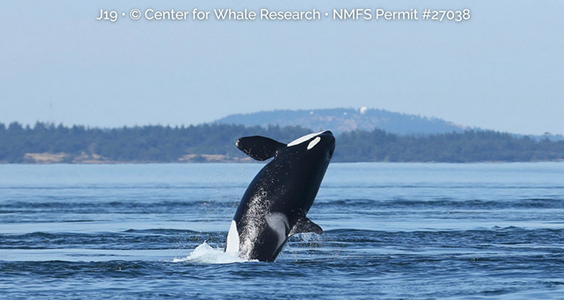
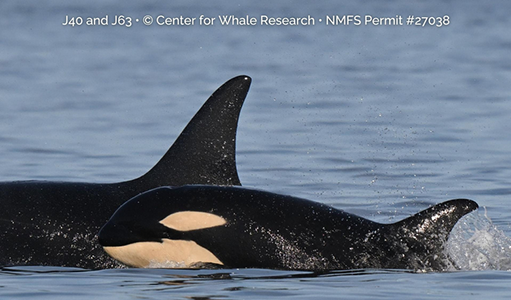
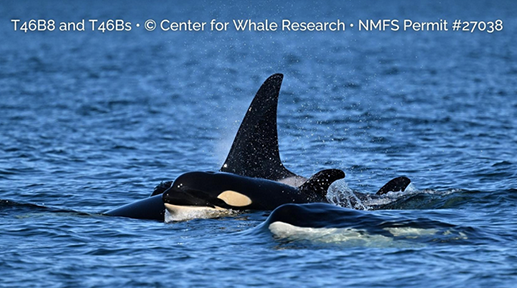
EncSummary: Mark and Joe departed Victoria mid-afternoon, following up a report of a large group of killer whales heading east in the Juan de Fuca, near Sooke. With the strong flood push, they estimated that the whales could already be east of Secretary Island by the time they arrived in Mike 1, so they slowed for a scan at Beechey Head. Sure enough, they began seeing many spread blows ahead, and slowed to begin their encounter. The first whale spotted was Southern Resident female L55, travelling close to shore and very quickly leading the group east, toward Race Rocks. Nearby were several pairs and small groups, but the whales appeared quite spread from just a few hundred metres off the East Sooke shoreline to over a mile offshore and at least a mile back to the west. Mark and Joe began methodically trying to collect identification photos for as many individuals as possible…J pod had not been documented in the inside waters since mid-April, and L pod had not been seen since the CWR last encountered them in February! Nearest L55 were L109 and the J19s, with J51 and L109 paired and trailing a playful J58-J62 duo, who were themselves just offshore of J19 and J41. J39 was very near the latter two. Just offshore, a small group including a young calf appeared, and the field team was pleasantly surprised to find a yet-undocumented calf travelling alongside L91! The newest Southern Resident stayed in echelon to L91 throughout the next few breath sequences, looking plump and energetic. It appeared to be at least a few months old, perhaps born shortly after the last time the group was encountered by CWR in February. L103 and L122 were travelling in lockstep with this pair, and J38 and L123 were quickly catching up. The whales became quite animated as they cleared Race Rocks and surged ahead with the strong flood current, the majority of them choosing Race Passage over travelling south of the park, and none passing through the reserve itself. Several individuals began breaching and pec-slapping the surface before all fanned out in pairs and trios and angled northeast for Constance Bank. Over the next little while, the team managed to document all of J pod and most of the greater L4s, missing only L86, L90, and L116 – though these three individuals would later be photographed by the American team out of San Juan Island (see Encounters #43-2 and #44). The whales were perhaps beginning to travel in their matrilines by the time they neared Constance Bank, as the J16s, J11s (less J39), J19s (plus J39) and L72s were whole, but some mixing was still observed, with J46 and J53 travelling with the J14s – and little L125 playfully tagging along next to J59 – while the rest of the J17s were several hundred metres abeam with J45 and L106. The J16s and L72s were travelling near one another, and only L83, L118 and L55 appeared to be without company by the end of the encounter, as they travelled solo, flanking the rest of the whales from the west. K pod was not present, nor were the extended L12 or L54 sub-groups. Throughout the encounter, no foraging was observed and the inbound residents kept up their strong northeasterly pace until Mark and Joe ended the encounter and turned for home, just south of the entrance to Victoria harbour. Unfortunately, the young calf documented with L55 and L103 in February was not seen today, though both females were. Based on its poor body condition when first encountered in February, as well as the high mortality rate Southern Resident calves face relative to other populations in the region, this is perhaps not unexpected, but disappointing all the same. On a positive note, youngsters J63 and L130 appear to be filling out quite nicely and had no trouble keeping up with their quickly travelling mothers. |

**If you are reading theOrcasonian for free, thank your fellow islanders. If you would like to support theOrcasonian CLICK HERE to set your modestly-priced, voluntary subscription. Otherwise, no worries; we’re happy to share with you.**




Leave A Comment