How can I let go and let God when I believe I was forsaken by him?
||| I’M NOT THE CHURCH LADY from ROSIE KUHN |||
Not everyone experiences firsthand the ravages of war, earthquakes, a diagnosis of a critical illness, or the unanticipated death of a loved one. But almost everyone knows what it’s like when something happens and the world as they know it shatters.
In the wake of such devastation, most feel lost, abandoned—even God-forsaken. What once felt safe or true is reduced to rubble. And there is no way back. No way out. Only through.
It can feel like a kind of insanity—the unbearable in-between–where nothing makes sense, no solution restores what was lost, and no amount of effort returns us to safety. It’s excruciating, deeply human and quite ordinary at the same time.
What may not be obvious, is how many people around you are living within some version of this aftermath. Something happened. And in response, they armor up to protect their heart. They strategized so they are never again brought to their knees. And their innocence disappears into its own underworld, where it waits out the devastation in silence.
The consequence?
One of the consequences of such devastation is that trust is obliterated. No one, no thing—not even God is allowed in this ravaged interior. How easily annihilation of our reality gets interpreted as abandonment by God. (I laugh at myself for writing this sentence. Of course it was God. What else could it have been?).
I heard comedian Mike Birbiglia say, “For a long time it was me and God. And then, it was just me.” I knew exactly what he meant. Nowhere to go, nothing to do, we come to build our lives around a single truth: It’s me. It’s only me.
I hadn’t realized the degree to which my life is organized around It’s only me, until today, in a very ordinary moment with my cat Lucy. This very myopic perspective revealed itself yet again. And I got to see the degree to which I still guard against forsakenness more than I welcome Divine support.
A Cat Mom Dilemma
A few days ago, my cat Lucy slept in, which she does on occasion–especially when the hunting goes well the night before. But when I went in to let her know I was heading out, I noticed her left eye was completely shut. At first, I thought maybe it was one of those sticky velcro burrs that can do odd things, so I prodded a little around her eye. Nope. That wasn’t it. She ran off out the
door to escape any more of my prying. Oh, man! A voice that speaks wisdom to me always, said, “She’s fine. Don’t worry.” I said thank you to the voice. I trust it, always.
While driving into town, I wondered if Lucy was really okay. Does she need to go to the vet? Do I need to give her a supplement? The voice responded, “She’s fine.” “Thank you,” I said.
When I got home later that evening, Lucy still seemed fine. She ate, drank water, took a treat from me, and settled in for the night. The next morning, wanting to be a good cat mom, I started wondering again what I could do. The voice said, gently and patiently as always, “She’s fine.” I said,
“Should I pray?”
No.
“Should I do Reiki on her?”
No.
“Should I hold her in love and light?”
Again, the voice said, “No.”
Apparently, there are moments when the most spiritual thing I can do is absolutely nothing.
No Meddling Required
I saw how quickly my mind returns to the thought that something is wrong, even while my intuition is telling me everything is fine. I also saw how I look for ways to enter myself into the process, even when there’s nothing to do. Can I pray? Can I send love? Can I do Reiki? Can I at least do something spiritually respectable?
That was the revelation.
Was I trying to help Lucy? Or, was I looking for some spiritual action that let me feel in control? If I could do something—especially something holy-looking—then I didn’t have to totally let go and let God.
Here’s the bottom line: While being encouraged to let go and let God—let Lucy be in the care of the Divine intelligence that knows far more than I do, I realized I didn’t want to let go!
I did not want to go and let God.
And that’s when, out of the ethers of who knows where, the deeper question rose up: How can I let go and let God when I can’t trust that God won’t again forsake me?
Well now. There it is. Not a theory. Not a spiritual teaching. A lived experience.
Somewhere in the eternity of my life, something happened. Something devastating enough that some part of me concluded: I am not safe. I am not held. I cannot trust. I’m on my own. I am forsaken! “For a long time, it was me and God. And then, it was just me.”
Love as a Disguise for Control
My need to intervene with Lucy may not be love at all. It may be love wrapped around something else—fear, distrust, a need to remain in control—not let something outside myself be the source of another shattering.
Maybe my resistance to surrender isn’t about Lucy’s well-being at all? Maybe my meddling is the behavior of someone who doesn’t actually trust as much as she believes she does? Maybe my need to control the situation is my way of avoiding meeting another moment of unrectifiable obliteration of my life? Maybe “helping” is, at times, the holiest-looking disguise for “I’m not
willing to let go of control.” This was a sobering and yet laughable moment.
I live by the principle that God—Source Intelligence, Divine Presence, whatever name we want to use—is loving, present, and knows more than I do. I say that all the time. But saying it and living it are not always the same thing.
When my fear takes over, there’s no room left for Divine Presence. There’s only me, my worry, my vigilance, my need to make sure Lucy is okay, my need to insert myself into the process so I don’t have to feel the helplessness of not being in control.
In other words: It’s only me.
Spelunking
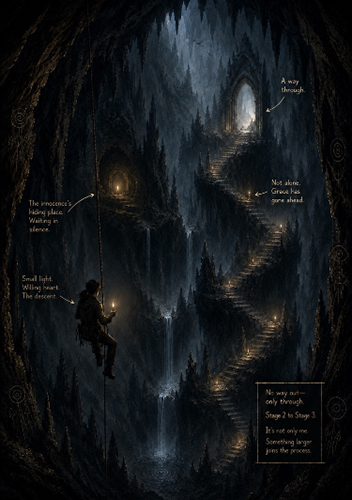
When an insight like this reveals itself, there’s a desire to resolve it, asap! This is where the spelunking begins.
My years of experience has taught me that I cannot fix the truth revealed. And nothing is served by making myself wrong for it. I can’t force myself into surrender because that would be the “spiritual” thing to do. So, what’s left to do is to slowly descend into the inner cavern where this belief still lives: the belief that God abandoned me, that I am alone, and that control is the only
thing standing between me and devastation.
It’s Not the End—It’s Never the End
Stan Grof’s Birth Matrix has helped me enormously in understanding moments like this—these devastating, in-between passages where there is no way back, no obvious way forward, and no amount of right-effort that can return me to the safety of what once was.
In the birth process each of us experience: Stage 1: Bliss. Stage 2: Hell —No way out. This is when everything closes in. We experience pressure, pain, suffocation and impossibility. Trust shatters here. Faith shatters here. And from this place, “It’s only me,” makes perfect sense. But Grof doesn’t stop at Stage 2, nor does the birthing process. This matters hugely to me, because when trust is shattered, and there’s no way out, it can feel like the end. It can feel like proof that God failed me, and therefore I must never trust again. It can feel like the final verdict on existence itself: You’re on your own, kid!
But what if that’s only Stage 2 talking—there’s only Hell, and there’s no way out? What if this is the moment when the shift happens?
Stage 3: Hell—with perspective. There is still no way out—only through—but now there is movement. There is a visceral sensing that what felt like annihilation was not the end but only a part of a birth process. Not pretty, not easy or graceful—but a birth process, nonetheless.
Stage 4: Death vs Rebirth. At this stage, the baby has gone as far as it can go. It’s compressed, exhausted, powerless. There’s nothing left. No way to push itself out of the discomfort.
Suddenly, something beyond the infant’s own effort enters the process. There is an unanticipated propulsion that carries it forward—the mother pushes. Birth happens.
I find this deeply comforting.
Because when I’m in the grip of It’s only me, when I’m exhausted, defeated, and trying to control my way through the impossible, with no end in sight, I know through experience, that, when I go as far as I can go, something greater than myself joins in the process. The journey is still required, but along the way, an added propulsion I cannot generate on my own arises.
This doesn’t mean I suddenly trust God and skip into the light. What it does mean is that I begin to experience that shattered trust, not as the end of faith, but maybe the end of a certain kind of faith—faith in control, faith in my ability to manage life into safety. It may also be the beginning of something truer. Something more conscious. Something is born not out of spiritual platitudes, but out of spelunking the very caves where my innocence went hiding. And with innocence, trust also begins its return.
I can feel the difference between Hell no way out, and Oh… there’s perspective now. I can feel the difference between devastation as the end, and devastation as a stage in a larger unfolding. And, actually, that’s huge!!!
Maybe letting go and letting God doesn’t begin with trust. Maybe it begins with telling the truth about the part of me that still says, Hell no! Maybe it begins with seeing how fiercely I cling to control when I’m afraid God will forsake me.
And maybe, just maybe, when I have gone as far as I can go, I experience an unanticipated propulsion through which I discover, once again: It was never only me after all.

**If you are reading theOrcasonian for free, thank your fellow islanders. If you would like to support theOrcasonian CLICK HERE to set your modestly-priced, voluntary subscription. Otherwise, no worries; we’re happy to share with you.**