||| FROM LOVEL PRATT for FRIENDS OF THE SAN JUANS |||
A new analysis by Friends of the San Juans shows that ocean-going vessel traffic in the Salish Sea is projected to increase by nearly 2,000 additional shipping transits annually, including a dramatic increase in tanker traffic going to and from Canada that could more than quadruple historic tanker traffic levels.
The 2026 Salish Sea Vessel Traffic Projections identifies 1,980 additional annual vessel transits associated with proposed, permitted, under-construction, and recently completed projects in Washington State, Oregon, and British Columbia. If all projects move forward, annual ocean-going vessel traffic in the Salish Sea would increase from 11,944 transits in 2025 to 13,924 transits, a 16.6% increase.
Key Findings
- 1,980 additional ocean-going vessel transits per year projected throughout the Salish Sea
- 11,944 ocean-going vessel transits in 2025 and 13,924 projected for 2026 and beyond, reflecting a 16.6% increase in annual vessel traffic
- Four of the twelve projects identified account for more than one-third of the projected increase in Salish Sea vessel traffic.
Most concerning is the recent and projected increase in tanker traffic to Canadian ports, driven largely by Canada’s increase in fossil fuel exports. From 2007 to 2023, annual tanker traffic to and from Salish Sea ports in Canada remained relatively stable, averaging 400 voyages per year. According to the Department of Ecology’s Vessel Entries and Transits Reports for Washington Waters, tanker traffic surpassed 700 transits in 2024 and exceeded 1,000 transits in 2025. Tanker traffic more than tripled from 346 transits in 2023 to 1,056 transits 2025, dramatically increasing the risk of accidents and major oil spills. Canadian projects, including the proposed one-million-barrel-per-day pipeline and export terminal, just north of the U.S.-Canada border at Roberts Bank, could more than quadruple historic tanker traffic levels.
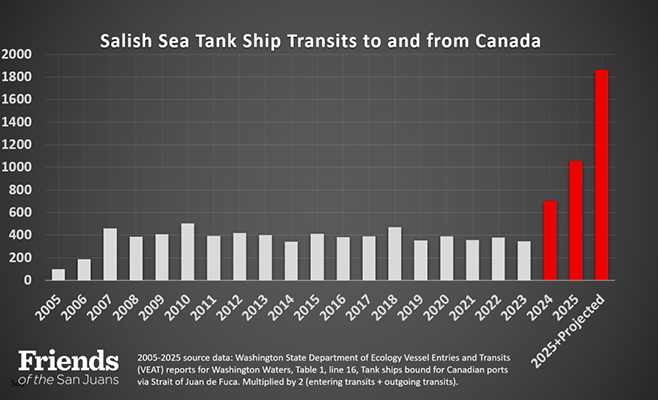
Proposed Canadian projects could more than quadruple historic tanker traffic levels.
The Salish Sea is one of the world’s largest and most biodiverse inland seas, providing habitat for a wide variety of marine species and ecosystems. The cumulative impacts of the projects identified in this report will be experienced collectively in the Salish Sea’s interconnected ecosystem.
If all currently proposed and permitted projects proceed, the addition of nearly 2,000 annual vessel transits would significantly increase cumulative impacts throughout the Salish Sea. More vessel traffic would increase congestion in already challenging navigation corridors, elevate the risk of oil and hazardous cargo spills, and generate additional greenhouse gas emissions, air pollution, and toxic scrubber discharges that contaminate marine food webs. Increased shipping would also place greater pressure on Tribes’ and First Nations’ cultural and treaty-protected resources and further threaten the recovery of Southern Resident killer whales through increased underwater noise, disruption of foraging behavior, and a higher risk of vessel strikes.
The economic stakes are substantial. According to an Earth Economics 2022 report, the Salish Sea provides an estimated $91 billion to $153 billion annually in ecosystem services, including fisheries, tourism, recreation, carbon storage and climate regulation, water filtration, flood protection, and cultural and Indigenous values.
Despite the growth of vessel traffic, the cumulative impacts from projects throughout the Salish Sea are not being comprehensively assessed or managed.
“The health of the Salish Sea ecosystem matters to Coastal communities and economies, critical habitats for endangered and at risk species, and Tribal and First Nations cultural and treaty-protected resources,” said Eva Schulte Executive Director with friends of the San Juans. “This projected increase in vessel traffic, particularly the tanker traffic, underscores the urgent need to address cumulative impacts before additional projects move forward.”
For more information, visit: https://sanjuans.org/our-work/the-salish-sea/ssvtp/
About Friends of the San Juans
Friends of the San Juans’ mission is to bring people and nature together to protect the San Juan Islands and the Salish Sea through education, science, policy, and law. In addition to the Salish Sea Vessel Traffic Projections, Friends engages in permitting processes to ensure that environmental reviews address project-related vessel traffic risks and impacts. Friends focuses on reducing shipping pollution, protecting Southern Residents, and increasing oil spill prevention and spill response preparedness. To learn more about our work, get involved, or sign up for action alerts, visit sanjuans.org.

**If you are reading theOrcasonian for free, thank your fellow islanders. If you would like to support theOrcasonian CLICK HERE to set your modestly-priced, voluntary subscription. Otherwise, no worries; we’re happy to share with you.**





It’s difficult and unpopular to criticize Friends of the San Juans, but the data used in this analysis doesn’t appear to fully match up with the Department of Ecology data.,
The Salish Sea extends from essentially the northern tip of Vancouver Island to Puget Sound’s southern point near Olympia. I asked eight adults at random yesterday what comprises the Salish Sea, and only one got it basically right. Point is the Salish Sea includes the ports of Seattle and Tacoma, and it”s pretty much a given that shipping traffic is almost certainly going to increase with the passage of time.
DOE reports tanker traffic to Canadian ports was 528 in 2025. This article quotes double that number at 1,056 … which is based the logic of ships going and coming, but a number of those of those transits are empty tankers.
Vessel congestion? iI’s not a congested vessel area. Dozens of areas in the world have FAR more vessels than the Salish Sea. In tanker traffic alone, the newsy Hormuz Strait, the average tanker traffic was just over 100 tankers a day pre-war. The Salish Sea currently has less than 1.5 a day … or 3 if the number is double for in and out of the Salish Sea.
“Dramatically increasing the risk of oil spills and major oil spills” by a 16%+ increase in traffic seems just a little over the top. There is always going to be some risk in anything that moves, but Canada is most likely going to complete their pipeline projects since billions of dollars are on the line, and tanker double hulls, escort vessels, and vessel traffic control will most likely keep the Salish Sea about the same as it is today.
Hi Robert, thank you for your thoughtful comment. I helped with this study by Friends and just wanted to reiterate that the data we used to estimate Salish Sea vessel traffic projections were from the WA Department of Ecology’s Vessel Entry And Transit data (linked in the article), as well as publicly available information on how development throughout the Salish Sea is likely to impact the number of vessel transits. While shipping traffic in and of itself is a risk to the marine ecosystem and surrounding communities, it’s important to take into account what cargo and/or fuel the vessels are transporting through the narrow waterways. Even an empty tanker poses a threat as they are still carrying millions of gallons of propulsion fuel for transportation. Double hulls, tug escorts, and the U.S.–Canadian Cooperative Vessel Traffic Service are important safeguards, but they do not eliminate the possibility or consequences of an accident. Our purpose is not to suggest that a spill is inevitable. It is to ensure that decisions account for the cumulative risks and impacts associated with a substantial increase in vessel traffic across the shared waters of the Salish Sea.
Vessel congestion can occur when traffic is constrained to waterways where commercial vessels, ferries, fishing vessels, recreational boats, and marine wildlife share limited navigation space. The Salish Sea has several narrow passages, such as Haro Strait and Rosario Strait, where vessel congestion is more likely to occur, making it more difficult for vessels to pass unencumbered. It is our sincere hope that information similar to what we’ve provided above can be used to help governments make educated decisions about if and how to proceed with a project that may have serious environmental concerns, including those threats posed by an increased amount of vessel traffic in a semi-enclosed sea that is home to several endangered species and already experiencing adverse impacts from climate change.
Given as a whole the numbers reflected in the article above (thank you Lovel) speaks volumes. Though it’s true that numbers reflecting totals can often be interpreted in different ways potential oil spills represented by tanker traffic (that which your comment is focused on Robert), is only one of the hazards related to increased shipping… hazards that further threaten our already stressed local waterway. I find your comparison of the Salish Sea to the Strait of Hormuz to be a bit disingenuous… if for no other reason because I don’t live there. In making comparisons to the Salish Sea it should be noted that at its narrowest point the Hormuz Strait is about 24 miles across, and at its widest point it is about 60 miles wide.
IMO, any argument based on the logic of “it’s going to happen anyway” is DOA. I’m resistant to the notion that an increase in fossil fuel consumption is in our planet’s best interests, and I appreciate the efforts of those who are trying to minimize it.
Here are some numbers for you with the following being excerpts (with thanks to Joe and team) from the SEADOC Society’s “About the Salish Sea.”
“The Salish Sea is one of the world’s largest and biologically rich inland seas.”
Total number of islands: 419
Total population: more than 8 million.
Number of different marine animals species estimated: 37 species of mammals, 172 birds species, 261 species of fish, and estimated to be more than 3,000 species of macro-invertebrates.
Number of species/subspecies listed as threatened, endangered or are candidates for listing: 135.
“Increasingly, the sea and its surrounding watersheds are challenged by an ever-growing list of threats. Ocean acidification, a burgeoning human population, increased marine shipping traffic, and unchecked waste water and sewage runoff are just a few of the immediate pressures that are endangering this jewel of an ecosystem.”
“Most alarmingly, between 2008 and 2011, the number of marine wildlife species in the Salish Sea listed as threatened or endangered nearly doubled from 64 to 113.” (Let us not forget that this number includes our beloved Orcas).
“If healthy ecosystems foster economic prosperity, unhealthy ones represent lost opportunity and income. Whether we depend upon the ocean for our living or for our quality of life, we all benefit from a healthy Salish Sea.”
https://www.seadocsociety.org/about-the-salish-sea
In a common sense world where human and ecological health as well as the future of living things was understood and respected we would not be seeing such insane increases in worrisome fossil fuel pipelines, port expansions and transport vessel increases while the earth’s atmosphere inexorably heats up. Energy consumption would be already tightly regulated and alternative energy sources rapidly developed in an attempt to stave off catastrophe. We were sort of headed that way but alas.
Knowledge is power and numerical analyses should be welcomed in our mounting emergency but both the US and Canadian governments are owned by fossil fuel corporations fully capable of dragging all of us to the brink of destruction for continuing profit. This era will be remembered forever in the annals of history and those many who are pressing the gas pedal rather than applying the brakes will be known as the widely despised Unforgiven. If you foolishly believe that basic human nature is reliably humble and compassionate or that changes in our Congress this November will drastically alter the arc of world history you should be ready for great disappointment. It isn’t the Salish Sea that has a gun to it’s head with this expansion but the entire earth. All efforts are appreciated but a terrible future unfolds with an increasing probability. I wish that I was a dreamer rather than a rational realist. Spills are unlikely but always possible and would be devastating to our island archipelago in terms of community resilience and self-reliance that we should be focusing on in bracing for the coming difficulties.