Having an agenda of no agenda requires me to simply show up and see what shows up
|||
What if recovery isn’t some place we have to get to? What if it isn’t another project to manage, another self to improve, or another part of myself that needs fixing? What if recovery begins the moment I stop ignoring, avoiding, and distracting myself… from myself?
And what if recovery isn’t what happens when I finally let go of a substance, a thought, or a behavior? What if recovery is what begins to reveal itself once the process of letting go is underway?
Heather
A client of mine, Heather, knows something in her life is coming to completion. She knows it’s time to close her private practice. Financially, she can afford to step away—money isn’t the issue. The issue is, that she doesn’t yet know what’s next. She doesn’t know what’s hers to do. There’s no set path, no structure or agenda for her to focus on. And this terrifies her.
“What if nothing specific shows up that I want to do? What if I never want to work again? What if I lose my ambition? What if I can’t make the kind of money I’ve made before? What if I become directionless? What if I end up just like my parents?”
As I listened, it became clear that beneath every one of those questions was a single, unspoken assumption: I don’t trust myself. Perhaps even deeper than that: I don’t trust that Life is working in my favor.
Addictions
Over the years, I’ve come to believe this may be one of the deepest addictions many of us carry. Not alcohol. Not work. Not food. It’s the addiction to abandoning ourselves. It’s the addiction to not trusting our own knowing. It’s the addiction to handing over our authority, our agency, and our sovereignty to something outside ourselves, because we are afraid of what might show up when we show up.
Carla
Another client, Carla, has been sober for over thirty years. Thirty years! She knows recovery intimately. And yet recently she discovered something she’d never considered. She is addicted to proving herself, to productivity, to earning her worth. She is addicted to busyness and to disregard joy. These addictive patterns, which perhaps were the underpinnings to her substance abuse, revealed themselves as fully alive and fully in charge as ever before.
Recently, Carla said something that stopped me in my tracks. “I want an identity that will outlast me. It’s what I want to be known for.” I understood exactly what she meant. And I also heard the exhaustion. How much of her life has she spent trying to become someone she wants to be known for? But in the end essentially has no
control over?
What if the person she’s been searching for has been quietly waiting beneath all the proving and improving? No trying. Just listening.
The way I understand addictions.
Now, the moment I use the word addiction, many people quietly excuse themselves from the conversation. “That’s not me.” “I’ve never had a drinking problem.” “I’m not an addict.”
But what if addiction isn’ defined by what we’re using? What if it’s defined by what’s in the way of freely choosing to choose what we truly wish to choose? That’s a lot of choosing, and that’s part of my point. For me, addiction isn’t defined only by a substance. Addiction is any pattern of thought, feeling, or behavior that repeatedly overrides our capacity to choose freely.
Early in my career as a therapist, I spent eight years working with alcoholics, addicts, and their families in Nova Scotia. Eventually I left the addiction field and moved into coaching and spiritual guidance. Or so I thought. Looking back, I realize recovery never left me.
Because regardless of what brings someone into my office, we eventually arrive at the same place. We discover patterns they’ve been living inside, the beliefs they’ve mistaken for truth, and the habits that quietly override their freedom to choose what they wish to choose.
Not everyone is recovering from alcohol. But everyone, in one way or another, is recovering from something. That’s why I often ask people two simple questions:
- Where are you not free to choose what you want to choose?
- What keeps you from trusting your own knowing—your own ability to choose for yourself?
Almost everyone can answer to these questions. Which means almost everyone is familiar with this conversation. Whether or not they want to be in the conversation is another story. And the degree to which they can entertain the possibility that stuff—patterns and habits are interfering with them having a better life, well, that’s the degree to which they may be addicted.
Recovery
For me, recovery isn’t simply about what I’m recovering from. It’s about what I’m recovering—as in, what’s been hidden, undiscovered, concealed.
For me, recovery is the gradual restoration of my relationship with my own inner wisdom—the part of me that has always been trustworthy, even when I couldn’t hear it. It is my willingness to live in relationship with something greater than the frightened part of myself that only wants to live in safety from fear.
Little by little, I find myself recovering free choice, free will, self-trust, innocence, spontaneity, relationship, and joy. These are things I didn’t even realize had quietly gone missing.
Rehab Centers
Some people absolutely need the structure and support of a residential treatment center. And thank goodness those places exist. Most of us, however, may simply need to create one a little closer to home.
The purpose of my rehab center is to be a space quiet enough that I can hear myself again. It’s where I begin removing everything that convinced me I wasn’t enough—that I had to keep proving, improving, producing, and controlling in order to deserve my own life.
I’ve come to experience recovery beginning the moment I stop trying to recover from being me. For instance: I stopped doing anything I should do to prove or improve. I noticed and acknowledged what showed up intuitively. I allowed time for inspiration to come in. And, through these few practices I found something truly remarkable occurred. Everything that needed to get done got done. Not out of control, pressure and looking good. They got done because I got my “stuff” out of the way. HUGE!!!
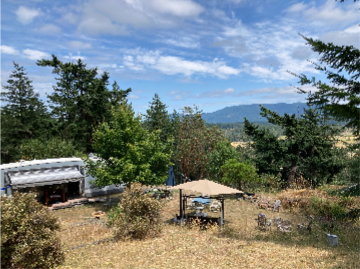
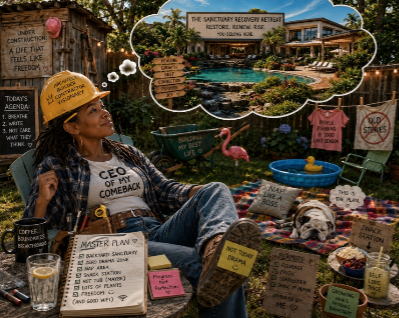
My recovery center isn’t fancy. It’s my backyard. My iPad. My garden swing and hammock. A blanket. A glass of water. A good pair of walking shoes. A wise book. And, of course, a snack station.
Living in the midst of recovering me from all the stuff that I thought was me, isn’t always comfortable. It takes courage to let go of expectations, and attachments to specific identities. It can feel exhausting to stop proving, to release productivity as an identity, and to practice what I now call an agenda of no agenda. But for me, it works.
When I have no agenda, a different question begins to emerge: What’s mine to do?
Not what should I do. Not what will impress people. Not what will prove my worth or make me money or famous.
Simply… What’s mine?
Then I listen.
Sometimes nothing comes.
Sometimes I feel restless, guilty, or frightened. Sometimes I discover just how addicted I am to having a plan, or worrying about how I’ll be seen.
Other times I notice something surprising. I take a walk. I pet Lucy. I read a page from The Language of Letting Go. I write. I take a nap. I laugh. I do the dishes. Quietly, the life I wish to choose unfolds in a way that never could have been scheduled.
Recovery, for me, has become less about following a program and more about learning how to stay present long enough to listen as my own life speaks to me.
Who am I learning to trust?
I’ve discovered that trusting myself has very little to do with trusting my personality, my preferences, or my certainty. It has everything to do with trusting my capacity to listen.
Actually, truth is, I exist in my listening of me. You exist in the listening of you. This perspective allows me to recognize that someone wiser is always present—not fear, not guilt, not shame, but love expressing itself through my own essential nature.
Over the years I’ve read hundreds of books, listened to teachers, sat with clients, prayed, doubted, laughed, grieved, and questioned almost everything I thought I knew.
My Own Personal Menagerie
None of it became the answer. It all became part of my collection of a menagerie of wisdom. Some of it came from recovery. Some from A Course in Miracles. Some from Oneness. Some from Paul Selig. Some from my clients. Some from my children. Some from life adventures. Some from my own spectacular mistakes.
None of it required me to surrender my authority. Quite the opposite. Each conversation with books, people, nature, life, Lucy, invited me back into relationship with me.
In the Agenda of No Agenda, I am invited into the precious experience of the moment. I can’t anticipate what shows up in any of these situations. I just know something always does show up when I show up! I’ve learned to trust that there is nothing to fear. So, I can stay in wonder and curiosity!
What’s Mine to Do?
I’ve realized that my work in the world isn’t to repeat what someone else has discovered. My work is to listen long enough until something true introduces itself to me. And then through me it expresses itself through the only voice I have—my own.
Perhaps that’s what recovery has been restoring in me all along. Not my certainty. Not my productivity. Not an Identity or Brand. Not what people will remember me for.
Recovery has been restoring my authority, my sovereignty, my agency, being in alignment with my highest truth, my highest good, and my highest contribution to the world.
What’s ongoingly being restored is a quiet authority to know what I know, to question what I don’t know, and to trust that what is mine to know, mine to live, and mine to share will continue revealing itself in its own perfect time.

**If you are reading theOrcasonian for free, thank your fellow islanders. If you would like to support theOrcasonian CLICK HERE to set your modestly-priced, voluntary subscription. Otherwise, no worries; we’re happy to share with you.**