

Stopping the burn is a marathon, not a sprint
||| EARTHRISE BY JAY KIMBALL |||
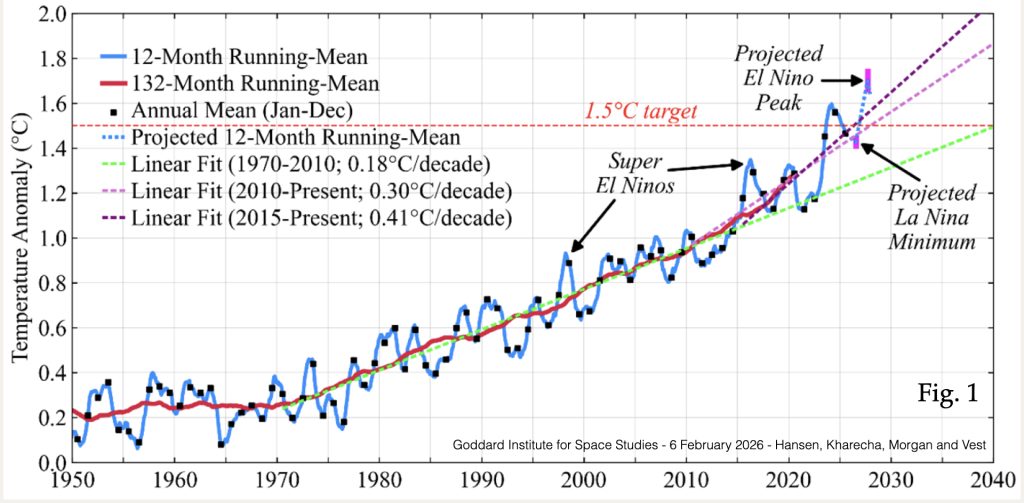
As war rages in the Strait of Hormuz, one wonders if we are watching an important nail in the coffin of our collective global oil addiction. March record heat waves throughout the west and an El Niño cycle gaining momentum tell us this year is different. Records will be broken.
Energy analyst Rory Johnston observed: “There is no better advertising for the clean energy transition than blocking off 20% of the world’s oil coming from the Middle East.”
He’s right. And history backs him up.
Jason Bordoff, founding director of Columbia University’s Center on Global Energy Policy, has noted that fossil fuels declined faster as a share of economic activity in the decade following the 1973 Arab oil embargo than in the decade following the 2015 Paris Agreement.
Importing Vulnerability
Climate policy asks governments to act against future harm. Energy security confronts us with present pain — at the pump, at the grocery store, on the farm. Most things we buy have embedded fossil fuels in them.
Just a handful of $20,000 drones and naval mines can halt the passage of hundreds of tankers, each carrying 2 million barrels of oil worth $200 million. That asymmetric warfare is a wakeup call.
Suddenly, nations have a renewed determination to stop importing vulnerability. Even if the Strait reopens, the wound doesn’t close. The memory of severed supply lines, spiking prices, and rationed fuel lingers — a geopolitical PTSD that reminds every energy planner, every finance minister, every household: this can happen again. When the cost of not transitioning is measured in price shocks, supply rationing, and economic disruption, political will tends to materialize quickly.
The Iran oil shock is, paradoxically, one of the most powerful accelerants the renewable energy transition has ever had.
San Juan County: Bad News, Good News
San Juan County is acutely exposed to exactly these dynamics. Nearly everything that powers daily life here — food, energy, building materials, emergency helicopters — arrives from somewhere else. When global fossil fuel prices spike, island households feel it faster and more directly than many mainland communities.
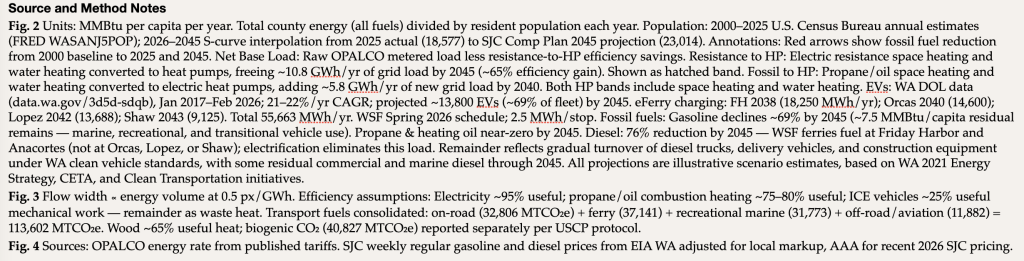
But something has been shifting here, quietly, over the past 25 years. We have collectively reduced our personal share of fossil fuel imports by 34%. We have become more efficient. And we are on a path to an 84% reduction by 2045 — mirroring Washington’s goal of net-zero emissions by 2050.
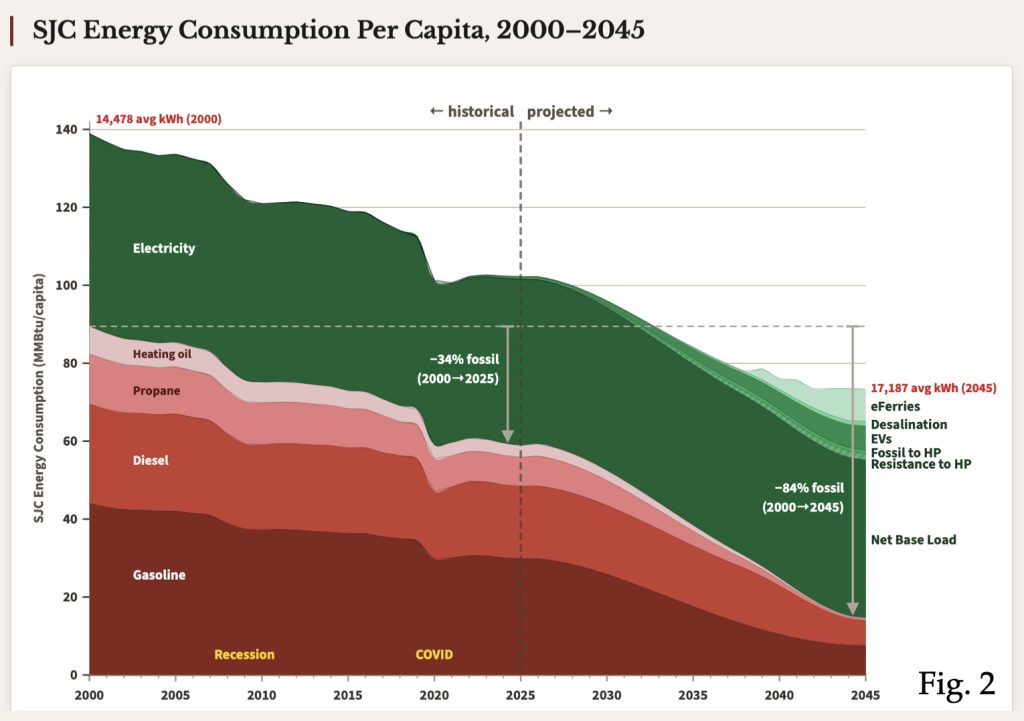
The trend is visible and consistent. Propane, heating oil, gasoline and diesel are giving way to heat pumps and electric vehicles (EVs) that are three to four times more efficient. San Juan County now has the highest per capita EV market share in Washington State. Walking, bicycling, and staycations are on the rise too.
Less fossil fuel imported per person means less pollution emitted. The county’s overall energy mix has been steadily decarbonizing — through a series of individual household decisions that, in aggregate, add up to a substantial reduction in fossil fuel pollution and greenhouse gas emissions per person.
The Cost of Fossil Fuel is Deep and Wide
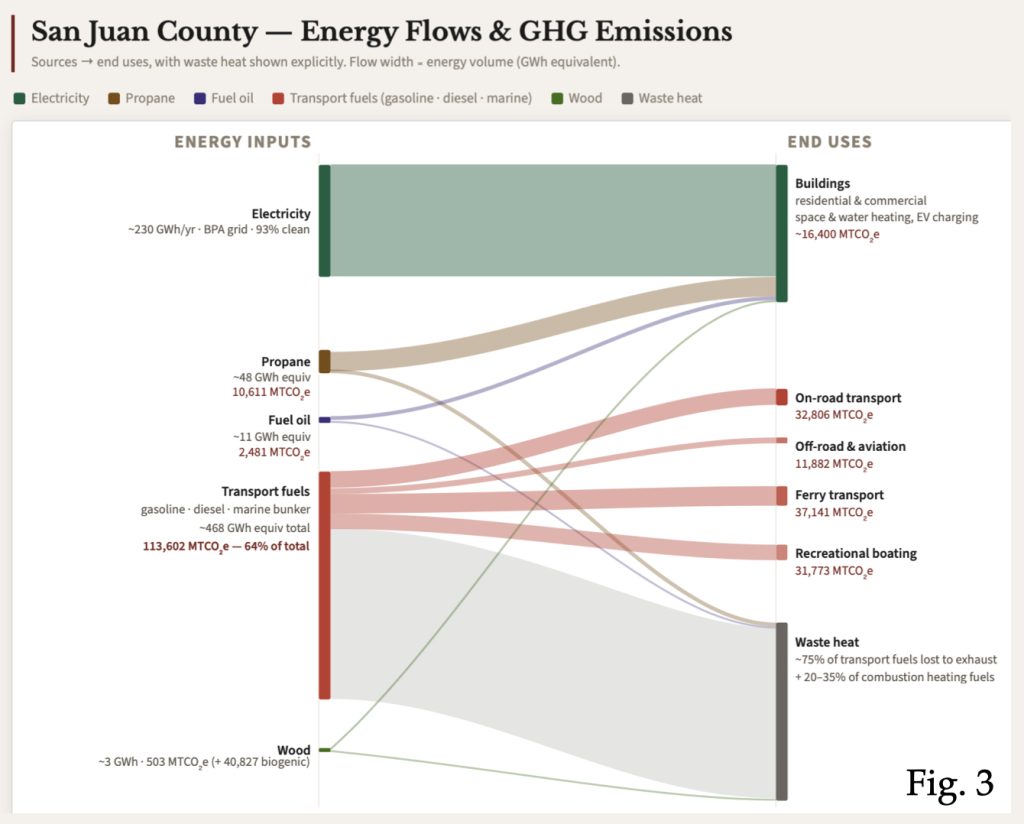
Fossil fuels account for 77% of county energy imports, and 88% of that goes to fuel transportation. Most of that fossil transportation energy ends up as waste heat.
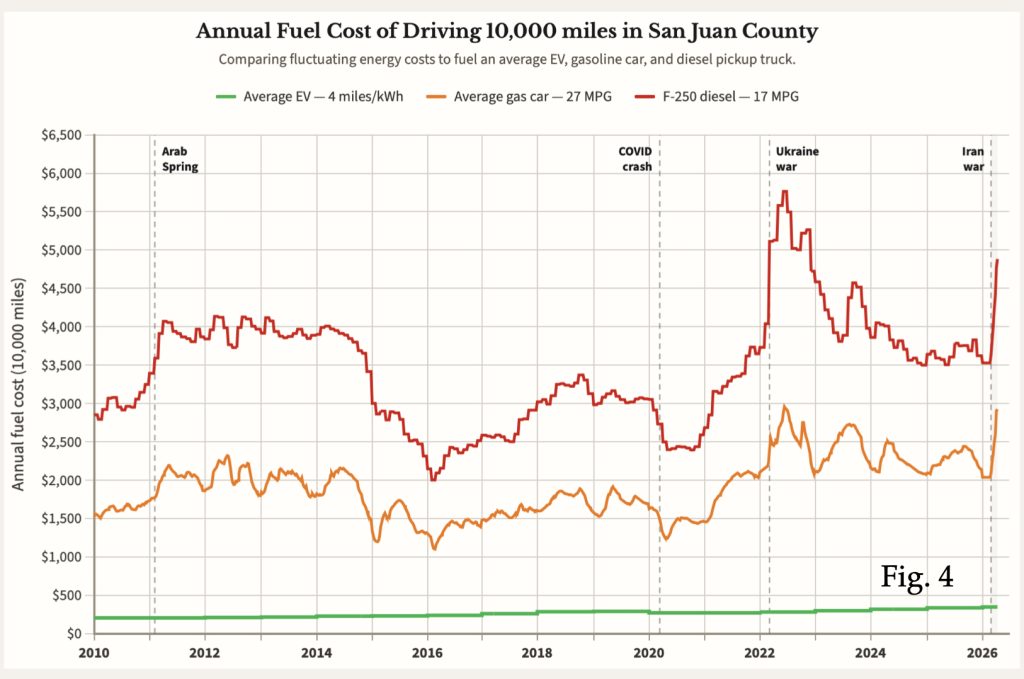
As the transportation fuel cost chart below shows, it’s been a bumpy ride. Fossil fuel prices, especially diesel, are spiking — driving nations to prioritize production of electric motorbikes, cars, and trucks, particularly in India and Southeast Asia, which are especially dependent on oil flowing through the Strait of Hormuz. Our county is not immune, as the recent price spike in diesel and gasoline shows.
But our fossil fuel dependence has a price that runs deeper than what we see locally.
The federal government currently provides at least $35 billion per year in direct fiscal subsidies to oil, gas, and coal. These subsidies were already substantial before 2025, when the One Big Beautiful Bill Act added nearly $4 billion in new annual fossil fuel support on top of roughly $31 billion in preexisting commitments.
In 2023, the International Monetary Fund estimated the total implicit subsidy — reflecting the hidden societal cost of fossil fuels: premature deaths from air pollution, health care costs from respiratory disease, and mounting climate damages. Economists debate the precise valuation, but the direction is not in dispute.
Spread across roughly 130 million American households, that combined burden works out to approximately $5,800 per household per year — a hidden tax that never appears on any invoice, but is paid through insurance premiums, medical bills, disaster recovery, and foregone public investment.
Now add the US taxpayer’s share of a war in Iran costing an estimated $1 billion per day — the lives lost on all sides, the collateral damage to families and cities, the refugees, and the bitter irony of warships, aircraft, and burning infrastructure pouring more carbon into the same atmosphere we are trying to save.
And beyond the money lies the environmental toll. The Salish Sea and surrounding oceans have absorbed 93% of global warming’s accumulated heat, while fossil fuel pollution acidifies the water, imperiling shellfish, coral and the ocean food chain.
The Iran oil shock is one of the most powerful accelerants the renewable energy transition has ever had.
The same asymmetry that makes fossil fuels so vulnerable is what makes the renewable energy transition so unstoppable — small actions, compounding.
Next week, we look at some of the community hurdles ahead in this marathon — who is running, who is being left behind, and what that means for our island community.
Earthrise: A Climate Action Journal
This climate action journal offers information and actions we can take together, locally and globally, as we care for this precious Earth.
“The best way to heal a living system, is to connect it with more parts of itself.” ~ Margaret Wheatley
If you like what you read here, pass it forward to a few friends and ask them to do the same. Like a pebble tossed in a pond, the rings emanate outward, reflecting and growing exponentially. “Going exponential” is what it will take to reverse the climate extremes that are accelerating around us.
Thank you…
+ Get an alert when there’s a new Earthrise post: Notify Me!
+ Previous Earthrise posts:
• First Light • Robert Dash – photographer, educator, environmentalist • Extreme Rain • A Poem for the Snow Leopard •
• How the Chinese spy balloon can inspire climate action • Tidal energy in the Salish Sea •
• The biggest source of county greenhouse gas pollution • The future of clean transportation in island communities •
• Healing Nature •
Notes
In a World on Fire, Stop Burning Things
Washington 2021 Energy Strategy
Washington Clean Energy Transformation Act (CETA)
Washington Clean Transportation
Transportation Electrification Strategy (TES)
San Juan County 2025 Comprehensive Plan
Fossil Fuel Subsidies Surged to Record $7 Trillion
U.S. Spending Bill to Grant $40 Billion in Fossil Fuel Subsidies

**If you are reading theOrcasonian for free, thank your fellow islanders. If you would like to support theOrcasonian CLICK HERE to set your modestly-priced, voluntary subscription. Otherwise, no worries; we’re happy to share with you.**






Leave A Comment