||| FROM COLIN WILLIAMS |||
Framing Transportation
We face real environmental challenges, and transportation is a contributing factor towards the issues we face here on our islands.
Transportation can also be a barrier to equity. I believe one of the best ways to address both our environmental issues and equity issues related to transportation is to provide a base level of transportation accessible to everyone.
In a spirit of volunteerism and wanting to contribute to the public benefit in my community — and after first reaching out to incumbent transportation groups with no response. I worked towards creating the “Friends of Rural Public Transportation.”
Engineering Practices
How do you design a system, or a product? How do you evaluate it? In a previous article [1], we introduced what we call “AAA Service” requirements that we claim could be employed to evaluate any transportation service. These are simply: Affordability, Accessibility, and Availability. As a quick first step, think about a transportation service: What are the hours of operation? What places does it serve? Can everyone use it, or does it cater to a particular segment of the population? What are the implementation and operating costs?
But aside from evaluating the benefits of the service itself, what about the “side effects” of that service? Does that service have the potential to reduce the number of cars on our roads? Will that service increase visitor traffic? What is the “Carbon Cycle” impact of that service? Could that service have any impact on our ferry system operations?
Engineering involves a planning process. We need information to create the best design: understanding our users and their needs, current road usage patterns, and whether we want to set limitations to prevent negative impacts. Our initial proposal [2] translated the AAA requirements into a concrete three-route plan covering the island’s key destinations.
Early Visions
When I started thinking about route planning years ago, I thought about how we could build a robust transportation system that people would think twice about: “Could I leave the car at home and catch the island transit?” Fiddling around with Google Maps, drawing on experience from ridership in regional transportation systems, and being around the island roads, I suggested that a three-route operation — East, West, and Central routes with a 45-minute to hourly service interval — might be a good shot at something we could pull off, something that may attract ridership and benefit us in many ways [2].
I mention “fiddling around with Google Maps” deliberately — this kind of grassroots exploration is something anyone in our community can do. We’d love for more islanders to think through these questions and bring their own ideas forward.
But if we think about transit system design, driver salaries are one of the biggest expenditures. The most significant expenses in public transit are staff salaries and infrastructure/vehicle purchase costs [1]. If we reduced the number of salaried employees, what could we get away with by reducing the number of routes in terms of reduced infrastructure and operating costs?
Cold Start Design Thought Experiments
Assume that we don’t have the luxury of information from the incumbent transportation planners. Assume that the county employees are too busy to answer informal (or formal) information requests [3]. Let’s work through planning a hypothetical system and see where we arrive.
A “cold start” design means building a plan from scratch without baseline ridership data or institutional support — which is the situation we find ourselves in.
Hypothetical Route Plans
Route 1: The East–West “Transportation Moat”
This plan would essentially be a single fixed-route system with one operating vehicle at a time, running East–West: Doe Bay to Eastsound to Deer Harbor. It would allow stopping at Turtleback Mountain Preserve and Moran State Park. It includes travel through the Deer Harbor, West Sound, and Doe Bay hamlets. This could be implemented at approximately an hourly service interval.
We call it the “Transportation Moat” because it doesn’t service travel between Orcas Landing and Eastsound. If we didn’t want to allow access to transportation for visitors arriving at the ferry landing, we could employ this route. It’s my perception that it does provide value in connecting many of our hamlets and key destinations — with the big caveat that some residents may see the exclusion of the ferry landing as an advantage in managing visitor volume.
As a Deer Harbor resident, I see high value in this route’s ability to connect our hamlets — Deer Harbor, Olga, West Sound — together with our village of Eastsound. A resident of any of these communities would benefit from direct transit connections to the others. Of course, we must admit that Orcas Landing, White Beach, Orcas Road, Buckhorn, and other areas are all not included in this route.
Route 2: The North–South “Ferry Run”
This route is perhaps the most commonly envisioned route. It serves between Orcas Landing and Eastsound. In its simplest form, it might connect just these two destinations. High-density areas near Eastsound would be well served by this route, along with a trip down North Beach Road, perhaps a detour to Buckhorn Road, and maybe a return route through Enchanted Forest Road.
The value this route provides is supporting one of our highest-traffic areas and serving our busiest roadway — the corridor between the ferry landing and our village. Subsidizing walk-on passenger fares combined with transit could prove more cost-effective than subsidizing vehicle fares across the WSF [3]. Route 2 would be the natural backbone for that approach.
However, while this route addresses a real traffic need, it does little on its own to provide adequate transportation across our island or to fully connect our community.
Not Fully Informed Opinion
The heading of this section is deliberate. We acknowledge the significant work we’ve put into this analysis, but we want to be transparent: we are operating without information that should be available to us. Our open letter to Island Rides and local transportation officials — published in full in A Community Conversation on Island Transportation — went unanswered. The incumbent transportation planning group has not been working with us, and our information requests to county agencies have gone largely unfulfilled. This limits any plan we produce, and we believe the community should know that.
With that said, if there were a single route implemented on Orcas, I’d argue that Route 1 would be the most beneficial for islanders in building a sense of community. It would connect most of the major hamlets to our village and vice versa.
In the case that Route 2 was the only route implemented on Orcas, its main benefit is connecting the ferry landing to our village and addressing traffic on our busiest corridor. There is real value in that, but on its own it isn’t realistic in providing connectivity throughout our community.
If we were to create a sustainable transportation system that could have a very positive impact on our community, it’s our opinion that the most valuable system implementation requires the development of both routes. Evaluated against our AAA requirements [1], Routes 1 and 2 together provide the strongest combination of Accessibility across the island and Availability at reasonable operating cost.
What’s Missing (Aside from Information)
Quite a bit. This isn’t a fully informed plan. We have the aforementioned issue regarding information access. Vehicle selection, technology type, flag stops, required infrastructure costs, seasonal changes, flex route possibilities, and more remain unaddressed. We provide some framework for evaluation but don’t apply it fully in this discussion. We don’t discuss “side effects.”
For context on our broader vision — including vehicle selection considerations, the case for starting with conventional vehicles, and the school district resource-sharing model — see [1] and [2]. Our comments on the county’s comprehensive plan [4] also address how transit fits into the county’s broader transportation planning.
However, despite our limited access to information, we believe that this plan represents a strong foundation for further planning.
We look forward to continuing this discussion — and we want to hear from you. Visit forpt.org to see our upcoming community meetings, join our mailing list, or share your thoughts on these routes. Your input will make this plan better.
References
[1] Transit System Design: A “Good Enough” Vision for Orcas Island — Our vision for a practical transit implementation, the AAA evaluation framework, and cost analysis identifying staff salaries and capital expenditure as primary cost drivers. Updated version on our site | Original in The Orcasonian
[2] Should Orcas Island Have Public Transit? — Our initial opinion piece proposing a three-route summer transit pilot and the school district resource-sharing model. Updated version on our site | Original in The Orcasonian
[3] A Community Conversation on Island Transportation — Our correspondence with local transportation officials, including discussion of walk-on fare subsidies and information requests that went largely unfulfilled. Updated version on our site | Original in The Orcasonian
[4] Comments on SJC’s Comprehensive Plan Transportation Element — Our advocacy for including public transit in county transportation planning. Published in The Orcasonian
Data Sources
WSF Ridership Data Reports — Ferry ridership data we’ve been analyzing as part of our planning process.
About the Author
I’m Colin Williams, a “2nd generation” resident of San Juan County. Dave Roseberry from the Orcas Grange told me islanders used to say my dad Bill Williams came to Orcas pushing a wheelbarrow off the ferry. Bill first came to Orcas with longtime resident Margot Shaw, the mother of my half sister Christine, who was born here.
My mother Sara Williams grew up in Deer Park, Washington. She is a writer — a journalist and a novelist. She met my father at Rosario Resort in the 1970s. If you want to blame someone for my writing, you might blame her for encouraging me to write.
I’ve spent perhaps around 15–20 years of my adulthood on island. I attended part of my youth at Orcas Island Middle and High School, and many adolescent summers on Orcas. Aside from Orcas, I’ve probably spent around 15 years in the Seattle Metro as an adult. I share this background because my perspective on island transportation comes from decades of living in and traveling around this community.

**If you are reading theOrcasonian for free, thank your fellow islanders. If you would like to support theOrcasonian CLICK HERE to set your modestly-priced, voluntary subscription. Otherwise, no worries; we’re happy to share with you.**




I don’t know any locals that are complaining about a lack of public transportation. The senior center has a van, the Y camp is covered. Is it the hotels, air BNB owners, or the chamber that are complaining? This kind of thing is great….Friday Harbor, maybe.
RR and Tony — thank you both for engaging. These are fair questions and exactly the kind of community conversation we want to have.
To the question of who’s asking for this: just this week I met a new employee at Moran State Park who was surprised to learn they’d need to buy a car to live and work on Orcas. That’s a real barrier for the workforce our island depends on — not tourists, not hotels, not the chamber.
On the tax concern: our very first proposal was designed to avoid raising local taxes, using existing funding sources like Climate Commitment Act dollars that we already pay into but don’t benefit from. San Juan County remains the only county in Washington without public transit.
And Tony, you’ll notice that Route 1 in the article — the “Moat” — deliberately does not connect to the ferry landing. It’s designed specifically to serve residents by linking our hamlets together. The article actually addresses your concern head-on.
Thank you Mr Davis this issue goes beyond local interest village transport.Do we really need this stress on our tax base.annual maintenance and replacement of vehicles and recruitment of drivers.?OR IS THIS AN ISSUE TO PROVIDE TRANSPORT FROM THE FERRY TO THE ECONOMIC HUB OF EASTSOUND ?IF THE BUSINESSES ARE SO HUNGRY FOR MORE TOURISTS,LET THEM PAY FOR IT.
“This issue goes beyond local interest.” Is all I need to hear when taxes and “go fund mes”.are at the level they are now.
San Juan Transit is already planning service for Orcas this summer. Best thing people can do is support their work.
Alex Freeman
I appreciate the suggestion. If you follow it through, though: San Juan Transit’s schedule page sends Orcas customers to OrcaShuttle.com, which currently says they won’t be running a public route this year.
This is actually a pattern worth examining. A private shuttle tied to a car rental company will design its route and schedule around what’s profitable — the summer tourist corridor from the ferry to Eastsound. When the economics don’t work, the service goes away. That’s not a transportation solution; it’s a seasonal business decision.
Our community needs transit that’s designed around where residents need to go, that operates across seasons, and that doesn’t disappear when it stops being profitable. That’s the difference between a private shuttle and public transit — and it’s exactly what we’re working toward.
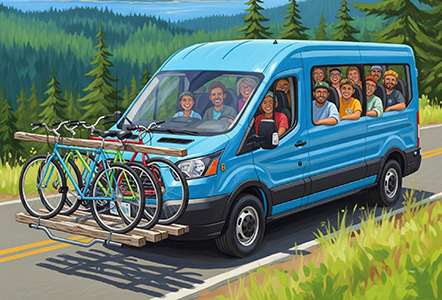
The AI-generated image with the van driving on the wrong side of the road immediately sets the stage for skepticism. This was called out in replies to the author’s previous article on The Orcasonian (titled “Let’s talk public transit for Orcas, San Juan” and published on March 30) but the feedback does not appear to have been taken into consideration. In a world of free stock photos taken by human photographers, why choose a defective AI-generated image to represent your grand vision?
The AI slop image might actually be the perfect symbol for this proposal. It’s easy to go down the LLM chatbot rabbit hole and convince yourself that you’re a genius whose brilliant ideas will solve all of the world’s problems. Even the text of the article has that “LLM” sheen to it, including the most notorious marker of ChatGPT-generated text: an unusually high prevalence of em-dashes. The author might consider instructing his chatbot to operate in a less sycophantic mode, because it appears to be convincing him of something that’s probably not realistic.
Thanks Sadie for the feedback.
I would suggest because your comment is so long, that perhaps it be published as a separate article where folks might read it and comment on it directly. I think it would be more appropriate there. But there’s quite a bit of great content !!
Feel free to email me at colin@forpt.org if you’d like some support with editing or publishing.
David Bowman,
I spent perhaps 8 hours drafting this article. I did pass it through an AI system, after my handwritten draft was produced. To support formatting , adding my citations, etc.
There’s a stink of cynicism to your response and no valuable feedback. I’m sorry you are unable to envision how Public Transit will benefit us. And you active campaign to discredit our effort disturbs me.
Orcasonian Editor
Mon, Apr 6, 12:53 PM (1 day ago)
to colin
What would you prefer as the accompanying image?
Colin Williams
Mon, Apr 6, 1:02 PM (1 day ago)
to obstructionpress
No image necessary. It’s the writing that matters.
Thank you,
Colin
Mon, Apr 6, 1:12 PM (1 day ago)
All of our posts have an image…
Lin McNulty
Mon, Apr 6, 1:14 PM (1 day ago)
to me
and I suspect that Orcasonian readers will quickly recognize your blue van pic.
Mon, Apr 6, 2:08 PM (1 day ago)
I am not sure that my earliest posts employed that image. But if it’s your preference that we use that image given we don’t have another. Then feel free to publish it with that image.
I apologize for the inconvenience.
Kindly,
Colin
David, I’m terribly sorry that I upset you with the AI image. I did request to the editor to not employ the image, which email I attached above.
However, feel free to more directly criticize our transit ideas. I’ll make sure the editor doesn’t publish with the image again. So we will not upset you further.
I wrote this very late last night. You all know it will be long. No time to edit. But this is what landed for me both in the article and the comments. It probably needs to be in two parts so consider this part one.
WOW. I’ll start with this: I was impressed by the article and everything laid out in it. And I was surprised and turned off by the outright resistance and hostility in the comments. What’s going on? There seem to be lots of assumptions that the money needed for Public Transit would have to come through land or sales taxes or levies. Why do people automatically think it’s going to be a levy when Colin laid out other ideas? Is that as creative as people can think about garnering funds for worthy projects that would benefit us all?
The person who said they don’t know anyone who complains that there is not enough public transportation is apparently out of touch with the segment of the population who need and would use Public Transit. ‘Complain’ sets a negative spin and disses the ideas laid out here as being unnecessary. Says who? How about this instead: There is a need, whether you know any of the people who need it or not. The idea that there is sufficient Public Transit with a summer bus that runs for two or three months, falls flat when what we need most is in the other months of the year when there’s nothing. We need augmentation of the existing things in place.
Island Rides operates from 10 am to 3 pm weekdays and by appointment some Saturdays. I used it when I couldn’t drive my car, was injured, and walked with a cane for awhile because I could barely walk and had to water my garden and go to chiropractic and PT appointment. It was great as far as it went – the drivers were excellent and went out of their way for me where they could. But many medical appointments, need to get to the ferries in early morning or home at night, are all legitimate and very real needs for a lot of people.
The points that Colin brought up, while discussing routes and what the moat route would encourage, is spot-on. I love the idea of the east-west route as a community-building by connecting our hamlets; especially for commuters to and from work. I would use it to visit friends on the East side and go to Moran Park or Doe Bay or Deer Harbor. My car is very old, fragile, and can’t do hills; now he clutch is going out. I’ve had it for 20 years. It’s over 40 years old. I love that car. It was reliable for so long and still is, for short drives. I baby it and only drive it around town now. I’d love to have access to more of Orcas again. I’ve been here for 45 years. Not everyone here lives in the lap of luxury.
There are plenty of poor people on Orcas. More and more folks can’t afford cars. Electric cars are out of sight expensive and come with their own issues, as does all-electrification of clustered housing in Eastsound UGA homes being built. I looked into the ‘borrow an electric car’ program. You have to have comprehensive car insurance because each of those electric cars cost over $100 K. Who can afford that kind of car insurance? Not the poor! Liability is all I can afford, not very well on a fixed low income. At least I live in low income housing, for which I am grateful. Workers or retired workers who don’t, and have to rent at exorbitant prices have it even worse. There are workers who may prefer not to drive, given a choice. Not everyone can afford an electric car.
A segue, but I think we all need to take a long look at the lithium, cobalt, and copper mining needed for all those eBike and car batteries and AI data centers proliferating like some kind of toxic fungus. The whole ‘clean energy’ mandate for so called clean energy and all electrification (including the ‘clean’ nuclear hype) when OPALCO is fearmongering us with looming outages to come and the unaffordability of electricity soon to come and already happening for us. The climate mandates don’t even consider that, or the heavy toll that AI databases are taking on our electricity grids everywhere so that again, the poor and middle class have to endure base rate increases and may not have electricity for winter heat or hot water, in the events of the outages to come that OPALCO keeps saying are a given.
This is ALL related, for anyone wondering why all these other points are being brought up. For those who can afford cars or electric bikes, great! There is a class structure top down system here that prevents many services for people other than seniors and those with means. But we’re not supposed to talk about them. Nonsense. All the more reason to educate ourselves about them. Eastsound was envisioned originally as a walking village. Now, there are so many cars in Eastsound it’s unbelievable – and good luck parking! Another piece of forests gets bulldozed to make way for… parked cars.
see part two.
part two of my comment. I guess this needs to be 3 parts according to the algorhythms!
I hitchhiked all over this island for 19 years – from age 28 to age 47, when I finally got a drivers license and my first car. In times of bad weather or the times I walked many miles and it took hours to get to someplace 20 minutes away by car, hitching could be a drag. But it was the sense of community I felt when I got into a car and someone trusted me enough to take a chance and pick me up. The people I met who picked me up – both tourists and locals, were enjoyable. Interesting. I loved talking to visitors and how much they saw through un-jaded eyes what is so great about Orcas Island. We had memorable conversations on all kinds of subjects. That same thing is what I love most about buses.
I occasionally (when I can get a ride to the ferry) go off island and ride Skagit Transit from the ferry landing to Anacortes, Mt Vernon, or LaConner sometimes and I love meeting the people who ride the buses. All are interesting. and most, friendly. I have had many fascinating conversations on buses to everywhere, via Skagit Transit. I LOVE Public Transit and have used it on and off for most of my life – in Seattle, in Philadelphia. In the suburb where i was raised. The buses were well used everywhere I rode – by working class people and others trying to do the right thing by riding, rather than driving. We could have park and rides in strategic places too (NOT in the UGA please!). There are whole classes of people who actually depend on Public transit.
Washington got a huge grant for Public Transit. Some of that money went to Skagit Transit. Some came to the San Juans, – how that was used, I don’t know, but I think nothing was stipulated in how to spend those funds, when I believe it should have all gone to increase public transit in places where there is no service – like Orcas.
Like it or not, we are growing beyond our means with no hope of seeing that slow down. anytime soon. VRBOs are everywhere, pushing locals out. As I watch more and more deforestation of our wetland watershed Urban Growth Area’ (UGA) and more and more traffic and parking problems, and more forests felled to make way for more cars, I feel the island groaning under the weight – especially Eastsound UGA. Now they want to enlarge the UGA – again with no environmental protections with real teeth to stop the rampant deforestation. MORE cars, MORE traffic. Do we need that? Do we want that? I think the time is ripe and right for Public Transit. I am full of ideas and inspiration, just thinking about it! So tired of the nay-sayers with no creative vision or faith and trust in possibilities.
see part 3
Part 3 of comment.
People ask how it will be funded, before even giving it a chance. I envision volunteer shuttle drivers maybe, to connect people to bus stops. (Many Island Rides drivers are volunteers and we thank them!) There are so many ways to collaborate and not just shoot down someone’s well thought vision but rather, get behind it and creatively help build it. I’n gobsmacked that it’s not happening, sincea I believe that we can as a community.
I’m In, Colin! Don’t give up just because you are met with resistance or even hostility. We DO have a right to transparency from our local government. We CAN have this if we work together toward it. Something to augment existing things like Island Rides, Senior Van (not really sure why that is mentioned since it holds very few people, most of them seniors, as I am), summer t bus, would fill the needs we have the other 10 months of the year. I’m all for it and I think it would be well used. It might entice more visitors to leave their cars parked on the mainland or at their VRBO, and more workers to ride the bus.
I have a lot to say on this. I felt inspired by Colin’s write, and I plan to read the others. But I’m turned off by all the negative comments. Not one encouraging thing. Really? What does this say about our community? To me it says it is even more important that this vision stay alive and that we encourage and support it. Volunteerism, giving time, skills, or money, grant research for private and government grants, collaboration, brainstorming, supporting and celebrating the win-win situations – this is what makes a community and draws the right kinds of visitors.
As for the AI image…weak point. I’m not an AI person but really… so petty and nit-picky. It was explained here in the posted email dialogue between Colin and Lin. Perhaps a local artist could render an image (by hand, using no AI) that would satisfy the people who hate the AI image. Or one of you could find an image that can be used each time. Perhaps there could be a contest for high schoolers or children to make the art to be used for future articles.
This is a vision for something that is needed year-round on the island. The all-electrification of Eastsound and the solar farm idea, so unsuitable for our winters and much of the year, has hurt us all, even the NIMBYS on other parts of the island. Sea level is rising. We’re in a liquefaction earthquake zone in our downtown and clustered homes corridor.. All our clustered housing and infrastructure is here in this two mile radius – next to huge aboveground propane tanks. All of this seems so short sighted and not thought out – and frankly, as un -creative and out of touch as it gets. We never should have had the UGA be hwhere it is. Or the airport. Too late, I know. But we still can look for transportation solutions.
We can make the need to drive our gas or electric cars be so much less with Public Transit. I once moved house, all on buses, in Seattle! I had so much less possessions because I lived in group housing. Not having a car helped with owning less. There is a whole class of us, whether some like it or not, who want and would use Public Transit. What’s not to like and support about it? Public transit does everything good toward reducing traffic, pollution of our waters from car tires (electric car tires pollute too!), and strain on our roads already groaning under the weight of unlimited unmitigated growth and car traffic without any real strategy to keep us a rural island with a quality of life and community that inspires both locals and visitors.
end of comment
Hi Sadie,
I really appreciate your comment. I think it’s worthy of writing your own piece as I think readers will be challenged to read it in the comments section. I would encourage you to publishing it directly and mentioning it’s a response to the “Moat and the Ferry Run” article. Then I will give thoughtful response to it.
If you need some support feel free to reach out to me via email at colin@forpt.org
Public transportation would be a wonderful thing. It would significantly ease barriers to getting around the island as not everyone has the financial means or physical capability to just jump in their vehicle, get behind the wheel and drive whenever they want to. It would be “progress” in the right direction for the environment. It would take a lot of work to develop a successful public transportation system, though I can’t think of any other negatives.