

Stopping the burn is a marathon, not a sprint
||| EARTHRISE BY JAY KIMBALL |||
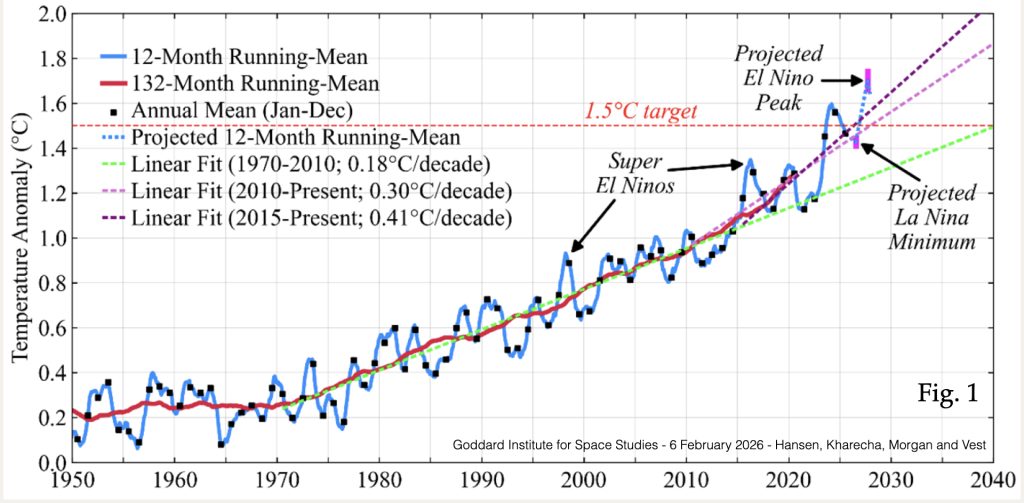
As war rages in the Strait of Hormuz, one wonders if we are watching an important nail in the coffin of our collective global oil addiction. March record heat waves throughout the west and an El Niño cycle gaining momentum tell us this year is different. Records will be broken.
Energy analyst Rory Johnston observed: “There is no better advertising for the clean energy transition than blocking off 20% of the world’s oil coming from the Middle East.”
He’s right. And history backs him up.
Jason Bordoff, founding director of Columbia University’s Center on Global Energy Policy, has noted that fossil fuels declined faster as a share of economic activity in the decade following the 1973 Arab oil embargo than in the decade following the 2015 Paris Agreement.
Importing Vulnerability
Climate policy asks governments to act against future harm. Energy security confronts us with present pain — at the pump, at the grocery store, on the farm. Most things we buy have embedded fossil fuels in them.
Just a handful of $20,000 drones and naval mines can halt the passage of hundreds of tankers, each carrying 2 million barrels of oil worth $200 million. That asymmetric warfare is a wakeup call.
Suddenly, nations have a renewed determination to stop importing vulnerability. Even if the Strait reopens, the wound doesn’t close. The memory of severed supply lines, spiking prices, and rationed fuel lingers — a geopolitical PTSD that reminds every energy planner, every finance minister, every household: this can happen again. When the cost of not transitioning is measured in price shocks, supply rationing, and economic disruption, political will tends to materialize quickly.
The Iran oil shock is, paradoxically, one of the most powerful accelerants the renewable energy transition has ever had.
San Juan County: Bad News, Good News
San Juan County is acutely exposed to exactly these dynamics. Nearly everything that powers daily life here — food, energy, building materials, emergency helicopters — arrives from somewhere else. When global fossil fuel prices spike, island households feel it faster and more directly than many mainland communities.
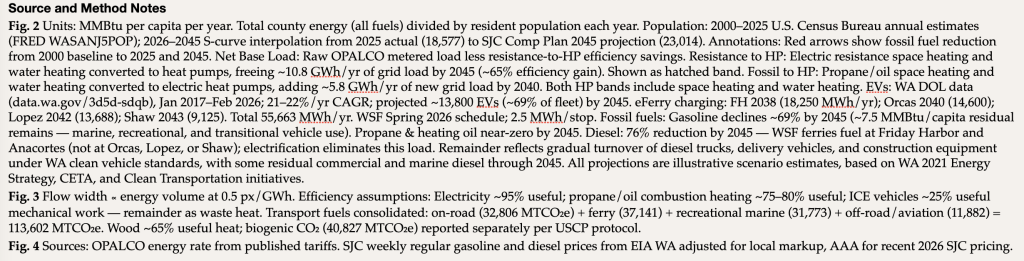
But something has been shifting here, quietly, over the past 25 years. We have collectively reduced our personal share of fossil fuel imports by 34%. We have become more efficient. And we are on a path to an 84% reduction by 2045 — mirroring Washington’s goal of net-zero emissions by 2050.
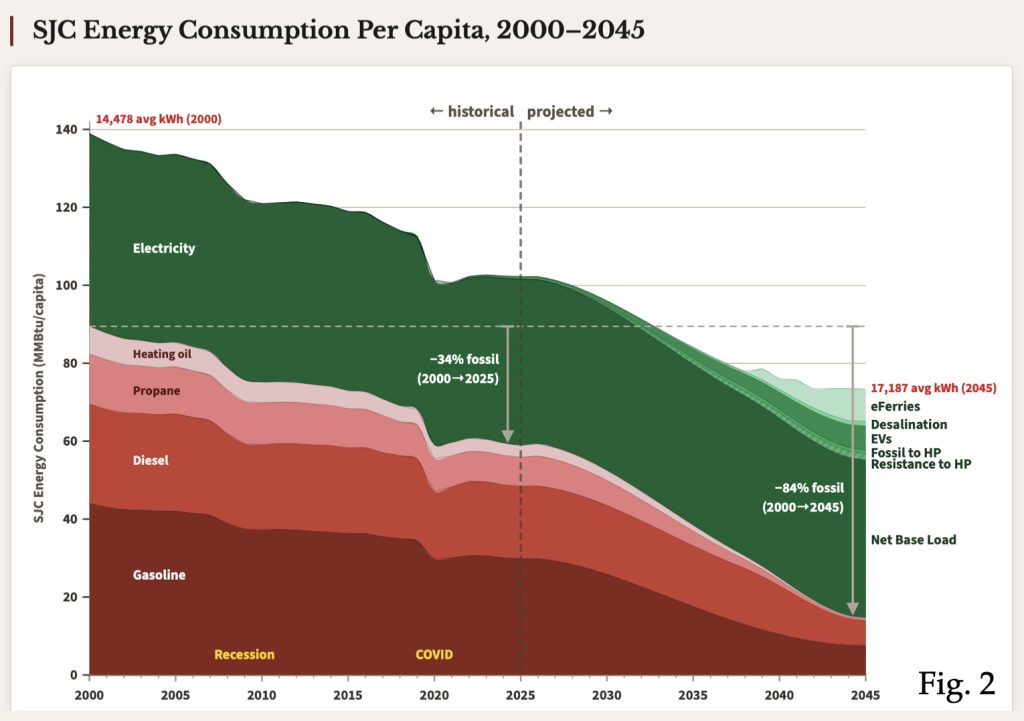
The trend is visible and consistent. Propane, heating oil, gasoline and diesel are giving way to heat pumps and electric vehicles (EVs) that are three to four times more efficient. San Juan County now has the highest per capita EV market share in Washington State. Walking, bicycling, and staycations are on the rise too.
Less fossil fuel imported per person means less pollution emitted. The county’s overall energy mix has been steadily decarbonizing — through a series of individual household decisions that, in aggregate, add up to a substantial reduction in fossil fuel pollution and greenhouse gas emissions per person.
The Cost of Fossil Fuel is Deep and Wide
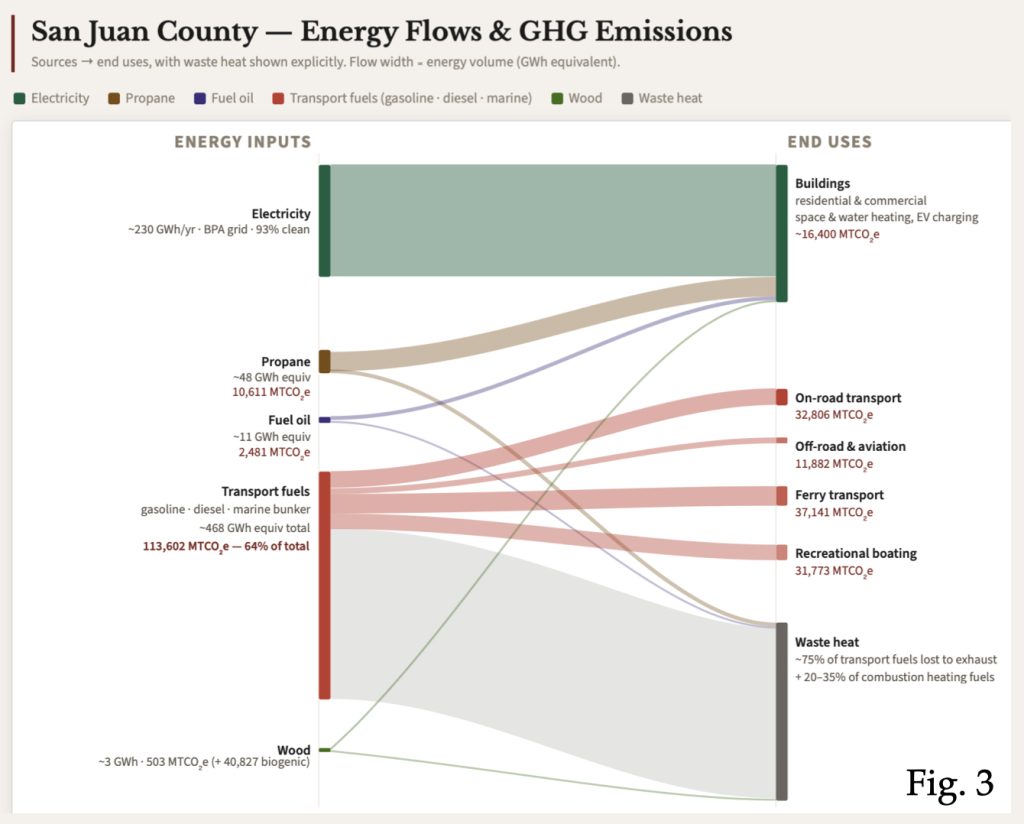
Fossil fuels account for 77% of county energy imports, and 88% of that goes to fuel transportation. Most of that fossil transportation energy ends up as waste heat.
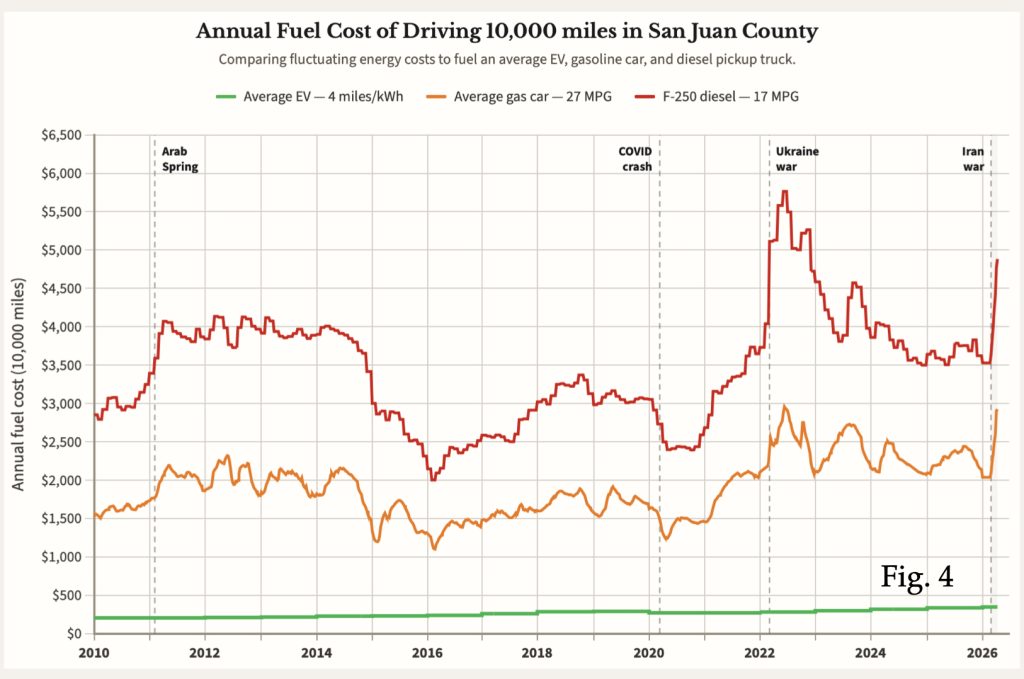
As the transportation fuel cost chart below shows, it’s been a bumpy ride. Fossil fuel prices, especially diesel, are spiking — driving nations to prioritize production of electric motorbikes, cars, and trucks, particularly in India and Southeast Asia, which are especially dependent on oil flowing through the Strait of Hormuz. Our county is not immune, as the recent price spike in diesel and gasoline shows.
But our fossil fuel dependence has a price that runs deeper than what we see locally.
The federal government currently provides at least $35 billion per year in direct fiscal subsidies to oil, gas, and coal. These subsidies were already substantial before 2025, when the One Big Beautiful Bill Act added nearly $4 billion in new annual fossil fuel support on top of roughly $31 billion in preexisting commitments.
In 2023, the International Monetary Fund estimated the total implicit subsidy — reflecting the hidden societal cost of fossil fuels: premature deaths from air pollution, health care costs from respiratory disease, and mounting climate damages. Economists debate the precise valuation, but the direction is not in dispute.
Spread across roughly 130 million American households, that combined burden works out to approximately $5,800 per household per year — a hidden tax that never appears on any invoice, but is paid through insurance premiums, medical bills, disaster recovery, and foregone public investment.
Now add the US taxpayer’s share of a war in Iran costing an estimated $1 billion per day — the lives lost on all sides, the collateral damage to families and cities, the refugees, and the bitter irony of warships, aircraft, and burning infrastructure pouring more carbon into the same atmosphere we are trying to save.
And beyond the money lies the environmental toll. The Salish Sea and surrounding oceans have absorbed 93% of global warming’s accumulated heat, while fossil fuel pollution acidifies the water, imperiling shellfish, coral and the ocean food chain.
The Iran oil shock is one of the most powerful accelerants the renewable energy transition has ever had.
The same asymmetry that makes fossil fuels so vulnerable is what makes the renewable energy transition so unstoppable — small actions, compounding.
Next week, we look at some of the community hurdles ahead in this marathon — who is running, who is being left behind, and what that means for our island community.
Earthrise: A Climate Action Journal
This climate action journal offers information and actions we can take together, locally and globally, as we care for this precious Earth.
“The best way to heal a living system, is to connect it with more parts of itself.” ~ Margaret Wheatley
If you like what you read here, pass it forward to a few friends and ask them to do the same. Like a pebble tossed in a pond, the rings emanate outward, reflecting and growing exponentially. “Going exponential” is what it will take to reverse the climate extremes that are accelerating around us.
Thank you…
+ Get an alert when there’s a new Earthrise post: Notify Me!
+ Previous Earthrise posts:
• First Light • Robert Dash – photographer, educator, environmentalist • Extreme Rain • A Poem for the Snow Leopard •
• How the Chinese spy balloon can inspire climate action • Tidal energy in the Salish Sea •
• The biggest source of county greenhouse gas pollution • The future of clean transportation in island communities •
• Healing Nature •
Notes
In a World on Fire, Stop Burning Things
Washington 2021 Energy Strategy
Washington Clean Energy Transformation Act (CETA)
Washington Clean Transportation
Transportation Electrification Strategy (TES)
San Juan County 2025 Comprehensive Plan
Fossil Fuel Subsidies Surged to Record $7 Trillion
U.S. Spending Bill to Grant $40 Billion in Fossil Fuel Subsidies
Escape route from Iran energy shock leads to China
Chinese Solar Exports Doubled in a Month During the Iran War
Chinese solar exports soared to record levels in March, according to data from the Chinese customs authority compiled by the research group Ember. China’s monthly exports doubled over the previous month, Ember found, and were roughly equivalent to the entire solar capacity of Spain. Fifty countries, many in Asia and Africa, set records for purchases of Chinese solar equipment.
The spike was driven in part by a looming price increase for Chinese exports, Reuters reported, but the market is also getting a boost from the energy shock radiating outward from the Strait of Hormuz. High oil and gas prices are pushing some governments to accelerate their plans to install renewable power sources.
This is not the only indication that the war is driving people toward energy alternatives. In Europe, some rooftop solar companies have seen demand double since late February. E.V. sales in Europe rose by a third in the first quarter of this year compared with the same period in 2025. — NY Times

**If you are reading theOrcasonian for free, thank your fellow islanders. If you would like to support theOrcasonian CLICK HERE to set your modestly-priced, voluntary subscription. Otherwise, no worries; we’re happy to share with you.**






Thank you Jay for this very insightful and rigorous analysis. I have been reading a lot about what is going on in Asia and the countries that already shifted to renewable energy, Those countries have not been as impacted by the war, whereas those that haven’t shifted were telling people to stay home one day a week and shutting down universities. I expect to see significant shifts in Asia (already happening in Europe). We should also see advances relatively quickly because bringing renewable energy on-line is significantly faster than fossil fuel production. The US will just be left behind – but not in SJ County!
Thank you Jay.
“The Iran oil shock is, paradoxically, one of the most powerful accelerants the renewable energy transition has ever had.”
I find great irony in the fact that our willful transition from fossil fuels to EV is one spurred by lifestyle and economy, not by a desire to save the planet… it being the result of war, and lest we forget– war for resources. War, the largest tax-payer subsidized and number one fossil fuel polluter in the world.
When pondering the ludicrousness of it all I’m reminded of Elisabeth Robson’s recent introduction of Christine Webb’s The Arrogant Ape: The Myth of Human Exceptionalism and Why It Matters, by Christine Webb, ” when she states–
“What if cooperation were the means by which evolutionary ‘success’ was measured and achieved, or qualities like longevity, resilience, and the ability to sustain thriving “interspecies communities?”
“The result is a peculiar kind of circular logic. We define “success” in ways that favor ourselves. Intelligence becomes the ability to build complex tools. Achievement becomes the ability to dominate landscapes, extract resources, and expand our influence. By these metrics, of course, humans appear unrivaled.”
“The book asks the question: what if those metrics are precisely the wrong ones?”
“The very traits we celebrate—limitless growth, extraction, technological amplification of power—are now destabilizing the ecological systems that sustain life. A species that undermines the conditions of its own survival might not be the pinnacle of evolution at all. It might instead represent a kind of ecological anomaly.”
One element essential to modern life we get from natural gas extraction is helium. It’s used in all kinds of industrial applications and manufacturing, including MRI machines, fiber optics, semiconductors (use about 25% of global supply of helium), welding, as a “lifting” gas, etc. We get our helium from underground when we extract natural gas (fossil fuel) because once in the atmosphere it easily escapes into space because it is so light.
Electric grids, “smart” grids, energy storage, EVs, etc. all rely on semiconductors. No helium, no electronics. No natural gas extraction, no helium (at least, not right now). Refining helium requires significant amounts of energy. It’s also worth noting that, like natural gas and quartz for silicon, etc., helium is “non-renewable”, meaning we are drawing down Earth’s reserves that will not be replaced on human time-scales. According to this source (https://j2sourcing.com/blog/helium-crisis-semiconductor-manufacturing-electronic-components-2026/), helium use is expected to rise for semiconductor manufacturing 5x by 2035.
About 1/3 of the global supply of helium is from Qatar, behind the Strait of Hormuz. Another third comes from the US (again, from natural gas extraction). South Korea and Taiwan, two of the largest manufacturing sites for semiconductors, get the majority of their helium from Qatar. Or, they did.
Natural gas => helium => semiconductors => electrical grids, EVs, etc.
Thanks, MJ. and Liz. You highlight two essential questions:
• “What if cooperation were the means by which evolutionary success was measured?”
• “What if those metrics are precisely the wrong ones?”
They make me think of Joseph Stiglitz’s thoughts on how we tend to grow what we measure. Like a garden, we have a choice about what we grow. Are there ways we can grow our economy that restore abundance rather than consume it — and what would we have to start measuring to get there?
http://8020vision.com/2009/06/22/nobel-laureate-joseph-stiglitz-on-sustainability-and-growth/
Human exceptionalism–what I usually call human supremacy–as described in The Arrogant Ape and my recent review of the book, is the pervasive cultural story that we are somehow different from all other species; that overshoot and collapse can’t and won’t happen to us; that we can somehow violate the laws of physics and nature because we’re just that smart. It is, of course, a load of bunk. But almost everyone in the world is a human supremacist.
The widespread belief in “green growth” (“grow our economy in ways that restore abundance”) is an expression of human supremacy and serves a psychological function: to allow people to believe that we can
* maintain our modern lifestyles
* avoid large sacrifices
* restore nature simultaneously
It treats the economy as if it is separate from nature. But the economy is part of the biosphere; it utterly depends on the biosphere.
Energy & materials use and economic output move in lockstep. Efficiency has improved but not broken this link. In fact, efficiency often increases the use of energy and materials by making things cheaper (the rebound effect).
The economy is a dissipative system that consumes energy and materials to maintain complexity: to run cities, maintain infrastructure, transport goods, produce food, operate networks, etc. Without energy and materials, it fails (as the closure of the Strait of Hormuz demonstrates so vividly) and eventually collapses.
The abundance agenda (just “green growth” repackaged with new words) sounds great but is energy blind, materials blind, and overshoot blind. A growing economy requires building more of everything, which still requires more energy, mining, land use, and materials, all of which is rapidly drawing down the natural communities of the world and fraying the web of life.
So-called “renewables” and batteries use the same raw materials and rely on the same processes as the fossil fuel economy. No oil, no “green energy” either. Pretending that solar panels and EVs just appear out of nowhere as if they grow on trees won’t make it otherwise.
If we could pretend our way out of this predicament, wouldn’t that be nice?! I understand why people have this fantasy–it’s incredibly alluring. Of all the species, humans do seem uniquely susceptible to fantasy. Perhaps *that* is what makes our species different from all the rest.
So, to answer your question: No. In my opinion, there are no ways to “grow the economy” while “restoring nature”. That is the predicament.
Lest people think I’m making up the massive fossil fuel requirements for renewables and EVs and batteries and so on, let me provide just one more example. (I’ve given plenty before, including helium, above, extracted from natural gas and required to make semiconductors. The typical car contains 1,000-3,000 semiconductors, with EVs usually having the most.)
Graphite is the main ingredient in Lithium ion batteries that we use in devices from phones to EVs and battery energy storage systems (BESS), etc.
While natural graphite can be mined (using lots of diesel!), the vast majority of ultra pure graphite needed for batteries is synthesized from a small amount of natural graphite and a large amount of petroleum coke. Petroleum coke (“pet coke”) is basically baked oil. It is made in furnaces at temperatures exceeding 3000°C that must run continuously (i.e. using fossil fuels).
Along with using pet coke to make synthetic graphite for batteries, it’s used in making things like electrodes for electric arc furnaces (used in making steel from recycled steel), aluminum (a key metal for EVs and solar panel frames), high purity silicon (for things like semiconductors and solar panels), and burned in cement kilns (imagine the massive cement bases of land-based wind turbines, for instance), etc.
To run our modern economy, there is no escape from fossil fuels, and so-called “renewables” are utterly dependent on them, just like almost everything else we make and do.
Thanks, Liz. “To run our modern economy, there is no escape from fossil fuels…” To that point, a good friend shared this timely video by the wonderful Nate Hagens, that highlights the embedded ubiquitous presence of oil in most everything, with vivid deep dives into food.
https://www.youtube.com/watch?v=_kEwDNlNwF0
We are slowly moving from a linear system of infinite extraction to a more circular system of durable regeneration. We aren’t just changing the fuel; we’re changing our fundamental relationship with Earth’s materials—moving from a model where we burn what we take, to one where we build, use, and eventually recycle. It will take fossil sources, but with less burn.
Ultimately, this shift allows us to reduce the ‘infinite burn’ and move toward what E.F. Schumacher called for: stopping the treatment of the Earth’s finite resources as expendable income, and instead building at a scale that converges on a cleaner, more sustainable future for all.
Thank you for the links… I found the Stiglitz piece to be fascinating.
“What if those metrics are precisely the wrong ones?”
I think when it comes to our utilization of metrics that this is just hitting the tip of the iceberg… that is, in my reading on everything from economics, environmentalism, foreign policy, tourism, growth, the hazards related to nuclear energy, etc., etc., etc., that public perception is shaped by and decisions are being made that are fundamentally based on the wrong criteria (metrics), and are promoted through a relentless stream of misinformation and manufactured consent that is fed to us by mainstream media.
“The opposite for courage is not cowardice, it is conformity. Even a dead fish can go with the flow.” Jim Hightower.
“It is no measure of health to be well adjusted to a profoundly sick society” Krishnamurti
“Capitalism survives by forcing the majority whom it exploits to define their interests as narrowly as possible. This once was achieved by extensive deprivations. Today in the developed countries it is achieved by imposing a false standard of what is and what is not desirable.” John Berger