

“What if cooperation were the means by which evolutionary ‘success’ was measured and achieved, or qualities like longevity, resilience, and the ability to sustain thriving interspecies communities?”
||| A BOOK REVIEW by ELISABETH ROBSON |||
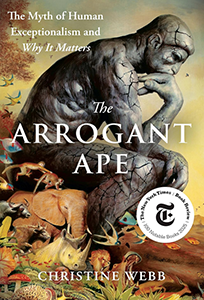
One of the implicit assumptions embedded in modern culture is that humans are the most successful species on Earth. We rarely say this outright, but the belief sits just beneath the surface of our stories about progress, intelligence, and civilization. Our cities, technologies, and global reach appear to confirm it.
In The Arrogant Ape, Christine Webb challenges that assumption directly. The book explores how humans came to see themselves as separate from, and superior to, the rest of life. Webb traces this belief to a long tradition of dualistic thinking: mind separated from body, humanity separated from nature, culture separated from ecology. Once this split is accepted, it becomes easy to place humans above the rest of the living world rather than within it.
The result is a peculiar kind of circular logic. We define “success” in ways that favor ourselves. Intelligence becomes the ability to build complex tools. Achievement becomes the ability to dominate landscapes, extract resources, and expand our influence. By these metrics, of course, humans appear unrivaled.
The book asks the question: what if those metrics are precisely the wrong ones?
The very traits we celebrate—limitless growth, extraction, technological amplification of power—are now destabilizing the ecological systems that sustain life. A species that undermines the conditions of its own survival might not be the pinnacle of evolution at all. It might instead represent a kind of ecological anomaly.
Webb invites readers to consider a different way of measuring success in the living world. All species aside from our own participate in ecosystems rather than dominate them. Their success lies in persistence, balance, and reciprocity within communities of life that can endure for thousands or millions of years.
By that measure, coral reefs, forests, and soil microbiomes are extraordinary achievements of evolution: vast cooperative systems that sustain countless forms of life. Compared with these, our current human civilization begins to look less like the culmination of nature and more like a brief and unstable experiment; one that, like all civilizations before it, will eventually collapse under the weight of its own ecological demands.
The strength of The Arrogant Ape lies in how it gently dismantles the intellectual scaffolding that supports human exceptionalism. By exposing the assumptions behind our worldview, Webb shows that the idea of human supremacy is not an objective conclusion but a cultural story we have told ourselves.
Consider how narrow our measures of excellence really are. The living world is full of capacities that far exceed our own. Eagles and hawks see with a clarity that makes our eyesight seem dim by comparison. Migrating birds navigate across entire oceans using magnetic fields we cannot perceive. Octopuses solve complex problems with distributed nervous systems unlike anything in human biology. Trees communicate through underground fungal networks, sharing nutrients and chemical signals across forests. Even the smallest soil microbes cooperate in astonishingly complex communities that make terrestrial life possible. By almost any measure other than the ones we invented for ourselves, humans are not the champions of the living world but simply one participant among many remarkable forms of life. Webb’s book is filled with fascinating tales of animals and plants who can do things we can barely imagine and cooperate in ways we usually do not notice.
The same logic appears in the excitement surrounding missions like NASA’s Artemis II, widely celebrated as another triumph of human ingenuity. To send a handful of people briefly beyond Earth’s orbit is undoubtedly a remarkable engineering feat, yet the cultural meaning we attach to it reveals our assumptions. We speak as if leaving Earth demonstrates our transcendence of nature, proof that humans are destined to expand beyond the planet that evolved us. In reality, the opposite is true. Every human who ventures into space must carry with them an elaborate life-support system—air, water, food, temperature control—because our bodies remain completely dependent on the conditions of Earth. Space travel does not free us from our animal nature; it highlights how utterly bound we are to the thin ecological envelope that sustains life here. To treat such excursions as the pinnacle of success is simply another example of measuring achievement by the wrong metrics.
After dismantling the story of human supremacy, Webb invites us to adopt a different posture toward the living world; one grounded not in dominance but in humility. Humans are neither masters of the planet nor aliens dropped onto it. We are one species among many, embedded in networks of life far older and more complex than we can possibly conceive of.
Webb suggests that abandoning the myth of human supremacy could allow us to relearn how to live within the wider community of life. It is a hopeful vision, one rooted in reciprocity rather than conquest.
Yet the trajectory of modern civilization raises a harder question: whether a global system built on expansion, extraction, and perpetual growth can truly transform itself before the limits of the planet impose their own correction. Human history is essentially the story of civilizations that fell because they mistook temporary dominance for lasting success.
Humility may be the lesson our species most needs to learn. It is possible, perhaps likely, that we will never recognize the wisdom of that lesson even as our final, global civilization built on the opposite assumption unravels.

**If you are reading theOrcasonian for free, thank your fellow islanders. If you would like to support theOrcasonian CLICK HERE to set your modestly-priced, voluntary subscription. Otherwise, no worries; we’re happy to share with you.**






Leave A Comment