||| FROM DOUGLAS MARSHALL |||
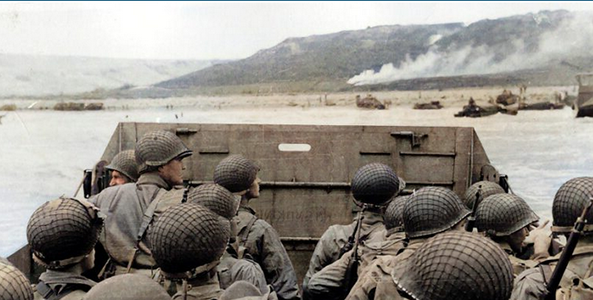
Before dawn, a seasick 22-year-old 2nd Lieutenant and his mortar platoon climbed into their landing craft and motored three hours toward the French province of Normandy, on a day code-named D-Day and toward a place code-named Utah Beach. Approaching the shore, the ramps of their landing craft dropped into the cold waters, and they waded into eleven months of combat with the German army which had occupied France for four years.
Utah was the westernmost of the five beachheads which were captured on D-day by US, British, Canadian, and Free French armies. The Utah assault was led by the 21,000 soldiers of the 4th Infantry Division, which suffered only 197 casualties that day. Their movements on shore were coordinated by the division’s assistant commander, 56-year-old Brigadier General Theodore Roosevelt, Jr. — the son of one President and a distant cousin of the then-serving President. The oldest American soldier to go ashore that morning and the only General, he had insisted on leading the first group. Roosevelt brought with him one of the 17 Commanche “code talkers” who handled radio communications among the Division commanders. “Landed at wrong place but are adjusting.” If German intelligence heard their transmissions, they could not understand a word.
Most of these soldiers had no combat experience before D-Day, but they were motivated. About half, including my dad, were farm kids who knew that when things break, you just find a way to fix them. They created a safer way through the dangerous hedgerows of Normandy by welding makeshift plows to their Sherman tanks.
The 2nd Lieutenant who would become my father served in the 8 th Infantry Regiment, the first of the 4th Infantry Division’s regiments to land. They were to secure the beachhead so that thousands of men right behind them could land safely, and then move inland to link up with the 82nd and 101st Airborne Divisions, who had parachuted and glided in during the night. Both missions were largely accomplished by mid-day.
That afternoon, the 4th Division began fighting its way north toward the port city of Cherbourg. The vibrant American economy had sent many shiploads of men and equipment to England. They could easily get to France via the docks at Cherbourg, which was captured on D-Day plus 19. That night, dad could finally write to his bride of eight months, describing his landing and seeing boats and landing craft everywhere he looked. Then, he found a real bed for the first time in France.
Years later, a delightful French woman from that part of Normandy recalled to me her village’s excitement when the Americans arrived. She posted a map of the US on the front of her house. Soldiers came over to it, kissed their fingers, and placed the kiss on their home city.
By late July, they were strong enough to break out of Normandy through the German defenses. In those days, US armies were racially segregated. By August, white troops were advancing 50 miles per day toward Paris, while supply trucks driven by black soldiers kept them going. A long, 24/7 round trip supply chain followed one road system eastward with deliveries, then took another route westward back to Normandy to reload. Secrecy required driving at night without headlights — very dangerous as the days of summer faded into fall.
In 1947 France marked the route from Utah Beach to Cherbourg, then to Paris and on to Belgium. In 1997 I drove a rural tree-lined road which dad’s regiment had taken into Paris, gratified to see concrete road markers reading “La Rue de la Liberté” – Liberty Road.
The 4th Infantry was the first American division into Paris, greeted by jubilant crowds that we can see from newsreels from that day. They camped overnight in a Paris park, then headed Northeast. One element of the 4th became the first American soldiers to enter Germany. They encountered very difficult fighting in the Hurtgen Forest of Germany, then supported the Battle of the Bulge in Belgium before moving into Germany. Their war ended on May 8, 1945.
Unlike dad’s brother-in-law, who volunteered his war stories, my father seldom talked about his experiences. Mom explained that he had nightmares for many years. Even after dad pinned 2nd Lieutenant’s bars on my uniform when I was commissioned, he never really opened up to me. Long after he died, my brother found three citations documenting why the Army awarded him two Bronze Stars and a Purple Heart. We were surprised!
Like many WWII veterans, dad had returned home and looked to the future. He used the GI Bill to get his Masters’ degree and focused on his family and his career. Longtime NBC anchor Tom Brokaw wrote a book about “The Greatest Generation” – not just those in uniform, but also those like dad’s brother who worked in the Bremerton shipyards, and like my mom who worked for the War Department in New York. They sacrificed for our generation, helped us get good educations, and passed along their values.
My first political memory is from age 6, being awakened on the morning after the 1952 election: “Ike won!,” dad shouted. General Eisenhower had been Supreme Commander of the D-Day armies, and later the first commander of NATO. “Ike”, as his troops called him, would be our next President. Every President since WWII (whether R or D) has believed that the US benefits from NATO and similar alliances around the world – every President except DJT.
My parents voted for “moderate Republicans” like Dan Evans, who as a state legislator and then as our Governor helped expand public schools and universities for us Baby Boomers. They voted for school levies. They supported Catherine May, who voted for our state Civil Rights Act in 1956 while representing Yakima in our State Legislature, and who then as our congressman voted for the Federal Civil Rights Act of 1964. A friend of Dad’s was a longtime Republican state legislator. I knew his son, Dan Newhouse, when we were kids and later when he was our State Director of Agriculture under a Democrat governor. In 2021, Dan was one of 10 Republican Congressmen who voted to impeach DJT.
So, I inherited such political values as developing international alliances to extend our economic and military influence; balancing budgets rather than borrowing against the future; and supporting others who are different from us. I remember Dad relaying conversations with soldiers who had liberated concentration camps in Germany. “Don’t let anyone tell you that never happened,” he warned. Upon becoming a lawyer I again swore the oath to uphold and defend the Constitution and all that it guarantees. Sadly, those guarantees are being whittled down!
Our country’s stature seems to be declining. The world is dismayed by the unpredictability of US policies, the childish and disrespectful insults, the chaotic use of tariffs, and the bullying. Nobody likes to be bullied! Historical allies like Europe, Canada, and Japan concluded they can no longer count on the US, so they strengthen trade and military relationships with others, rather than with us. What would the “Greatest Generation” think about what we have done with their legacy? I think about the unfortunate soldiers who ended the war in American cemeteries – were they “suckers” as someone suggested? I say “heroes”!
I believe their legacy helped several generations grow up in what became – despite all our faults — the world’s strongest and most respected country. It’s a legacy of values we should honor, help perfect, and pass on to future generations.

**If you are reading theOrcasonian for free, thank your fellow islanders. If you would like to support theOrcasonian CLICK HERE to set your modestly-priced, voluntary subscription. Otherwise, no worries; we’re happy to share with you.**







Thank You. Nicely written account and sentiment. Needed to add more words to be long enough.
Thank you Doug, for reminding us that today is D-Day, and why it has significant meaning within our country’s history. I appreciate learning about your father’s involvement in that critical military action, for including the details you wrote to put the times and people into context, and for including how you and your family have also served to preserve the liberties that we have enjoyed. Your father was indeed a hero, as were so many then.
Your boyhood friend, Dan Newhouse, will soon be retiring from office. He is to be admired as a WA State Representative who has exemplified high ethical standards and dedication to helping the needs of his constituents.
YES to all that you express about what is happening to our country today. I certainly share your concern about the legacy this generation will pass on. Remembering, learning about, and understanding our hard fought history is one positive way to help ensure that the most honorable values will be carried on.
Doug, thank you for that reminder of what America once stood for and the sacrifices that were made. That time now seems long ago and far away; and the story of the Allied victory has paved the way for American economic and military hegemony worldwide.
You and I are of the Viet Nam generation. It’s worth noting on this D-Day anniversary, that, since the end of WWII, the United States has engaged in over 20 military coups and international armed conflicts, most of them undeclared and unauthorized by Congress, as required by our Constitution, at a cost, according to https://www.warcosts.org/, of $4.8 trillion and 940,000 lives lost just since 9/11. Those are human and economic costs we continue to pay forward as our national debt continues to grow. Our current undeclared war on Iran and continued support of Israeli aggression involves the entire middle east and, as the remote drone war continues, only increases the risk of further escalation. The American Empire has reached its tipping point, both economically and morally, and the dream of post-WWII prosperity and moral superiority has long faded. It’s high time to return to being a nation that is governed by a democratic Constitution and that wages peace.
Hi, Brian . . . good to hear from you. Your cautions are right on. It’s one thing to build alliances and stronger economies, it’s quite another thing to use that power wisely. Over the years, we have had difficulty with that second step.
We can only borrow so much without adverse consequences. The tendency over the past quarter century or so to “just spend the money for whatever we want” has been slowly undermining our economic stability. I join you in blaming a Congress that ignores Constitutional checks and balances. But I blame even more those of us voters who are so focused on our personal economics that we ask Congress to spend on the things we want, but then ask Congress not to raise our taxes to finance those things.
It’s remarkable, i.e., worthy of remark, how similar our concerns and fears are regardless of perspective. Nobody likes a bully and there’s plenty of that in contemporary politics as well as foreign relations, but we’ve reached a point where hitting folks forcefully with a 2”x4” appears to be the only way to deliver a message.
For far too long “moderate Republicans” were pushover patsies enduring demonization by the left for the sake of civility – think John McCain.
For far too long our “Allies” shirked their fair share of cost and responsibility – think DeGaulle, making France “great again” and the paucity of NATO.
For far too long we extended “most favored nation” trade deals to friend and foe alike in an effort to create an “equitable” world – think Canada imposing near 400% tariff on Wisconsin butter.
For far too long Americans have asked “what can my country do for me,” how can I get my “fair share” – think “learing centers” and hospice care scams exposed throughout the country.
For far too long NGO’s have been siphoning off the life blood of our nation with kickbacks to political partners – think Southern Poverty Law Center subsidizing the Klan and the Nazi’s.
My friends, the United States of America is insolvent as we speak. FDR once said “I will try something, and if it doesn’t’t work I’ll try something else and I’ll keep trying until I find something that works.” He led our parents through the privations of the Great Depression and savagery of the Second World War, changing course as necessary. Yes policies may need to be nimbly changed.
Indeed what would our parents think of what we have squandered – think JFK “and so my fellow Americans ask NOT what your country can do for you, ask what you can do for your county”
Love him or hate him Donald John Trump was democratically elected in 2024 for the second time as president of this nation, by popular vote and the electoral collage despite an avalanche of bullying and harassment from the left including false legal charges a raid on his home under an unconstitutional “general warrant” and being shot in the head. Yes he may be uncouth, brusque and undiplomatic. But he may well be the blunt instrument we need for our nation and our central virtue of liberty to survive, much less be great again.
One thing is for certain, the. Left has nothing to offer.