
I’m so confused
||| I’M NOT THE CHURCH LADY by ROSIE KUHN |||
Hello. Thank you for your call. Your prayers are important to us. Press 1 for Jesus, Press 2 for your Guardian Angel, Press 3 for prosperity and abundance, Press 4 for issues with people, pets and lost items…. For all other inquiries, please stay on the line. Your prayers are being listened to.

Even after all these years, I’m still confused when it comes to who I need to pray to. I suspect that almost everyone has had that experience of wondering, who am I talking to? Like calling my bank. I don’t need to speak to the bank president or the manager. I just need someone who can give me an answer or take action on my behalf. How do I know who that is?
In Catholic school, I was taught to not bother Jesus and God with my prayers—they were too busy. So that left angels, saints, and the Holy Spirit—which I never understood what that was. But I gave it my best shot.
I learned as a child to pray for what I wanted—other wise known as supplication. “Please help! Please give me… Please make me… Please take away… It’s kind of like a relationship with my dad. I only called him when I wanted something. He’d always answer, “What can I do for you?”
Over time, I began noticing something. Praying to get what I wanted, when I wanted it, wasn’t really helping to change me or grow me. Whether my prayers were answered or not, I remained organized around needing and getting. Not a very empowering position. And honestly, these prayers never worked.
Researching, studying and yes, praying for assistance in trying to figure out who I should be prayeing to, I eventually noticed something surprising. No matter who I addressed my prayers to, I was almost always asking for the same thing: fix this, give me that, make this different. The recipient kept changing. The relationship didn’t.
I’ve spent years wondering who’s on the other end of the conversation. What if the more revealing question is: Who’s on this end? What if who I pray to isn’t nearly as important as how I pray? In other words, Who am I while I’m praying?
Question after question arose—each one creating an expanded opening: What do I get when I enter a relationship based solely on needing and wanting—wanting what I want, wanting it my way, on my time? How did it come about that I only enter relationships beginning with needing something? Did I decide every relationship had to begin with needing something? What would it be like to be me in relationship with God, with life and with people, without needing anything?
Prayer as Conversation
All in all, for the majority of my life, prayer wasn’t very useful. I didn’t feel heard. But then again, I was asking for what I thought I needed and wanted. Maybe whoever was on the other end of my prayers was waiting for me to show up differently—open to a different quality of relationship.
What kind of relationship does prayer create?
I practiced so may forms of prayer. There’s prayer as transaction: Please give me… Please make… Please fix…
Then there’s prayer as conversation. Hey, God. It’s me, Rosie! How’s it going? It’s nice hanging with you.
There are prayers as participation or companionship: We are in this together—whatever this is! I pray to connect, to experience unity and connection. In the practice of prayer, I acknowledge that I’m not alone—I’m in relationship with someone or something, even though I may not understand what that is.
Through various indigenous practices, I experienced prayer in a way that I’d not been exposed to before. Prayer was more like a conversation. It was an opening up to hearing and seeing differently. It wasn’t about fixing or changing anything. It was like having a healthy relationship where everyone is seen heard and gotten, in love, appreciation, honor and respect. Man! That was foreign to me!!!
At first it was awkward. Again, like learning to talk with my dad without asking for anything, especially when he’d say, “So what can I do for you?”
I spent much of this life recovering the capacity to be in relationship without performing, earning, pleasing, fixing, or needing or placating. Praying has eventually become part of this same recovery process. Because, if I listen to what I’m praying for, I can see where I’m at, and if where I’m at is where I want to be.
What kind of relationship am I creating when I pray? What kind of relationship is prayer inviting me into? Prayer has been teaching me how to relate all along? And, I get curious: How am I being in relationship with the relationship itself.
Can I be in relationship, without attachment to the outcome. Am I willing to remain with what is emerging rather than forcing what should emerge? Can I sit in patience, not fixing, healing, getting, needing, no persuading?
To greater degrees, I’m able to preserve in my prayers my own authority. I can reflect, question, notice patterns, or offer possibilities. What I experience here is a space where my own listening becomes easier.
Prayer gives me room for listening to occur and to unfold. It’s becoming less about asking for things and more about noticing what shows up when I become available to the conversation. Just listening, just being present, then welcoming what arrives. I think this kind of prayer makes this kind of listening easier to inhabit. And to my amazement I’m becoming increasingly hospitable to mystery, wonder and awe.
The most interesting conversations almost never end where they begin.
I started this piece asking: “Who’s listening?” I’ve come to: “What does prayer reveal about my attachments to what I’m afraid to lose? What is it I want so I don’t have to let go of what I want to hold on to?
When I’m praying, “Please make them change…” perhaps I’m living in powerlessness, or fear of losing control, or fear of change itself.
When I’m praying, “Please don’t let this happen…” perhaps I’m living in fear.
When I’m praying, “Thank you…” perhaps I’m inhabiting gratitude.
When I’m praying, “Hey! How’s it going? I’m listening.” I’ve entered an entirely different relationship. This feels more like sitting beside a river, with someone I don’t know. Together we are watching whatever floats by, occasionally pointing and saying, “Did you see that?” Sometimes it’s a profound insight. Sometimes it’s just life being life.
More often now, my prayers are just this: “I;m here. I’m listening. Let’s see what wants to introduce itself. Will I stay patient long enough for something true to arrive? Can I be with myself in the presence of Mystery without demanding an answer even when it’s uncomfortable?
Without needing certainty? Without rushing to the next insight? Just…remaining in the conversation.”
That may be the simplest description of prayer: The willingness to remain present in relationship with what is ultimately unknowable.
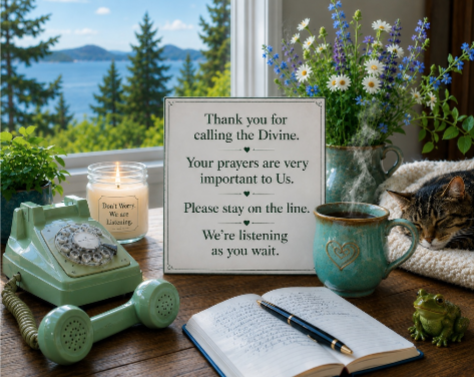
“Prayer is no longer a request for certainty. It’s the willingness to remain in relationship—even, and perhaps especially, while waiting.”

**If you are reading theOrcasonian for free, thank your fellow islanders. If you would like to support theOrcasonian CLICK HERE to set your modestly-priced, voluntary subscription. Otherwise, no worries; we’re happy to share with you.**