What if the most sane and sacred thing I can do is trust what I know?
||| I’M NOT THE CHURCH LADY by ROSIE KUHN |||
Psychology, at its best, says: What happened to you shapes you—how can you go forward? Spirituality, at its best, asks: Who are you beyond that? Both can become systems that tell us what we should experience instead of helping us articulate what we actually experience.
Families—No Escape
With the insanity of the world in which I was raised—the 1950s, post-war America, alcoholism, narcissism, and conservative Catholicism—I found myself caught in an entanglement from which I could not escape.
I was told what to believe, what to think, what to want, and who to be. Rarely was I asked what I believed, what I thought, or what was true to me. To survive, I learned to suppress my own knowing—my thoughts, feelings, needs, desires, and unique expression. Conforming to the world around me felt like the only sane choice.
Religion offered a similar dilemma. I was devoted to angels, saints, Jesus, and God. I longed for a direct connection with something spiritual. Yet despite my devotion, my praying, I do not recall a single moment within which the Sacred was communicating with me. Worthiness seemed to be the currency of the spiritual world, and my inability to experience connection felt like proof that I lacked it. That was painful.
Something appears to be wrong with me
From a psychological perspective, much can happen to a person when their own knowing is denied. We develop adaptations, defenses, coping strategies, identities, and ways of functioning that help us survive. We all exist somewhere along a continuum of psychological functioning.
Inevitably, our suffering eventually leads many of us to therapy because we’ve become convinced there is something wrong, and the strategies we developed just aren’t working!
Is there another way to look at this?
For me, this pointed to deeper questions: To what degree am I living from what I’ve been told?
To what degree am I living from who I’ve learned I must be, in order to function and to be seen as functional? And to what degree am I willing to trust my own truth and direct experience? For me, this is where the schism begins—not between psychology and spirituality, but between who I learned to be and what I know to be true through my own direct experience.
Psychology vs Spirituality
When we hear “psychology vs spirituality,” we think we know where the conversation is going. It’s going to be a debate about trauma vs transcendence, therapy vs religion, science vs faith. This is where consensus view of reality usually hangs out. This territory is well trodden. We know the arguments. We know the positions. Yet we keep exploring what we already know.
Why? Mostly because, it isn’t threatening or uncertain.
Instead, what if we venture into territory that can feel unbearably intimate? The place where psychology can no longer explain us and spirituality can no longer reassure us. The place where no diagnosis, doctrine, credential, theory, belief system, or spiritual practice can tell us who we are.
This frontier between the two is rarely embraced by priests, ministers, rabbis, sheikhs, monks, psychologists, therapists, psychiatrists, or coaches. Why? Because this territory cannot be taught or explained. It can only be experienced.
Safety precedes curiosity.
As someone credentialed in Psychology, this framework initially gave me a language for understanding what happened to me, how I learned to frame my reality so as be safe in a world of insanity.
As someone also credentialed in Spirituality, this gave me a language for understanding who I am beyond what happened to me.
For years, I thought these were two different conversations. But increasingly, I see that both are pointing toward the same thing: the recovery of trust in my own direct experience.
When I allow myself to be in the experience of me, as opposed to thinking about me, what emerges is not a comparison between psychology and spirituality, but a question about authority—agency, sovereignty of my human-spirit.
Am I experiencing me? And, if I am experiencing me, am I sane? For many of us, this experience of experiencing ourselves takes us out of our comfort zone and we question our reality.
Here’s a perfect example—perhaps.
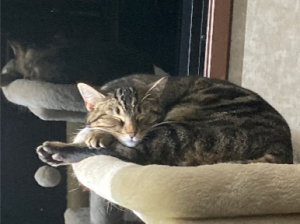
Through the warmer months here on Turtleback Mountain, my three year old cat, Lucy, will go on walk-abouts for sometimes a week at a time.
The first year of experiencing these disappearances took me down into deep trauma. “I must have done something wrong for her to abandon me.” Or, “What did I do that she felt abandoned, so ran away?” I was in deep guilt and shame. Immersion into deeply excruciating grief would go on for days.
From a psychological perspective, there were plenty of ways to explain what I was experiencing—trauma, anxiety, attachment, grief, catastrophizing, hypervigilance. The words may have pointed to something, but they were not helping me live in the experience of these moments.
On the other hand, from a spiritual perspective, these were considered “Dark nights of the soul.” I call them “Spiritual Immersion.”
I practiced letting go of the belief that I did something wrong. I practiced seeing Lucy as a cat who is doing what cats do—hunt, mark territories, explore. I began to say, because I knew the truth of it, that, “Lucy is with God, in God, as God.” This grounded me in a truth that allowed me to say the obvious: I’m not in charge. My cat is being a cat. I am powerless over her catness.
Throughout this period of time, I had to choose to either keep stirring up the psychological insanity, or learn to turn it over to a higher power. Again, these practices pointed me to something that was helpful, however at the same time, they did not minimize the degree of angst and anguish I was, at times, experiencing.
Then, Lucy would arrive unscathed and wondering why I was making such a big fuss about her being home.
Second Year
The second year of Lucy’s “catting around,” as I’ve heard it called, there was less trauma drama. However, it was still there. Of course I worried. Of course, I imagined the worst. But I saw that what was occurring was not just a cat doing cat. What I began to see was me being me—the way I had always been—questioning my worthiness, assuming I had done something wrong, bracing for loss, preparing for the worst.
I witnessed me doing me, as I’d done in the past, questioning my worthiness, wrongness, hopelessness, powerlessness. To greater degrees I was able to stop this pattern—this theme of being. “I’m not that! None of that is true about me. I can see this differently as it is.” That helped. And, there were those moments when all I could do was be in immersed in what felt like an excruciating ache that would be done with me when it was done.
Then, Lucy would arrive, unscathed and wondering why I was making such a fuss about her being home.
This Year
This year, I’m currently within a week of Lucy being Lucy. She’s been out for five nights. Very little trauma. Very little worry. I’m learning to allow the time without her to be good. I’m learning to let go of the guilt of not worrying or thinking about her.
Paul McCartney’s song, Let it Be, brings wisdom. Let it be. Let her be. I’m learning to let go and let God.
It’s All a Big Deal
The repeating of circumstances—regardless of what they may be, provides opportunities for me to explore the frontier of this in between of what is and what isn’t.
Our assumptions, given all the self-help support available to us from both psychological and spiritual perspectives, is that this should be no big deal. Just tell me what to do and how to do it and I’ll get through this.
But I know—through direct experience, that all of it is a big deal. All of it—every single circumstance is an opportunity to experience who we are as we are. They are opportunities to go beyond shoulds and shouldn’ts, right being and wrong being, and just be with what is. For me, with Lucy
The circumstances themselves haven’t changed. Lucy still disappears. My mind still imagines possibilities. Fear still knocks on the door.
What has changed is my capacity to sit in the what isn’t and the what is, long enough.
Long enough for what? Long enough to be comfortable experiencing me in discomfort, in uncertainty, in delight and playfulness, in creative consternation. It’s all me. And, I get to experience me, as me, if I want.
Perhaps this is the frontier between psychology and spirituality—not deciding which one is right, but discovering that neither can live my life for me. Both can offer maps. Neither can replace my direct experience. And perhaps the most sane and sacred thing I can do is trust what I know when the stories finally quiet down enough for me to hear whose here. That is most sane and sacred thing I can do— trust what I experience.
That Lucy is being Lucy. Reality is being reality. And Rosie is learning to let Rosie be Rosie.
Every Sunday morning at 10 AM, pacific time, I’m now hosting a live radio show on KIXP 102.3 FM called I’m Not the Church Lady. The show is a slightly irreverent (and playful) conversation exploring spirituality, everyday life, and the mystery of being human.
If you’re out of reach of the radio signal in Eastsound, WA, you can livestream the show at KIXP.org or listen to the recordings at Dr. Rosie Kuhn on KIXP FM

**If you are reading theOrcasonian for free, thank your fellow islanders. If you would like to support theOrcasonian CLICK HERE to set your modestly-priced, voluntary subscription. Otherwise, no worries; we’re happy to share with you.**