||| FROM CONOR AGNEW for THE WHALE MUSEUM |||
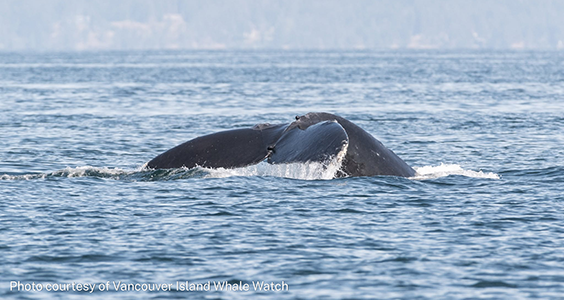
On July 14 2026, Vancouver Island Whale Watch spotted a young humpback whale CRC-22662, known locally as Starry Knight, whose return to the Salish Sea carried unusual significance.
The whale was last seen in the central Strait of Georgia on Sept. 12, 2025, 22 days after being disentangled for the second time that summer by responders from The Whale Museum and Cascadia Research Collective. Starry Knight was carrying significant injuries from the two entanglements.
Humpbacks often return to the same summer feeding grounds each year. As the 2026 feeding season progressed without a confirmed sighting, concern grew about whether the young whale had survived. Researchers noted, however, that Starry Knight had not previously been documented in the region before July 14.
The July 14 sighting this year does not erase the seriousness of Starry Knight’s injuries or the risks posed by future entanglements. It does, however, confirm that the young whale survived the winter and returned to familiar feeding grounds. For the responders, researchers, and whale-watchers who followed the two cases, that return was welcome news.
Studies estimate that only 7% to 10% of whale entanglements are ever detected and reported. Some whales free themselves and later carry scars from entanglements no one witnessed. Others die and are never seen again.
For that reason, responders use each documented case not only as an opportunity to save an individual whale, but also to learn how entanglements occur. They examine where the gear originated, which part of the gear caught the whale and how the entanglement affected the animal. That information can help fishery managers and fishing communities prevent entanglements or at least reduce the risk and severity of future entanglements.
Starry Knight’s two cases have already provided useful information:
In both entanglements, the whale appears to have encountered the gear well below the surface. Both involved trap gear. The first set was probably from a commercial fishery, possibly a crab fishery, although its markings could not be linked to a specific fishery. The second was identified as recreational gear, probably used for prawns.
Information from these cases is shared with state and federal fishery managers. Members of the response network also work with commercial fishers who are exploring changes to gear and fishing practices that could reduce entanglement risk and lessen the harm to whales that do become caught.
THE WHALE MUSEUM: Promoting stewardship of whales and the Salish Sea ecosystem through education and research
PO Box 945 • 62 First Street N • Friday Harbor, WA • 98250
360.378.4710 • www.whalemuseum.org
Starry Knight’s continued survival has been encouraging, and it highlights the need for quick, effective disentanglement responses.
As future funding for this work remains uncertain, please consider making a donation to your local response team, Cascadia Research Collective and The Whale Museum, to help support the Partnership and future entanglement responses.
To report an injured, dead, or stranded marine mammal contact NOAA’s West Coast Stranding Hotline at (866) 767-6114. To report an entangled marine mammal, call NOAA’s Entanglement Reporting Hotline at (877) SOS-WHAL / (877) 767-9425. For other incidents or other violations, contact NOAA’s Enforcement Hotline at (800) 853-1964.

**If you are reading theOrcasonian for free, thank your fellow islanders. If you would like to support theOrcasonian CLICK HERE to set your modestly-priced, voluntary subscription. Otherwise, no worries; we’re happy to share with you.**