EncSummary: Mark left Victoria Harbour on Mike 1 at 0745 to take advantage of what appeared to be ideal conditions to survey the western Juan de Fuca Strait. He had hopes to find the Southern Residents and was especially wanting to confirm that J31 was no longer carrying her dead neonate around after discovering her with one on October 3 (see Encounter 31-1).
As Mark got out west of Race Rocks he started getting into moderate swell so decided to cut in closer to the Vancouver Island shoreline for flatter water to enable better progress as well as easier spotting.
Mark did several binocular scans on his westward run and deployed the hydrophone offshore of Sombrio Point to see if he could hear any calls. There was a westbound freighter to the southeast of him, but he was fairly certain he was hearing some faint killer whale whistles over the rumble of the ship’s engines. After a binocular scan with no sign of any dorsal fins, he pushed on a few miles further west and did another hydrophone drop south of Port Renfrew. This time he definitely was hearing killer whale whistles but still no sign of any fins after a lengthy scan, so he worked his way southwest towards the middle of the Strait. The swells started to get larger, as well as a bit more confused, with some moderate northeast winds blowing out of the Port of San Juan. He deployed the hydrophone once again, and this time the calls were significantly louder and obviously Southern Resident calls! Before he got his binoculars to his eyes, he saw a bull dorsal heading west in the swells ~ a mile to the south of him. The westbound freighter was approaching, and it appeared that the bull was south of its track line, so Mark altered to port and went around its stern to reacquire. Once clear of the freighter, he got out his binoculars and had a scan to the south to take advantage of the backlit conditions and spotted many blows and westbound killer whale fins on the horizon. He then spotted a bull dorsal, likely the same one he had seen earlier, on the stern of the freighter, along with a couple of smaller fins, so he approached their left sides for the best lighting for getting ID shots.
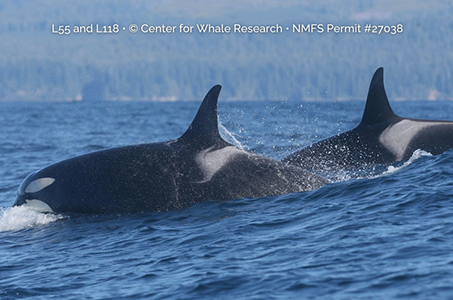
The bull was 22-year-old K38, and his aunt K27, along with his 4-year-old sister K45, were alongside him. Mark worked his way through the big swell and found K20 and K14 powering west along with K37, who appeared to be foraging as he doubled back to the east on a longer dive before following the western push of the rest of the whales. He came across most of the rest of K pod, including the newest calf, K47, along with mom K43 and its grandma, K12, before finding some members of the L12s; L94, along with her daughter and grandson, L119 and L126, were mixed in with several K pod whales, including K12, K22, and K33. He also confirmed L55 with three of her offspring: L103, L109, and L118, along with L103’s 11-year-old son, L123, who is starting to show signs of sprouting. L90 was also present along with L91 and her 11-year-old son, but there was no sign of her calf, the newest addition to L pod first sighted in June.
The whales started to high-speed porpoise in the confused swell, so Mark decided to double back to pick up a small group he could see trailing a few swells back. As they approached him, he spotted what looked like a newish calf tucked in alongside L72 and her 22-year-old son L105. These three were quite a ways behind the lead group with no others in sight. Mark paralleled them in the large seas for a few minutes to make sure he got decent shots of the calf to confirm that it was L130, being babysat by L72. He admittedly thought that it may have been a new one belonging to L72 until he sent some eyepatch pictures to Dave and Michael from the back of his camera, and they were able to conclude that it was indeed the four-month-old L130.
The whales were now a little over 8 nm from Swiftsure Bank, averaging 8 knots, so Mark ended the encounter here to head back towards Victoria and calmer waters.






Leave A Comment