
||| FROM CENTER FOR WHALE RESEARCH |||
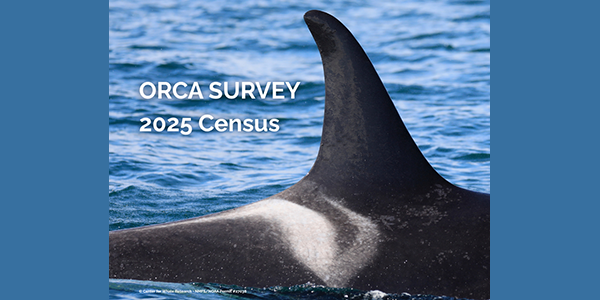
Fifty years ago, Orca Survey set out on a simple but ambitious mission: to track and understand more about the Southern Resident killer whales. In 2025, we are proud to share the 50th Orca Survey Census. As Dr. Michael Weiss, Research Director at the Center for Whale Research, shares, “The demographic census gives us an unparalleled long-term view of how this population is changing over time, and it helps us understand the consequences of environmental pressures and measure the effectiveness of conservation efforts.”
Below is a brief report on the results of the 2025 census.
|
How does Orca Survey Work? This work utilizes photographic identification methods (photo ID) to produce a count of all individuals in the population with very high precision. Additionally, new calves can be assigned to mothers with high certainty based on association patterns, allowing us to build matrilineal family trees. The census reflects the best estimate of the southern resident killer whales as of July 1st of each year. Mortality must be inferred retrospectively from individuals going missing, and some new calves are not observed for many months, which means it can be well into September before a good estimate of the July 1st number is available. Births and deaths reported as part of this census are therefore those that took place between July 1st 2024 and July 1st 2025. |
|
Population and Pod Sizes As of July 1st, 2025, the southern resident killer whale population consisted of 74 total members. This is an increase from the 2024 census number of 73. J pod increased from 25 members in 2024 to 27 members in 2025, while L pod stayed constant at 33 members and K pod decreased from 15 members in 2024 to 14 members in 2025. |
 |
|
Births During the census period, 4 new births were documented. In September 2024, L90 was documented with her first calf, male L128. In late December, J35 gave birth to female J61 and J41 gave birth to female J62. Finally, in April 2026 J40 was documented with her first calf, female J63. “The Southern Residents have a much lower reproductive output than other killer whale populations, even those living in the same region,” Michael noted. “Their dependence on declining Chinook runs means they face nutritional stress that directly affects their ability to reproduce and raise healthy calves. Deaths Unfortunately, new calves L128 and J61 did not survive to the July 1st 2025 census date. L128 was observed in poor body condition in October, and was not seen again. J61 was observed dead on December 31st, with her mother J35 carrying her body for at least 11 days. Additionally, adult male K26 went missing in late summer of 2024. K26 was the oldest surviving male in K pod at the time of his death, and was one of the few adult males left who was known from genetic studies to have successfully reproduced, with his son J51 still alive and reaching sprouting age. The future of the southern resident killer whales remains precarious, “we need to be enacting policies on a broad scale that take the environment seriously — that take the threats of climate change and ecosystem degradation seriously. If we want to preserve these whales for future generations, we have to make their survival a societal priority,” said Michael. |

**If you are reading theOrcasonian for free, thank your fellow islanders. If you would like to support theOrcasonian CLICK HERE to set your modestly-priced, voluntary subscription. Otherwise, no worries; we’re happy to share with you.**