

||| FROM ELISABETH ROBSON |||
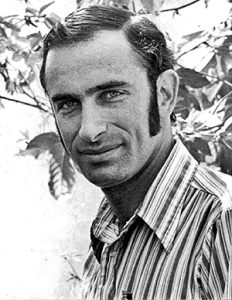
Paul Ehrlich
When Paul Ehrlich died recently (March 13, 2026), many of the obituaries and articles about him repeated a familiar judgment: he was alarmist, even brilliant, but ultimately wrong.
His 1968 book, The Population Bomb, warned of mass famine and ecological collapse that did not arrive on schedule. Critics still point to the famous Simon–Ehrlich wager as proof that he misunderstood the future and missed the advances in our capabilities to extract “resources” (i.e. nature, including soil, water, trees, etc.) that would make them cheaper.
Today, a new generation has revived that argument under a more appealing name: abundance. The idea is simple and seductive. Human ingenuity, markets, and technology create a world of ever-increasing plenty. More people mean more ideas. More ideas mean more innovation. More innovation means more “resources.” The abundance crowd sees all of the Earth as objects put here for us, and if we just keep innovating, we can keep growing in population and in abundance.
Essays like Revisiting the Simon-Ehrlich Wager 40 Years On are typical of the “Ehrlich was wrong, look at the abundance!” perspective the infinite growthers have today. Their conclusion is: Ehrlich worried about limits, but history proved him wrong. Prices fell, supplies expanded, and humanity innovated and adapted.
This argument rests on a profound and dangerous blind spot. It defines “abundance” almost entirely in terms of price and availability in human markets, while ignoring the condition of the living world that makes those markets possible.
Yes, many commodities became cheaper. But how did that happen? It happened because our technology innovations pushed beyond the ecological limits that Ehrlich saw in the 1970s and enabled the liquidation of the natural world for human use faster and at greater scale than he could have possibly imagined.
Industrial agriculture is the clearest example. The so-called Green Revolution dramatically increased yields through fossil fuels, synthetic fertilizers, pesticides, irrigation, and global trade. It allowed the human population to surge far beyond what local ecosystems could support.
Those increased yields simplified and degraded ecosystems by replacing diverse landscapes with monocultures, depleting soils, draining aquifers, and driving massive declines in insects, birds, and other wildlife.
The same pattern holds more broadly. When “resource” prices fall, it usually reflects increased efficiency and extraction, meaning we get more out of nature, faster. Economists celebrate this as progress; ecologists recognize this as liquidating nature for our use.
The abundance the infinite growthers describe is simply temporary abundance for one species out of ten million at the expense of the living world.
Even the logic of efficiency can backfire. As technologies make “resource” use cheaper, we usually end up using more of those resources overall. This is known as Jevons’ Paradox or the rebound effect. In a growing economy, efficiency does not reduce pressure on the Earth; instead that pressure accelerates.
This is where Ehrlich’s deeper insight still matters. He was pointing to a basic reality: exponential growth on a finite planet must eventually collide with limits.
What we have done, over the past half-century, is simply delay its consequences by drawing down the very systems that sustain us. The result is a strange, unstable condition: apparent abundance alongside real decline and an utter disaster for the natural world.
We have more food, yet less fertile soil per person, and we’ve destroyed forests, prairies, wetlands, rivers, aquifers… just about every ecosystem you can imagine, to get that food.
We have more goods, far beyond what we actually need (bobbleheads?!), yet fewer wild animals.
We have more energy, and a destabilized climate.
Even in the original Simon-Ehrlich wager (1980-1990), there were hints of this. Ehrlich bet that the price of five metals would rise, representing scarcity, and Simon bet they would fall, representing abundance. Simon won; prices fell. But price is not the same thing as physical or ecological abundance. While Ehrlich lost on metal prices, today in 2026, his concerns look far more prescient.
Take copper, one of the metals at the center of Ehrlich’s famous wager. For a time, its price fell, and critics declared victory. Today, copper has surged to record highs, driven by supply constraints and rising demand.
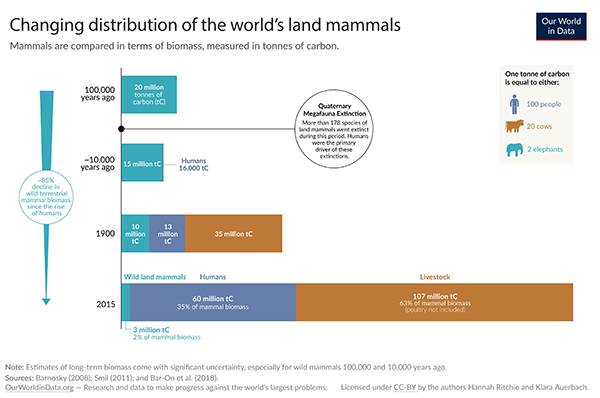
Instead of asking “Is X cheaper,” we need to be asking: are ecosystems healthier? Are soils, forests, fisheries, and freshwater communities being replenished or depleted? Are wildlife numbers increasing or declining? Are humans becoming more or less dissociated from the natural world?
If we ask these questions instead, we get a very different answer, illustrated well by this graph:
So what does this mean for us here in our own community?
It means we should be cautious about the comforting story that technology will always outrun limits. It means questioning what we really mean by “abundance.” It means recognizing that growth, while it can feel like prosperity in the short term, always comes at the cost of long-term resilience.
We are not exempt from these dynamics. We see them in strained water systems, rising costs of living, and the quiet disappearance of species and landscapes we once took for granted. We see them in the tension between continued development and the capacity of the land to support it.
Ehrlich understood the limits to growth on a finite planet, but he underestimated how far we would go and how destructive our methods would become to avoid them.
The tragedy of his legacy is that we still misunderstand the lesson. We point to cheaper commodities and call it victory, even as the living world grows poorer.
That is not abundance. It is overshoot, temporarily disguised as success.

**If you are reading theOrcasonian for free, thank your fellow islanders. If you would like to support theOrcasonian CLICK HERE to set your modestly-priced, voluntary subscription. Otherwise, no worries; we’re happy to share with you.**





Having to rely on Ai since I’m not quite old enough to remember the first humanoid on this planet, 99% of all species that have existed on earth (that might be conservative … some believe 99.9%) have gone extinct. It’s almost a 100% certainty humans will join that list of extinct species. Best Ai guess is species on earth generally last from 1 million to 10 million years. The first species with humanoid tendencies is estimated to be about 4 million years ago. Hummm. Are humans at half-life maybe?
“Overshoot” is one concept that might eventually cause such extinction, but putting a specific cause or timeline on human extinction is and will almost certainly remain impossible to predict, although it will continue to sell books because it s interesting to many when and how the end human existence going to happen, and consider what comes next after humans, if anything?
No way to know what the actual timeline is on overshoot leading to collapse. Overshoot is a well-known concept in ecology (this is a good intro to overshoot by Donnella Meadows, of Limits to Growth, in 1977: https://www.youtube.com/watch?v=f9g4-5-GKBc), and all species in overshoot end in collapse (extremely reduced population, or extinction). She explains how overshoot reduces carrying capacity, so that populations after collapse are lower than before because the environment has been so degraded.
Whether we are half-way along, or 95% of the way along, or even 99.99% of the way along is anyone’s guess. Given exponential growth in resource use, the dramatic declines in wildlife and habitat, and the dramatic increases in planetary-wide pollution, my guess is it is probably somewhere far closer to the end than half-way. But that’s just a guess of course.
As you point out, attempting to predict the future is probably not the greatest idea. Ehrlich must have tired of the endless flak he got for his predictions, even though, ultimately, he’ll be proven correct. And of course, from the perspective of the natural world and wildlife, the “bomb” in “population bomb” has already detonated, quite a while ago.
Thanks, Elisabeth, for your thoughtful commentary.
My cohort is largely those who came here to retire several decades ago. Many of us enjoyed good fortune in the choices that we made during our career years. Moreover, in my personal experience, every one of my cohort who were lucky enough to have had kids, and who now have grandkids, relish their good fortune. Yet, now, In nearly every corner of the world , woman and their families are deciding to have fewer kids, world-wide, collectively below the replacement rate. One seemingly cheery result seems likely to be reduced resource consumption in future decades. That may help offset impacts on climate, regionally, for example, perhaps reversing the declining winter snowpack in the Cascades. Yet, also, the capital needed to mitigate the effects of changing climate will wane with declining economic growth.
We can’t know the future effects of our choices. We can only aspire to make wise choices, despite an increasingly chaotic world. We’re all in this together. Wish us luck!
Jeff, while the birth rates are indeed dropping in a few countries, the human population of Earth continues to grow by a whole United States worth of people every 4-5 years (about 70-80 million people a year), with a commensurate decline in habitat and wildlife populations as we decimate more of nature to feed, house, clothe, and transport all of those people. Reduced consumption is, unfortunately, nowhere in sight.
And because CO2 is cumulative in the atmosphere (on human timescales) there will be no offsets in the impacts of climate change in the foreseeable future.
Climate change is just one of many symptoms of overshoot, and, for the natural world, not even close to the worst. The tremendous impacts of agriculture and all that goes with it is responsible for by far most of the horrors we have unleashed leading to the massive declines in wildlife etc., along with exploitation of wildlife and their habitats by virtue of our sheer numbers.
Unfortunately, the only thing that will mitigate many of the other impacts of overshoot is time… thousands of years to regrow old-growth forests; many millions to unpollute the Earth of pervasive microplastics, PFAS, dioxins, etc.
In 2023, 60 Minutes interviewed Paul Ehrlich on our state on this planet. Here is that piece.
https://www.facebook.com/reel/4442545419364262
Population Bomb: World’s current population (~7 Billion) projected to increase by another half and leveling off at about 11 Billion by the end of the century and beginning a gradual decline. A race, then, between increasing population and diminishing resources: how many will we consume by then and how will we apportion and share them? Some of us have advocated for a buildout study (population vs. resource availability, which would include energy and economic sustainability) here in our island world. Same question.
Then there’s the other bomb: the nuclear “Doomsday Clock,” long posited by the Bulletin of the Atomic Scientists, and currently set at 85 seconds before midnight. Another population scenario, and more choices. The question is whether we will go, in T.S. Eliot’s words, with a bang or a whimper, or…?
Brian, the current population is about 8.3 billion. The UN’s current projection for global population is for it to grow from ~8.3 billion to a peak of approximately 10.3 billion in the mid-2080s before declining slightly to 10.2 billion by 2100.
Personally, I think that level of growth is unlikely to be sustained given increasing political strife, rapidly dwindling “resources”, and accelerating declines in habitat and wildlife. As you point out, increasing population dramatically increases the risk of catastrophic outcome from conflict over a finite Earth and what we call “resources” (i.e. nature) that are declining by the day. But… predicting the future is a fool’s errand… so who knows?!
No matter what, we are in for interesting times ahead.