||| FROM CENTER FOR WHALE RESEARCH |||
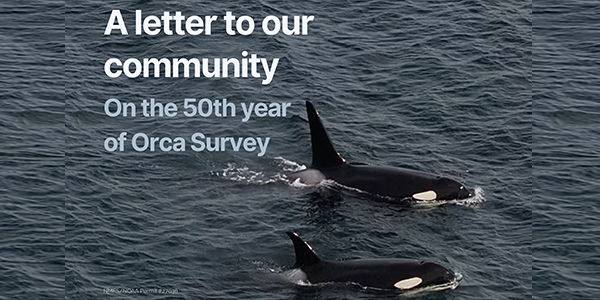
Fifty years ago today, in the waters of the Salish Sea, a young scientist named Dr. Ken Balcomb had his first encounter with the Southern Resident killer whales. That moment sparked a lifelong commitment – one that would grow into a study spanning generations of whales, and generations of people who care deeply about them and their future.
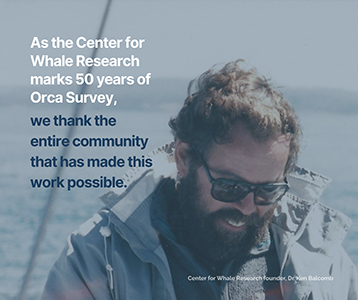
Today, as the Center for Whale Research marks 50 years of Orca Survey, we thank the entire community that has made this work possible.
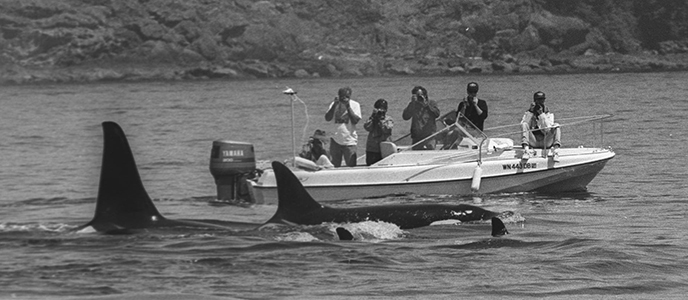
Because of your support, we have been able to follow the lives of 224 individual whales – watching families grow, documenting births and losses, and building a record of their lives spanning half a century. This dataset has transformed our understanding of killer whales, particularly the Southern Residents, and has helped guide their conservation and management.
Through this shared effort, we have come to understand these whales in profound ways – their deep social bonds, their culture, and even extraordinary traits like menopause, revealed only through decades of careful, consistent study. These discoveries are not just scientific milestones – they have also helped inspire a growing community of people who understand and care for these whales, a community that you have helped build.
But today is not only about looking back across the last 50 years.
The story of the Southern Resident killer whales is still being written and the next chapter is one of both urgency and hope.
The challenges they face are real. Fifty years of data give us detailed insights into the threats these whales face and what they need to thrive into the future. Declines in both the number and size of Chinook salmon, their primary food source, along with broader environmental changes, are putting increasing pressure on their survival and reproduction. It is essential that Orca Survey continues, so that the meticulous data we collect in the future can be compared with the past – allowing us to hopefully track recovery of this very special population, and to sound the alarm and push for conservation action if recovery does not happen.
Fifty years ago, Ken set out with a bold vision: to study these whales for 100 years- long enough to follow entire lifetimes.
Today, we are halfway there.
What comes next will depend, as it always has, on people – on a community that chooses to care, to support, and to stand with these whales.
Everything we do in the next 50 years will build on the foundation that you have helped create. And with your continued support, we will carry this work forward – so that future generations can know these whales not just as a story from the past, but as a living presence in the waters we all share.
Thank you for being part of this journey – for the past 50 years, and for the next 50 to come.

**If you are reading theOrcasonian for free, thank your fellow islanders. If you would like to support theOrcasonian CLICK HERE to set your modestly-priced, voluntary subscription. Otherwise, no worries; we’re happy to share with you.**






Leave A Comment