
||| NO PLACE LIKE LOAM by ALEX TAMAYO-WOLF |||
Sarah Lefton called from Once in a Blue Moon Farm about pruning their heritage orchard.
I drove out on a clear day on Orcas Island—cool, bright, restrained. The sun wasn’t warming anything yet. It was just showing what was there.
I’d been here before, years ago, walking these same trees for a preservation orchard project. Coming back felt less like a return and more like stepping into a sentence I hadn’t finished.
The farm was awake in the way working land always is. Ducks everywhere. Geese announcing themselves with the confidence of creatures who know they belong. The smell hit first—wet grass, old wood, salt moving inland, that particular layered scent the Maritime Northwest carried before everything became manicured or sprayed or renamed. It smelled like continuity. Like decades stacked on one another without apology.

Heritage apple trees at Once in a Blue Moon Farm—full-sized, storm-worn, and still working. This isn’t decline. It’s endurance.
Full-Sized Trees Don’t Fit Modern Ideas
There are about fifty trees in that orchard. Kings. Queens. Full-sized standards, planted when “full-sized” was the only option. Trees meant to grow as tall as they could, not as short as a ladder would allow. In their prime, some of them would have brushed three stories. Even now, collapsed and leaning, they dwarf most modern orchards by accident alone.
I knew within minutes I wouldn’t be pruning them. This wasn’t a pruning job. It was accompaniment.
Not because the work was beyond me—but because the framework was. These trees were too high, too old, too far removed from the logic of corrective pruning. Any attempt to treat them like young trees would be violence dressed up as maintenance.
So we walked instead.
We moved slowly. The way you do when the land is doing most of the talking. Many of the trees were no longer standing upright. They were laid down by time, storms, gravity, neglect—still alive, still connected, roots gripping the earth with the stubbornness of something that had decided not to leave yet. Branches fractured decades ago were still leafing out. Trunks split and hollowed were still moving water. It looked less like an orchard and more like a field hospital—bodies bearing old injuries, triaged by weather, kept alive by stubbornness and memory.
This was not decline in the way people imagine it. This was endurance. Even defiance.
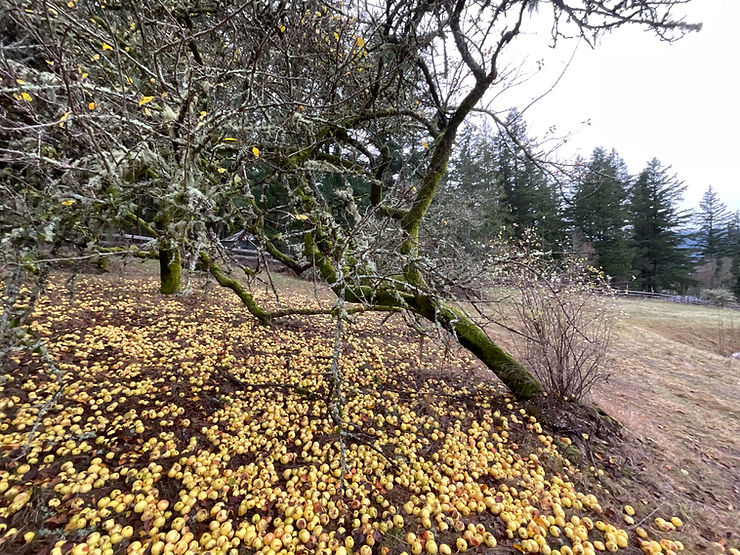
Late Newtown Pippins—or close kin—dropping under their own clock. These trees weren’t bred for convenience. They were bred to last.
Once in a Blue Moon Farm, Lost in a Poker Game and Still Working
Once in a Blue Moon Farm carries a history that makes modern timelines feel childish. The land has been producing since the 1800s. There are stories—some exaggerated, some probably not—about apricots too large to fit into canning jars. Strawberries that didn’t just win county fairs, but state fairs. Apples and pears shipped by boat, then loaded onto trains and sent up and down the West Coast, inland over the Cascades and the Sierras.
Rows of Gravenstein and King apples. Bartlett pears. Royal Anne cherries. Italian plums. Peaches. Apricots. Acres of tall-growing fruit trees during a brief, luminous period when San Juan County offered some of the best growing conditions in the Pacific Northwest.
By the 1920s, that era ended—not because the land failed, but because the system moved. Eastern Washington’s irrigated soils, rail access, and economies of scale shifted agriculture inland. Orcas Island farms couldn’t compete with efficiency. They were never meant to.
What remains are legacy trees on standard rootstock, many of them over a hundred years old. Majestic in a way that can’t be replicated. For those who walk quietly beneath their boughs, something settles in the body—peace, awe, the sense that you are standing inside someone else’s long memory.
And the land, of course, remembers everything.
In 1954, a horse fell down the well. In the 1930s, the farm was bet—and lost—at a poker game in a bar in Friday Harbor. In the 1980s, there was an earnest attempt to cultivate Black Perigord truffles with the help of a pot-bellied pig.
You can’t make this kind of history up. You also can’t prune it away.
Restraint Is the Only Respect Left
Standing there among those trees, it was obvious this wasn’t going to be a “normal” pruning plan. There would be no opening of centers, no height reduction, no seasonal productivity targets. These trees are not problems to be corrected. They are elders—veterans of storms, salt winds, neglect, and care applied unevenly over generations.
They don’t respond to ambition. They respond to restraint.
This is where the rules change. This is why we do not treat very old fruit trees like young ones. And this is where stewardship begins—not with cuts, but with listening.
From here, the work becomes something else entirely. Standing among those trees, the mistake most people make becomes obvious. They assume age is a problem to be solved.
Modern pruning culture is built on youth. On vigor. On trees that respond quickly, seal wounds efficiently, and rebound with obedient growth. It assumes the organism wants what we want: balance, productivity, symmetry, renewal. That assumption collapses the moment you step into a heritage orchard.
Very old fruit trees are not operating on growth logic anymore. They are operating on conservation.
They have already spent their explosive years. Their energy is stored, rationed, guarded. Every cut is negotiated against survival, not yield. When you prune an elder tree aggressively, it does not thank you. It panics. It diverts what little surplus it has into emergency growth—water sprouts, stress shoots, architectural confusion—burning reserves it may never recover.
This is why rejuvenation pruning fails here. Not sometimes. Almost always.

A fallen soldier of the canopy. The limb failed, the tree did not—still standing, still alive, still negotiating gravity on its own terms.
Why Heritage Trees Reject Modern Pruning Logic
Elder-tree care begins with accepting that the tree’s priorities have changed.
The goal is no longer to make the tree better. The goal is to make the tree last.
That means shifting from corrective pruning to structural mercy. From optimization to stabilization. From intervention to accompaniment.
In young trees, we prune to shape the future. In old trees, we prune to reduce harm.
Weight matters more than form. Load matters more than light. A heavy limb pulling against a compromised union is a greater threat than shade ever will be. A branch laid down by time but still alive may be doing more for the tree than one standing upright under tension.
Old trees don’t fail because they’re messy. They fail because gravity eventually wins arguments that were postponed for decades.
So the philosophy changes.
We remove what is already gone. We reduce what is already breaking. We leave what is quiet.
Quiet wood—old, slow, unremarkable growth—is not dead weight. It is stored history. It is energy saved for lean years. Waking it unnecessarily is theft.
This is why we don’t chase height. Why we don’t open centers. Why we don’t thin for airflow the way we would in a commercial orchard. Those techniques assume a metabolism these trees no longer have.
Timing matters more now, too. Elder trees seal slowly. They bleed differently. They don’t bounce back from seasonal mistakes. Pruning becomes less about calendar correctness and more about conditions—moisture, temperature, stress already present in the system.
And sometimes, the philosophy demands something harder still: acceptance.
Some trees will never stand again. Some will fruit lightly, irregularly, or not at all. Some are already in a long, graceful descent.
That does not make them failures.
They still hold soil. Still host life. Still carry genetics that no nursery can sell you. Still teach the land how to remember itself.
At Once in a Blue Moon Farm, the work isn’t about restoring an orchard to what it was in 1910. That era is gone. The land knows it. The trees know it. Pretending otherwise only shortens what time remains.
Elder-tree care is not nostalgia. It is respect expressed through restraint.
You don’t manage trees like these. You keep them company.
And if you do it well—if you listen first, cut last, and stop when the tree tells you to—you don’t just preserve fruit trees.
You preserve continuity.

**If you are reading theOrcasonian for free, thank your fellow islanders. If you would like to support theOrcasonian CLICK HERE to set your modestly-priced, voluntary subscription. Otherwise, no worries; we’re happy to share with you.**




Thank you. This is beautifully expressed and enlightning. There is an amazing old apple tree at the Orcas golf course in front of the clubhouse. I’ve watched the care it has been given for over 25 years with appreciation, and seen it age with loving support.
I’m also very interested to learn more about Once In A Blue Moon Farm.
How delightful to read these words written by a true observer of elder tree care. As a great granddaughter of fruit farmers here on Orcas, you have expressed the reference I feel when I am amongst these trees.