
||| FROM WHAT’S. UP WITH THAT? |||
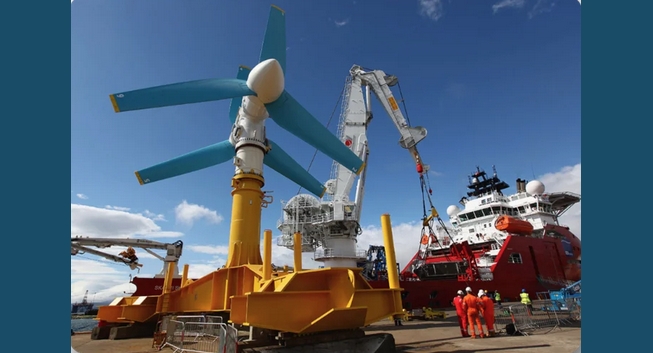
Let me invite you to consider the Scottish coast, where the tides are large and the headlines are gushing—much like the capital outflow—over the MeyGen tidal project, a four-turbine, six-megawatt marvel whirring away beneath the waves. The headlines scream Underwater turbine spinning for 6 years off Scotland’s coast is a breakthrough for tidal energy.

Me? I’m just a suspicious sort with too many years in the accounting trenches and a soft spot for arithmetic. So I thought I’d take a peek at the math behind the green curtain and see what’s really going on.
First, the basics. The capital cost for the four-turbine Phase 1A MeyGen project was £51 million at construction—call it £66 million in 2025 pounds, or about US$90 million at today’s exchange rate. No one seems keen to publish the total operation and maintenance (O&M) bill for Maygen, but industry estimates for similar tidal setups run 2–4 cents per kilowatt-hour (kWh). For 51 million kWh generated so far, that’s a ballpark $1–2 million for O&M.
So, $91 million spent, 51 million kWh produced. That’s $1.78 per kWh—over thirty times the US grid price for gas-fired power, which hovers around $0.04–0.06 per kWh. Ouch.
Now I can hear you thinking, “But that’s just the first seven years! The costs are front-loaded! Surely it gets better over time?” And you’re right. So let’s squint into the always-misty future.
Over the projected 25-year lifespan of the four turbines, the array is expected to generate about 164 million kWh. There’ll be two major overhauls—$3 million each—and 25 years of O&M at around $0.03 per kWh, totaling around $6 million. Add it all up: $90 million (capital) + $6 million (overhauls) + $6 million (O&M) = roughly $102 million.
Divide by the lifetime output, and you’re looking at a cool US$0.62 per kWh. That’s about ten times what gas power costs in the US.
Why are the costs so high? Well, in part it’s the “capacity factor”. That’s the percentage of the nameplate rating that they are actually generating. The individual turbines are rated at 1.5 megawatts. One has been operational for nine years, one for eight years, and two for 7 years. That’s 31 turbine-years, times 1.5 megawatts/turbine, times 8,766 hours per year, yields 407 gigawatt-hours (GWh) if they were running full-tilt.
But in the real world, they only put out 51 GWh, so their capacity factor is a pathetic 13% …
And that cost and capacity factor are assuming that there are no unexpected breakdowns in the next 18 years. Is that realistic, given that the ocean is one of the most corrosive natural environments on the planet.?
Well, a popular saying of my youth had it that “What goes around, comes around.”

**If you are reading theOrcasonian for free, thank your fellow islanders. If you would like to support theOrcasonian CLICK HERE to set your modestly-priced, voluntary subscription. Otherwise, no worries; we’re happy to share with you.**







Electricity generated from tidal power is by nature intermittent. OPALCO is blowing smoke telling us that their proposed tidal electricity project will provide backup for power provided by undersea cables from the mainland. Looking at the bright side of spinning turbines in the ocean, marine animals other than turtles can probably move quickly enough to avoid a direct strike from turbine blades, unlike unfortunate eagles and hawks who fly near wind turbines.
Lynn, please consider taking this article down. “Watt’s Up With That” is one of the most notorious pseudo-science climate change denial blogs around, publishing fossil fuel industry nonsense for almost 20 years. Arguably its purpose is to spread anti-renewable nonsense through the guise of appearing to be a credible “moderate” source.
The site is run by a conspiracy theorist who’s known faking his educational credentials. The site has received funding from the conservative Heartland Institute, where the author of the blog once worked. Heartland is a fossil industry shill group which for decades has run interference for the fossil fuel companies.
Here’s a rundown on Watts and his history of climate change denial disinformation:
https://www.desmog.com/anthony-watts/
https://www.desmog.com/heartland-institute/
There’s definitely room for debate over the OPALCO tidal project, but the talking points shouldn’t come from fossil fuel shills.
Readers should understand that this facility is NOT the Scottish prototype of the proposed OPALCO tidal power project. That is an Orbital Marine O2 tidal power plant the size of a Boeing 747 operating in the Orkney Islands northeast of Scotland.