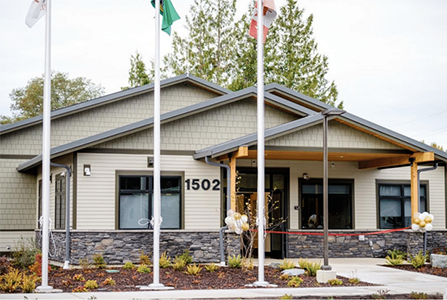
New facility will serve approximately 40 children, expanding access to quality childcare in Anacortes
||| FROM AMANDA SHOR for SAMISH INDIAN NATION |||
ANACORTES, Wash. (October 20, 2025) – The Samish Indian Nation celebrated the completion of its D Avenue Early Learning Center with a special ribbon cutting ceremony and tour for Samish citizens, staff, Federal and State Representatives, and the broader community on Thursday, October 16, 2025. Years in the making, the project transforms the former D Avenue Nursery site into a modern early learning center designed to increase childcare capacity and support working families across the region. Samish was joined by Anacortes Mayor Matt Miller to celebrate the milestone moment.
Located at D Avenue and 15th Street, the new facility features five classrooms serving infants through toddlers, with capacity for approximately 40 children, and a dedicated team of 17 staff. The center addresses a documented childcare shortfall: prior to the pandemic, only 12% of children under school age in Anacortes had access to full-time, licensed care, well below the Washington state average. The center is set to open in January 2026.
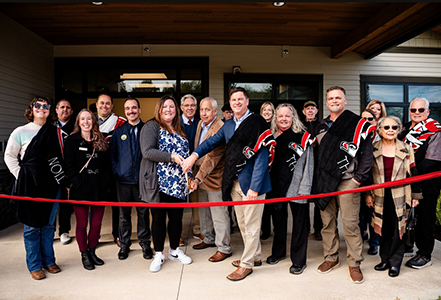
“This center is an investment in generations. By expanding access to safe, high-quality childcare, we’re helping Anacortes families return to work with confidence while giving our youngest learners the strong start they deserve,” said Tom Wooten, Chairman of the Samish Indian Nation. “Samish is proud to partner with our neighbors, the City, and state leaders to deliver a resource that serves the entire community for decades to come.”
Elected officials, community leaders, and project partners gathered for remarks and a ceremonial ribbon cutting, followed by guided tours of the new classrooms. Speakers highlighted the project’s long-term benefits for early learning, workforce stability, and neighborhood vitality.
“Things work best when our community stands shoulder to shoulder to make them happen,” said Anacortes Mayor Matt Miller at the event. “The opening of the D Avenue Early Learning Center isn’t just unlocking a building; it’s also opening doors to the future for Anacortes families and their children.”
“Reliable childcare is one of the biggest levers for economic mobility, especially for women and girls,” said Aleli Howel, Soroptimist International of Anacortes. “The D Avenue Early Learning Center will help families return to work, keep kids safe, and set them up for a lifetime of learning. Soroptimist International of Anacortes is so happy to have been a part of this project.”
“Rotary invests where it strengthens community for generations, and early learning is exactly that kind of investment,” said Jack Darnton, Anacortes Rotary Club. “This center will help parents thrive today and ensure Anacortes’ youngest learners are ready for tomorrow We’re proud to have been an early center supporter and we salute Samish for their vision and perseverance.”
The center comprises approximately 4,100 square feet and includes 32 off-street parking spaces on site. In partnership with the City of Anacortes, Samish is also funding improvements to D Avenue, 15th Street, and 16th Street that will include 13 on-street perpendicular parking spaces to benefit both the early learning center and the surrounding neighborhood.
Samish purchased the site with the support of a Washington State capital budget appropriation sponsored by Representatives Alex Ramel and Debra Lekanoff and Senator Liz Lovelett. Additionally, a number of non-profit service groups and individuals contributed to making the project possible. The project builds on Samish’s long-standing commitment to early learning, including the successful Samish Longhouse preschool.
To read more about the project, visit https://www.samishtribe.nsn.us/departments/planning/Samish-Early-Learning-Center. For more information on the Samish Indian Nation, visit https://www.samishtribe.nsn.us/.
About the Samish Indian Nation
The Samish Indian Nation is the successor to the large and powerful Samish Nation, a signatory to the Treaty of Point Elliot in 1855. Linguistically and culturally, the Tribe is grouped as Coast Salish and traditionally speaks a dialect known as “Straits Salish,” rather than Lushootseed dialect that is common to other neighbors in the region. The Tribe’s Traditional Territory historically stretched over a wide area from the Cascade mountains to the far western shores of the San Juan Islands.

**If you are reading theOrcasonian for free, thank your fellow islanders. If you would like to support theOrcasonian CLICK HERE to set your modestly-priced, voluntary subscription. Otherwise, no worries; we’re happy to share with you.**