Researchers monitor rare transmissible cancers spreading through two local species.
||| FROM THE SALISH CURRENT |||
What if cancer, already one of the deadliest diseases known to the animal kingdom, suddenly became contagious?

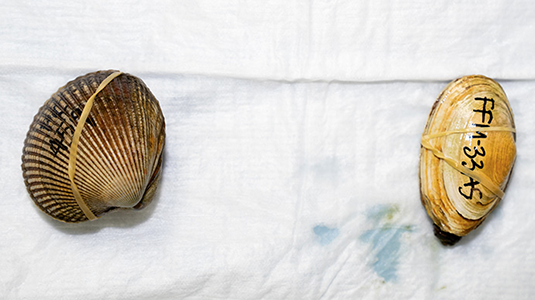
The basket cockle (left) and the eastern soft-shell (right) have developed transmissible cancers. (Eli Voorhies / Salish Current 2026)
Among certain species it has. Now, it’s happening in the Salish Sea.
Two local bivalves — meaning “two shells” and referring to mollusks like oysters and clams — have developed contagious cancers: the eastern soft-shell clam, which is non-native and arrived from the Atlantic in the 1870s, and the Nuttall’s cockle — more commonly known as the basket cockle — which is native.
If both species fall to their malignant foes, Washington waters and tribes will suffer.
The catch-all phrase for multiple lineages of contagious cancers in mollusks is bivalve transmissible neoplasia, or BTN. To date, BTN has been reported in no more than 10 species.
The first case was identified in a virology lab at Columbia University in 2015 by Michael Metzger. Cancer was afflicting New England soft-shell clams on a large scale, and he determined that it was not spreading through a supposed retrovirus, such as HIV or HTLV-1 in humans. Instead, the cancer itself was contagious.

Michael Metzger, the lead researcher of rare transmissible cancers in bivalves, poses outside of the Pacific Northwest Research Institute where his lab is situated. (Eli Voorhies / Salish Current 2026)
“It’s blurring the lines of what could be an infectious disease,” Metzger said.
In their cardiovascular system, bivalves have their own version of white blood cells called hemocytes. These microscopic soldiers recognize patterns of invaders, like parasites and bacteria, then attack — that is, they did until things went haywire.
At some point, DNA mutated in a single specimen of each bivalve species, causing the little soldiers to forget their jobs and multiply out of control.
The cancerous blood floods its victim’s tissues, eventually killing them. Simultaneously, these soldiers venture into the water, floating around until they are absorbed by an identical host.
In a hotspot of clams, this disease can spread like wildfire.
“Water is such a good medium for cancer to live in,” said James Dimond, a marine biologist at Western Washington University’s Shannon Point Marine Center in Anacortes.
Neither the soft-shell or the cockle are currently commercially farmed like other bivalves in Washington, but their loss, especially the native cockle, would be devastating for the environment.
“It would be removing a species from the ecosystem, which is never a good thing,” said Metzger.
The soft-shell and cockle are part of the food chain, a tasty snack for predators like sea otters and birds.
They are also bio-turbinators. When they burrow into sand, surface water reaches critters in the sediment who require the oxygenated water to breathe.
Finally, they filter vast amounts of ocean water.
“If we didn’t have them in the environment our water would not be as clean,” Dimond said.
An unwelcome surprise
Initially, researchers were surprised to find BTN in this neck of the woods.
Metzger, who now leads a lab on rare contagious cancers out of the Pacific Northwest Research Institute — PNRI — in Seattle, was going to expose BTN to samples of soft-shells collected from South Skagit Bay and Port Susan, south of Stanwood, in 2022.
The two samples were meant to be healthy — clean clams to compare against their cancerous kin of the Atlantic.

Jay Dimond poses in front of the Shannon Point Research Center on Dec. 17. (Eli Voorhies / Salish Current 2026)
He was astonished to find that a tenth of the Skagit clams already had it. Even worse, it was present in nearly a third of the Port Susan clams.
“We stumbled into that on accident,” Metzger said.
Now, BTN in the Port Susan and Skagit soft-shell populations has reached over 75%.
It was a similar surprise with the native basket cockle.
After Suquamish tribal members noticed it became harder to find cockles, an important first food, on local beaches in recent decades, the tribe partnered with the Puget Sound Restoration Fund — PSRF — for cockle restoration.
In 2018, the tribe screened local cockle populations in central Puget Sound for disease and found a contributing factor to the decline: cancer. The disease was later confirmed as BTN in at least 5–10% of those cockle populations, according to the Suquamish tribe’s shellfish biologist, Elizabeth Unsell.
“It’s certainly a challenging situation,” she said. “It’s all the more important to do all we can to support this native species.”
Since then, the Suquamish Tribe has kicked off several cockle restoration projects, prioritizing traditional food access.
The tribe is studying the genetics of wild cockles and outplanting cockle seed produced in the PSRF’s hatchery into the central Puget Sound. The tribe is even considering building its own hatchery.
In conjunction with PSRF and PNRI, tribal researchers are keeping an eye on certain cockle populations to see if BTN is more abundant during different seasons or moving into new areas.
Metzger is collaborating with Dimond and other researchers from California to Alaska to learn more about BTN in bivalves, particularly where the cancers started, what DNA mutation makes them possible and how clams evolve to fight the contagions.
Recent findings, new light
In the fall of 2023, Samuel Hart, a graduate student working in Metzger’s lab, published a landmark paper.Using genome sequencing, he determined that BTN in soft-shells had begun in a single clam at least 200 years ago and possibly dating back thousands of years.

A sample from a soft shell clam of hemolymph — invertabrates’ version of blood — is displayed at a microscopic view. The floating white-yellow circles are cancerous hemocytes, while the blue squiggles are normal behaving hemocytes, binding themselves to the bottom of the glass. (Eli Voorhies / Salish Current 2026)
Prior to Hart’s discovery, there was a different narrative: BTN was a new disease, wreaking havoc on vulnerable clams.
“What we think happens now is that you have these booms — outbreaks of cancer. (The outbreaks) will wipe out the population or lead to resistance and stabilization,” Metzger said.
Essentially, this is a historical process. Bivalves have probably encountered contagious cancers before. Cancers boomed until a bivalve species either died or adapted.
This information could be a boon for dealing with human cancer.
“We can find new ways to target cancer based on how evolution has been able to target and block cancers,” Metzger said.
Metzger thinks that soft-shell clams are facing their adapt-or-die moment. There are signs of hope as the contagious cancer is hitting a plateau in New England.
On the other hand, he thinks native cockles might have leftover BTN because they’ve already survived a cancerous cataclysmic event. Or, they could still be on the cusp of one.

**If you are reading theOrcasonian for free, thank your fellow islanders. If you would like to support theOrcasonian CLICK HERE to set your modestly-priced, voluntary subscription. Otherwise, no worries; we’re happy to share with you.**