Inside a Shoreline Assessment Workshop on Lopez Island
||| FROM BILL SYMES and ELAINA THOMPSON |||
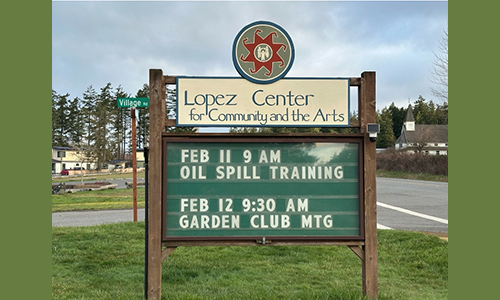
Islands’ Oil Spill Association (IOSA) held a public workshop on the classification, assessment, and cleanup of oiled shorelines, February 11 at the Lopez Community Center. Led by Gary Shigenaka, a 40+ year National Oceanic and Atmospheric Administration (NOAA) veteran and IOSA board member, the workshop featured speakers from NOAA and Washington Department of Ecology (Ecology), introducing IOSA volunteers and interested community members to the Shoreline Cleanup and Assessment Techniques (SCAT).
In the event of a large oil spill in San Juan County, this widely used system of standard terminology for describing oiled shorelines and best practices for cleaning them up would become a very important part of the recovery process. SCAT evolved out of the massive response to the wreck of the Exxon Valdez in 1989, which released 11 million gallons of crude oil into the previously pristine natural environment of Prince William Sound, Alaska.
This spill polluted 1300 miles of shoreline, causing catastrophic damage to environment and wildlife. The cleanup
operation went on for months and even years, involved many agencies and contractors, and underlined pressing needs for communication standards.
Gary opened the workshop, describing the role of SCAT in the typical disaster response structure involving multiple federal, state, and local government agencies and private contractors. SCAT provides a common language to enable cooperation. The nature of the shoreline, and the properties of oil soiling it, constrain the possible cleanup strategies. Commander Aaron Maggied, NOAA Scientific Support Coordinator for the PNW region, overviewed the SCAT shoreline categories and used them to analyze the 400+ miles of coast in San Juan County for damage potential. For example, rocky shores (about 25% of San Juan County’s coastline) are more resistant to oil pollution damage than tidal marsh.
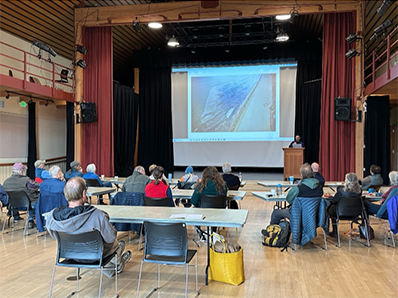
The type of oil in the slick also regulates its interaction with various coastal types. Heavy oil fractions behave differently from light diesel-like components. Gary illustrated these differences with visual analogs – fruit juice vs. corn syrup poured onto fine sand vs. dried beans. Laura Hayes of Ecology overviewed cleanup techniques and their relation to shoreline and pollutant characteristics, ranging from “natural recovery” – let nature take its course, often best with volatile and/or explosive pollutants such as gasoline – through manual removal of oiled material, water flushing (for example to refloat the oil for skimming) and use of machinery. The decision to end remediation measures is often controversial: as Gary pointed out, an oiled shoreline can seldom be returned to its pre-oiled state. Laura emphasized preventing health impacts on cleanup workers by the proper use of personal protective equipment (PPE) such as gloves, Tyvek suits, and boots. Hazardous materials handling and use of PPE are part of IOSA volunteer training.
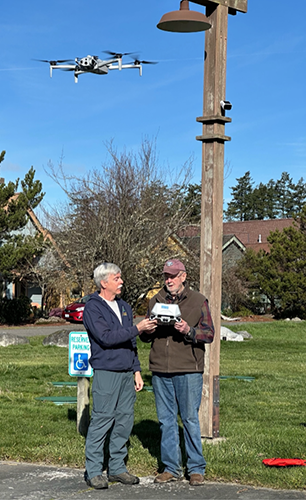
Identifying and tracking slicks are much easier from the air than from shore or a boat. David Byers of Ecology showed how useful Unmanned Aerial Vehicles (UAVs, drones) have become in oil spill remediation via a live demonstration. At the time of his presentation, it happened that Ecology staff were searching for a reported slick in the Columbia River near Vancouver, WA, flying a drone identical to one that David brought to Lopez. The software and comms built into this drone and its ground station enabled him to live-stream the search, and to ask the drone operators to show off some of its capabilities. After this extremely informative demonstration, David took the group to the parking lot and flew the same-model drone over Lopez village, showing off some of its other capabilities and explaining its controls. IOSA has begun to invest in drone technology and will be rolling out its local Drone Response Program by the end of 2026.
This demonstration underlined the possibilities for both local spill observation and integration with state agencies.
Matt Bissell (Ecology) brought the threads introduced in previous talks together in his review of SCAT forms. These forms guide the user through identification of shoreline types, tide and wind, oil characteristics, distribution of oil on the beach, accessibility of polluted areas, and resulting cleanup recommendations. To give participants a better idea of how the forms are used and how they capture the realities of an oiled shoreline, Matt led the group outside, where the other speakers had set up an assessment exercise.
The group divided into subgroups of 4 or 5. Each subgroup was provided with a form and assigned to assess a “beach” laid out on the lawn. “Oiled” areas were demarcated by colored lines, and flags gave additional information about the hypothetical polluted beach (“tarballs”, “dead salmon”, “gravel”,…).
Laura and Gary also addressed the interaction of cleanup efforts with cultural resources. Active cleanup, especially if it involves excavation, stands some chance of uncovering artifacts from earlier habitation, or even human remains. Ecology employs archaeologists and Tribal input to identify and preserve culturally significant objects that may surface during a cleanup operation.
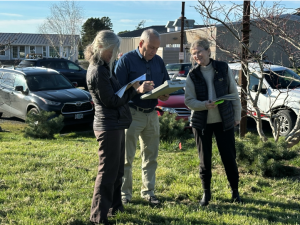
While IOSA’s operational focus is largely on keeping oil off the beach, the hazardous materials training and local knowledge that IOSA volunteers bring to the table can make them valuable contributors to early assessment and cleanup operations if oil does come ashore. By investing in workshops like this one, IOSA ensures that if the call ever comes, its volunteers won’t be starting from scratch — they’ll already speak the language, know the tools, and understand what’s at stake.
Islands’ Oil Spill Association is a one-of-a-kind spill response organization in the San Juan Islands, and one of very few non-profit, community-based, spill response organizations in the Nation. For more information, visit http://iosaonline.org. If you see oil in the water, report it to WA State at 800-OILS-911 or the USCG National Response Center at 800-424-8802. Both of these reporting agencies call on IOSA to respond within San Juan County.
(All photos: Gary Shigenaka)

**If you are reading theOrcasonian for free, thank your fellow islanders. If you would like to support theOrcasonian CLICK HERE to set your modestly-priced, voluntary subscription. Otherwise, no worries; we’re happy to share with you.**





Leave A Comment