

||| FROM KRISTA BOUCHEY for ORCAS POWER & LIGHT COOPERATIVE |||
Orcas Power & Light Cooperative (OPALCO) is inviting all members to participate in a newly launched Renewable Energy Survey designed to gather community insight on future energy programs, priorities, and opportunities.
As OPALCO continues planning for a resilient, sustainable energy future, member feedback will play a critical
role in shaping the cooperative’s long-term renewable energy strategy.
Members can take the survey online using the provided link or by scanning the QR code featured in OPALCO’s
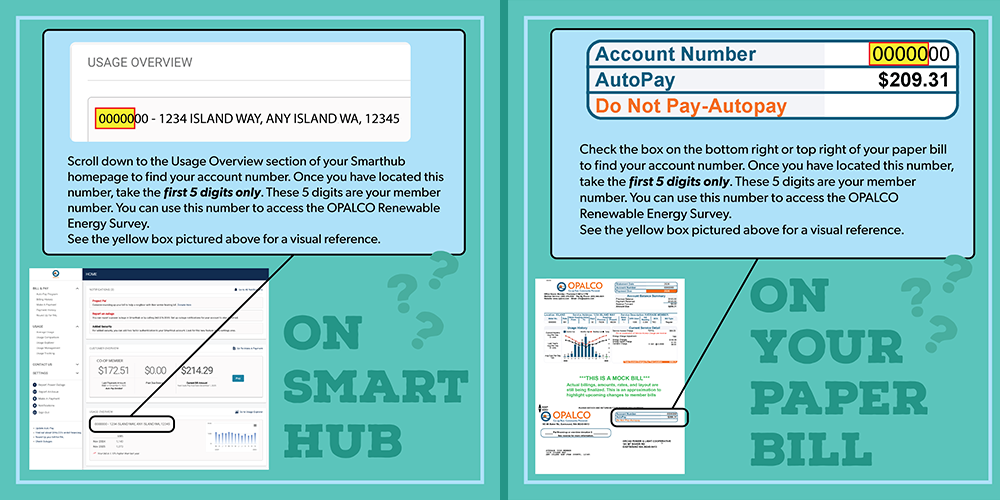
recent social media communications. To access the survey, participants will need their member number, which
can be found by locating the first five digits of their OPALCO account number. Visual guides have been shared on
social media as well to help members identify this number both in SmartHub and on their paper bills. For
additional questions about member number or accessing the survey, email communications@opalco.com or call
360-376-3500.
OPALCO has partnered with a research firm, DHM, to conduct a member survey that will be open until
December 12, 2025. OPALCO encourages all members to take a few minutes to share their thoughts. Those
needing assistance accessing the survey or who are experiencing any technical issues with the survey can reach
out to the help desk email: info@surveysinsight.com.
Visit the link to access the OPALCO Renewable Energy Survey: https://research-polls.com/uRk1
Orcas Power & Light Cooperative (OPALCO) is our member-owned cooperative electric utility, serving more than 11,400 members on 20 islands in San Juan County. OPALCO provides electricity that is 97% greenhouse-gas free and isgenerated predominantly by hydroelectric plants. OPALCO was founded in 1937.

**If you are reading theOrcasonian for free, thank your fellow islanders. If you would like to support theOrcasonian CLICK HERE to set your modestly-priced, voluntary subscription. Otherwise, no worries; we’re happy to share with you.**






I received a link for this survey but didn’t complete it because many of the questions were obviously biased in favor of OPALCO’s priorities. It felt like more of a public relations campaign than a legitimate effort to gather feedback. Here are a few examples of the choices that respondents could select:
• “San Juan County should keep current policies in place even if it means continued reliance on the mainland for energy, knowing that the frequency of energy blackouts will rise”
• ” I prefer to keep current land use policies, even if it limits the development of reliable energy sources and may result in occasional blackouts”
• “Current permitting processes should not be changed or streamlined regardless of urgency or potential power blackouts”
• “Not build renewable projects, knowing that energy blackouts may become more prevalent in the future”
By repeatedly invoking the threat of blackouts, and wording the survey questions in such a way that support for current permitting and land use policies is tacitly connected to blackouts, it felt like OPALCO was using scare tactics to convince respondents to provide the results that OPALCO wanted.
Consider this a PSA for anyone who’s considering the survey. Suggesting that we’re all going to freeze in the dark if land use policy doesn’t change is not the sort of nuanced approach that we should be having over this complex subject.
Looking at this opportunity for member expression as a political gambit is possible only in the absence of underlying facts. I would agree that OPALCO has been in part responsible for this twist by not describing the situation that existed in January 2024 that is expected to recur as our and the region’s power demands increase, irrespective of AI installations.
The Northwest Grid is a hodgepodge of interconnected generation and consumption much like a spiderweb. Generation and consumption are delicately synchronized in a gigantic ballet. When one dancer gets out of step, the effect cascades on the other tightly choreographed dancers who then have to stop dancing. In the case of electric utilities, they disconnect when they find themselves powering larger loads than those for which they are designed in order to save their own equipment and that (particularly frequency and voltage sensitive motors) of their customers.
New York City and environs suffered such a breakdown in New York City in August 2003. It took over a week for the involved utilities to come back on line and synch their voltage and frequency to rejoin the dance.
I think OPALCO is trying, not very articularly in my opinion, to prepare itself and its members for a similar event. January 2024 was a close shave here in the Northwest, and with the current trend in consumption and unstable weather, it must be seeing the risk increasing to the point where plans need to be made.
In short, this is not a case of OPALCO vs, ithe environment or against its members who, feeling their oats (a good sign of participation) see the issue as a political move by OPALCO to achieve control over the environment for, somehow, its purposes distinct from the interests of its members. OPALCO is legally bound to provide power to its members to the extent it can. However inarticulately, OPALCO is seeking to do so. Its efforts should not be seen as, and in my opinion are not, politically malign.
Please be constructive and respond to OPALCO’s poll. They’re doing their best; we should do ours.
I did not see this survey as anyone doing their best. In fact, I found it rather petulant. While I may be extrapolating a bit, some of the questions were akin to:
Would your rather:
a) die a slow painful death in an dystopian energy-void wasteland
b) allow us to pave the islands with solar farms
No mention at all about what can be done to promote conservation or creative problem solving. I have always been curious how far aggressive TOD rates used in conjunction with subsidized residential ESS implementations could go. I am now seeing a 32kWh battery being sold for less than $3000. A 240V / 12000W hybrid inverter runs about $5000. These two pieces of equipment would allow a house to be battery-run for the entire peak cycle, recharging from the grid each day from midnight to 0500 when there is surplus capacity. If the customer peaks above 12000W (very rare) the inverter would make up the overage from the grid as needed, up to a full 200 amp service. Rooftop solar could optionally augment this grid-based charging, and in some cases, replace it. Have you priced solar panels recently? They are laughably cheap. A 500 watt panel can now had for a few hundred bucks. The battery lasts 8000 cycles. (i.e. it will likely outlive you). This equipment sits in a closet or your garage, so no local environmental impact.
Is this is a better solution than solar farms and tidal generators? Could placing this setup in customer homes solve some of the problems? How would this compare cost-wise to solar farms and tidal generators? I don’t know because no one seems to talk about it.
OPALCO has an unusual challenge.: bringing power to these islands. The extraordinary cost of undersea cables that are doomed to deteriorate in what is a harsh environment for their constituent materials means that we must expect to replace them more often at far greater cost than land-based utilities must replace, or merely repair or upgrade, equivalent facilities.
This means that unlike other utilities’ financial structures, OPALCO spends large amounts per customer just to bring in the first watt of power to a customer.
This situation is inherently regressive but OPALCO cannot escape it, nor can its members.
Batteries are a great idea, but when we’re talking equity, what about those of us who are low income, and/or who rent?
What OPALCO is really selling isn’t simply electric power, but rather a vital asset referred to as capacity. OPALCO doesn’t know how much power you’re going to use (that is, how much capacity you intend to consume) beyond the size of your electric panel, which does figure into rates. But even that first watt of any capacity whatever is very expensive because it require an immense investment to supply, and to replace.
Each of us sees the rate structure from our personal perspective, but like it or not, we, all of us, rich and poor, share a large burden for having any power at all. And yes, it is inherently and I suggest inescapably regressive. The same rule applies to those living off-grid who must come up with sufficient capital to install a sufficient, reliable and safe system.
Bill, I don’t think you understood my comment.
I’m not suggesting everyone go buy a residential ESS, because yes, most probably could not afford it. What I am suggesting is that OPALCO add other possible solutions to the discussion. Building tidal generators, large solar farms, and full-scale battery storage systems is incredibly expensive and excruciatingly slow given the hypocritical population who reside and vacation here. People want no environmental impact but still live with all their usual luxuries, such as EVs and heat pumps. All I ask is how this would compare if OPALCO instead invested closer to the meter, and I gave an example of what that could look like.
Anyone who reads this survey quickly sees that this is not something OPALCO seems interested in. I could be wrong. I hope I am.
Furthermore, my comment made no mention of tariff structure. In fact, as much as I don’t like a nearly $70/month base fee, I see why it is probably the best compromise OPALCO can make at this time.
Thanks, I think we’re in closer agreement than I thought. My mistake. I do suggest that you engage directly with OPALCO concerning solutions close to the meter. Krista doesn’t just make pronouncements, and others respond directly and helpfully to constructive comment and suggestions.
It’s my understanding that OPALCO has looked at solutions closer to and inside the meter. But you’ve stated the conundrum: members want all of the benefits … provided that there is absolutely no (a “no” buried in a lengthy and expensive process) effect on the environment. It’s true that our spirits and our economy both rely on the environment. We sell (real estate) or rent (tourism) the environment, as well as experience the soul nourishing rush of seeing beauty about us. Power installations therefore create an immediate political issue in the minds of many reflecting the financial and aesthetic aspects of our society.
The bare fact is that like solid waste (including valuable clean green), we export what we are unwilling to deal with on-island for the simple reason that it degrades views and real estate values. The thinking is that our area is precious. Somewhere, anywhere else, is not.
The same thing is true about electrical power. We have in effect exported the burden of generating electrical power onto “less precious” areas, while enjoying its benefits in spades. In this respect, the actual amount used is beside the point, though there are many here glibly deciding on behalf of others that (1) we don’t need so much power, (2) that “certain people” use too much, and/or (3) well, OK, so long as (a) I can’t see it and (b) it doesn’t impact my real estate values.
My reaction to your note was simply “don’t complain. Engage!” starting by responding to the survey. And as to engaging directly, the worst thing that could happen is that mutual learning occurs. The best is that something actually happens.
In my personal opinion, something will happen. It may consist in a whole spread of things. Carping is not a solution, it is a behavior. If what OPALCO is asking isn’t to your mind relevant, engage, not en garde! (pun intended)
Wait… wait.. WAIT!!! What is this mass speculation about OPALCO, their motives and their push for solar in the San Juans as mere speculation?!? We don’t need to hypothesize and engage in their hyper normalization of mass energy consumption…We can look at DECATUR.
Decatur has apx 300 OPALCO customers….(only about 1/2 received their survey which seemed like thinly veiled propaganda)
It has only 100 registered voters. Seems like a great place to go if you don’t want all the opposition you got on San Juan. Never mind that it has no fire district, no ferry service, no paved roads and one county ramp. OPALCO loves to sing the praises of AgriSolar but that is not what is happening on Decatur. Their intention,if they get the conditional use permit, is to take out apx 16 acres of forested land in the middle of the island. It says 7-8 acres (on Website)of solar panels (but there will need to be additional tree removal so panels are not shaded) To those on larger islands, this may not seem like a lot but Decatur is very small. My point is that when they have choices , these are the kinds of choices they make. We as a community we need to stop giving them this “but they are a co-op” pass. Keep in mind that Decatur ALREADY has a micro grid but rather than go to another island, we are being made to contribute more.
My point is not a pity party for Decatur, it is in hopes that people will see this as a cautionary tale. Our 20 acres will soon be your 300 acres. To discuss any type of radical conservation of energy is to be mildly mocked. To me it seems much more radical to try to provide ENDLESS energy while destroying nature around us.
Bill Appel mentions the regional blackout that hit New York City in August 2003. It took over a week to restore power.
Although I am attracted to the idea of Agri-solar when it is carefully designed to benefit both the farmer and supply power to our community, I have questions about how OPALCO’s solar plus battery storage would prevent extended blackouts in the winter as well as expand service to an ever growing population in our county.
In the winter, solar panels in San Juan County produce only about 15% of their summer peak capacity. This is because the day lengths are shorter and there is more cloud cover in the winter months. Battery storage is expensive. It would be prohibitively expensive to install batteries that would store weeks, let alone months, of the energy necessary to supply our winter electricity demands, which are much higher than in the summer for those homes using electricity for heating. I know that cooling is sometimes needed in the summer (when solar would shine -so to speak), but OPALCO is promising the large scale solar plus batteries as a solution to all our growing energy needs in San Juan County.
Renewable energy, such as solar and wind, are intermittent and change seasonally in their average production.
Connecting large geographic regions with high voltage power transmission lines is part of the solution, but Washington States’s high voltage power transmission lines are already at max capacity. It is expensive to site new high voltage power transmission lines and landowners generally oppose them.
A few states allow new high voltage power transmission lines to be sited along highways, but this is against the law in Washington State. I think that we need to change this law.
There have been technological advances in geothermal energy that give me hope for this “firm” energy source as a backstop for when solar and wind power are insufficient. California has contracted with the geothermal firm FERVO to begin supplying power in 2026 from a site in Utah.
But until we address the barriers to expanding the high voltage power transmission grid, my hopes for this new source of firm backup power cannot be fulfilled.
I am also concerned that OPALCO has not addressed potential impacts to our aquifers from large solar arrays. OPALCO’s failure to perform a proper wetlands survey at the Bailer Hill site is part of the reason their permit was denied. I am certain that large solar arrays + agriculture can be installed to minimize impacts to groundwater recharge, but OPALCO would need to take the issue seriously, do the needed wetland surveys, and hire a design and installation company that understands these issues. When I have asked about this at public meetings, there has been no response.
Kendra’s observation that OPALCO’s survey “seemed like thinly veiled propaganda” is absolutely correct, only not so thinly veiled. If it really wanted to know how islanders felt about our current energy challeges and OPALCO’s proposal for dealing with them, it would have designed a far more neutral survey instrument instead of one that felt like a scold with pre-determined results.