
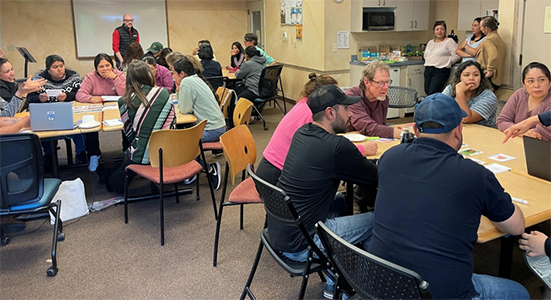
500+ hours of islander participation to generate 960 ideas to shape San Juan County’s future
||| FROM CHOM GRAECEN and FAITH VAN DE PUTTE for MADRONA INSTITUTE
September 18, 2025 — The Madrona Institute has released the Final Report of the COMPASS Project (Comprehensive Plan for Meaningful Public Action & Sustainable Solutions)—a community engagement initiative that gathered input from 258 San Juan County residents on the new Climate Element of the Comprehensive Plan.
Between September 2024 and July 2025, the COMPASS team convened 19 sessions—including public workshops, “beta test” pilots, and targeted focus groups—to engage islanders in a structured, science-informed conversation about climate change, housing, transportation, and community resilience.
Participants shared insights and personal observations on local climate impacts, examined emissions data, and brainstormed actionable steps San Juan County can take to reduce greenhouse gases and strengthen community resilience.
The result: 960 solution ideas and 120 written comment letters, now compiled and formally presented to County decision-makers as part of the Comprehensive Plan update.
“This type of open and participatory dialogue is not easy, especially when people face pressing daily challenges,” said Chuenchom Greacen, a co-lead of the COMPASS project. “But COMPASS succeeded in bridging lived experience with the best science available, presented in visually relatable ways. Islanders responded with creativity, seriousness, and hope for a more resilient community.”
Priorities Identified by the Community
Through dot-voting and facilitated discussion, participants identified key countywide priorities:
- Sustainable Transportation & Mobility: Support for transportation electrification, expanded
bus/shuttle service, EV charging stations, bike/walk infrastructure, and discouraging high‐impact
recreational boating. - Environmental Protection & Forest Stewardship: Calls to safeguard forests and habitats,
incentivize forest stewardship not harvests, and strengthen wildfire preparation. - Housing & Land Use: Advocacy for affordable & equitable housing through vacancy/second-home
taxes and house-size restrictions, and ADU and tiny home permitting reforms. - Local Food Systems: Investment in regenerative farming, food hubs, and local production.
- Renewable Energy & Electrification: Rooftop and community solar, battery storage, energy
retrofits, and rate reforms to discourage wasteful consumption.
Outreach to Underrepresented Voices
A key feature of COMPASS was intentional outreach to groups often left out of local planning conversations. Dedicated focus groups ensured their perspectives were elevated in the final report.
- Youth emphasized transportation, fairness in housing and consumption, and urgent climate action.
- Low-income and disabled residents prioritized accessible transportation, affordable housing, and
preservation of natural resources. - Spanish-speaking participants highlighted equitable transportation, local food systems, waste
reduction, tree protection, and better healthcare access.
These priorities underscored equity concerns and the need to align climate policy with access, affordability, and fairness.
Impact and Next Steps
Already, many community-generated ideas are reflected in the current draft of the Comprehensive Plan. From transportation improvements to house-size policies, the COMPASS process directly influenced official planning documents before the Planning Commission.
The process has logged more than 500 collective hours of resident participation, not including extensive preparation and data processing by the COMPASS team.
The revised Comprehensive Plan will go to the County Council. A public hearing is scheduled for October, where islanders will have an important opportunity to weigh in.
“COMPASS was direct democracy in action,” said the other COMPASS co-lead Faith Van De Putte. “It was incredible to watch the conversations unfold, the mutual learning and so many creative ideas about how we can make our community more resilient in the face of climate change.”
The full COMPASS Final Report is available online at www.madrona.org/compass.

**If you are reading theOrcasonian for free, thank your fellow islanders. If you would like to support theOrcasonian CLICK HERE to set your modestly-priced, voluntary subscription. Otherwise, no worries; we’re happy to share with you.**


Here is the direct link to downloading the COMPASS FINAL REPORT: https://drive.google.com/file/d/1V50u0ksXqO_QHnk-QxZSriMCIwHoUzTK/view?usp=drive_link
All the comments are available in Excel format as well: https://docs.google.com/spreadsheets/d/1kKKhqySVwhtw_qM7X6wEbSbwbFYEz82j/edit?usp=drive_link&ouid=110375033289361885464&rtpof=true&sd=true