||| FROM TAMAYO WOLF |||
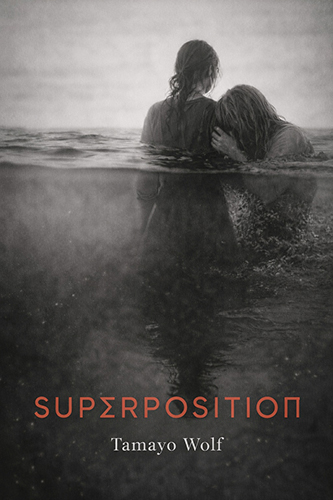
Reality is narrowing—coming to an unexpected end.
Interview with the Author, Tamayo Wolf
Tamayo Wolf is a writer whose work explores memory, belief, and the fragile mechanics that give reality its shape. His fiction blends speculative structures with literary restraint, often focusing on characters caught between conviction and doubt.
Q: This book took a long time to write. Why did it finally get finished now?
A: Well, my daughter was born right after I started, and I found raising her much more rewarding than writing. After I
picked it up again, I struggled to find an antagonist who wasn’t conventional, who was as unique as the story. Once I
saw that, the rest of the book stopped resisting.
Q: Who is the antagonist?
A: It isn’t really a who. It’s a system. One that doesn’t raise its voice or announce itself. It just persists. What unsettled me was realizing that systems don’t need intent to be cruel. Harm doesn’t have to be planned, it just has to be absorbed and normalized. Once damage stops registering as damage, cruelty runs on autopilot. That made for a surprisingly charismatic antagonist, once I put it in a fine suit and gave it excellent manners and a strong jawline.
Q: The novel deals heavily with doubt—religious doubt, scientific doubt, personal doubt. Is that the theme?
A: Doubt and belief, I would say. But doubt is the pressure, not the destination. The book is about what happens after doubt, whether people collapse under it or move through it. Every major character is forced to decide whether uncertainty absolves them of responsibility, or demands more of it.
Q: Some readers describe the book as dark. Do you see it that way?
A: I hope not. To me, it’s hopeful. The world needs a happy ending, right? I think it’s stubbornly hopeful, which is more uncomfortable. Darkness is easy to create, to write. Hope that has to survive contact with reality is harder. The book insists on resolution even when resolution is costly.
Q: Resolution is a loaded word in the novel. What does it mean to you?
A: Resolution isn’t certainty, isn’t closure. It’s commitment. It’s choosing coherence when incoherence would be safer. Every character is offered a way to remain unresolved, to delay, to defer, to hide behind systems or metaphysics. The question is who accepts that offer.
Q: The science in the book feels precise but never showy. How deliberate was that?
A: Thank you. I take that as a compliment. It really wanted to take center stage, and I had to resist that. Science here isn’t spectacle; it’s structure for the story. I wasn’t interested in explaining ideas so much as showing what they do to people, or can do for people. If the concepts feel grounded, it’s because they’re being used the way belief systems are used in real life: to justify choices.
Q: Readers familiar with Orcas Island may notice echoes of the landscape throughout the book. How intentional was that?
A: Very intentional. I wasn’t interested in disguising or promoting the place, just translating it. Islands already behave like thought experiments: they isolate, they preserve, they distort scale. Orcas gave me a physical grammar I could trust. I played with the history of it a bit, and that was fun and gave the story more depth. It’s also fun to be able to walk around your story daily.
Q: Point Doubt feels especially specific. Is it based on a real place?
A: Yes. Point Doubt is a refracted version of Point Doughty. The name change matters. Doubt isn’t just a mood in the book, it’s a location, a pressure system. I wanted the geography itself to feel isolated, uncertain, like a place where conviction erodes slowly.
Q: The church in town also feels very real. Locals will recognize it immediately.
A: If I’ve done my job, yes. There’s not much mistaking it, right? I didn’t invent a church for the story; I used the logic of the one that’s already there, the geographic logic, mostly, the spiritual logic too. And it’s positioned the way belief often is in small communities: central, visible, quietly burdened by the scale of the sea. You can feel that when you stand there.
Q: Did writing the book change how you see the island?
A: Yes. It sharpened it. You start noticing how many systems on an island operate on trust, ritual, and delay. Even today. Ferries, churches, families, reputations. When those systems fail, there’s nowhere else to put the consequences. That tension lives at the heart of the book.
Q: What do you hope readers take from Superposition?
A: I hope they come away less impressed by systems, and more interested in the quiet courage of individual resolution. Not answers. Decisions.
Q: What kind of reader is this book for?
A: Someone who’s felt their world get smaller and didn’t want to accept that as the end of the story. Or someone who’s curious about what belief actually does to a person, not as comfort, but as force.
Q: That sounds a bit like self-help.
A: I get why it could sound that way. But I wasn’t trying to offer guidance. I was trying to look at unresolved states—what happens when people refuse to decide, or are afraid to. The book isn’t telling you what to believe. It’s watching what belief does when you finally commit to something.
Q: Final Question. Why should someone read Superposition right now?
A: Because a lot of us are living inside systems that keep telling us to wait for clarity, for permission, for certainty, or just don’t offer it. This book asks what it costs to keep waiting, and what happens when someone finally doesn’t.
Superposition is Wolf’s second novel. It soft releases on
February 1, 2026.
https://www.amazon.com/dp/B0GHZ8721V
Superposition is available on Amazon only. Paperback will be available next month. https://www.amazon.com/gp/

**If you are reading theOrcasonian for free, thank your fellow islanders. If you would like to support theOrcasonian CLICK HERE to set your modestly-priced, voluntary subscription. Otherwise, no worries; we’re happy to share with you.**