A hopeful start, a hard lesson
||| FROM MEMBERS OF THE DECATUR COMMUNITY* |||
In 2018, Decatur Island became the first place in San Juan County to host a cooperative solar array. People here welcomed it. We believed in the promise of clean energy and were proud to play a leading role.
The promise did not fully materialize. The array delivered less energy than expected, the battery component lagged in installation and performance, routine maintenance and landscaping never matched the commitments, and the project highlighted how even small site and environmental details, if overlooked, can erode community trust.
None of these realities discredit solar power; they simply underscore a truth that applies across every island: projects meant to serve the public must be carefully planned, transparently managed, and properly maintained if they are to earn—and keep—public trust.
A pivot that raised questions
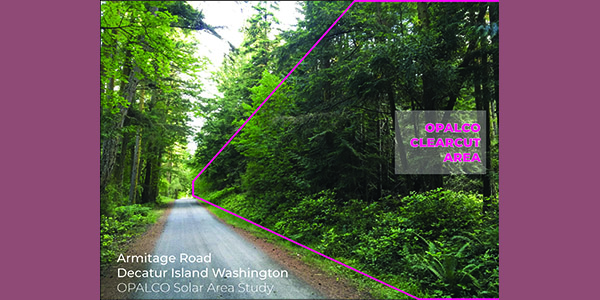
In 2025 OPALCO turned its attention to a proposed expansion of the existing solar array on Decatur that wasn’t in the original plan. For years, OPALCO focused on a larger array at Bailer Hill on San Juan Island. When that proposal stalled under a rigorous, multi-year review, attention shifted back to Decatur and a forested parcel near the existing substation.
For many residents, the pivot raised a principle, not a parochial concern: facilities of similar scale should face consistent permitting standards and transparent processes, no matter which island they are on. Rules should not change by ZIP code—or by ferry route, or by the lack of one for our outer islands. Consistent standards are how
communities build confidence that tradeoffs are being weighed fairly, island to island.
What the community did
Decatur’s response was not resistance; it was participation. Residents formed a study group, compared options, examined the site, and published a 29-page analysis. It offered alternate siting ideas (including non-forested or previously disturbed areas), specific mitigations for stormwater and fire risk, and a path to build renewable
generation that strengthens—not erodes—public confidence.
That is not “not in my backyard.” It is the opposite: it is a willingness to put shoulder to wheel, on the condition that the wheel is pointed in the right direction. The most efficient energy project is the one the public understands, trusts, and can help steward over its lifetime.
On August 19, a larger group of residents attended the San Juan County Council meeting. In coordinated presentations, they made the case that the proposed Decatur array is not useful or appropriate, that the County should not grant permits, and that the County should endorse an independent, citizen-led Energy Security Advisory Committee to address countywide challenges and develop a practical, effective plan.
The larger challenge
Zoom out from one parcel and one island, and the imperative becomes clearer. Our county’s energy security depends on more than additional panels. It depends on the health of the transmission backbone—the aging undersea cables that connect us to the mainland and between islands—and on choices that balance winter reliability, affordability, and climate goals with the realities of island life.
Those cables are nearing the end of their useful life, and replacing them will require a nine-figure investment and careful staging. Meanwhile, electricity demand is growing and winter peaks arrive when the sun is least helpful. Small solar projects can play a role—especially where they leverage existing corridors and infrastructure—but they are not a substitute for a countywide plan that honestly addresses cables, peak demand, and cost. In other words: the real challenge is systems planning, not just project siting.
A better way forward
There is a straightforward way to turn tension into trust: widen the table. San Juan County should support the formation of an Energy Security Advisory Committee—an independent, multi-stakeholder forum that includes OPALCO members, technical experts, environmental voices, tribal and local government representatives, and
community leaders from every island.
What would it do? Three practical things:
- Bring independent analysis to the public discourse. Commission objective studies on cable replacement timelines and costs, peak-season reliability, and the best mix of resources (including distributed solar, battery storage, and targeted demand management).
- Standardize how tradeoffs are weighed. Apply consistent criteria across islands for permitting, siting, and mitigation so that all projects face the same scrutiny and obligations.
- Build durable consent. Discuss concerns early, document commitments publicly, and measure outcomes against promises—so we learn and improve project over project.
This isn’t about slowing progress. It’s about taking the risk out of it. Big problems get solved faster when people can trust the process as much as the result.
Decatur’s contribution
Decatur is sometimes described as small, even peripheral. In this discussion, the island has offered something central: a template for constructive engagement. We welcomed the first array. When a second was proposed, we did our homework. We put forward alternatives and mitigations that could make any island’s project more credible and resilient. We asked for consistent rules and transparent planning so that each community carries a fair share of the work—and of the benefit. That is stewardship, not obstruction. It is what healthy cooperatives look like in practice.
What success looks like
Success is not the absence of debate. It is the presence of confidence. It is a member-owned utility explaining, in plain terms, how a project advances winter reliability, how it fits with cable planning, how costs are shared fairly, and how environmental protections are enforced—and then honoring those commitments over time.
Success is also geographic balance: a portfolio that respects each island’s character, leverages existing corridors where possible, and spreads impacts and benefits equitably. It is measuring projects not by what they symbolize, but by what they do—on the coldest nights of the year and over the full life of the asset. And success requires clarity: clarity of process, clarity of permitting standards, and clarity of finances, so that members can see plainly how projects fit into the cooperative’s long-term health.
A constructive request
The request to OPALCO’s leadership and board is simple: embrace an independent advisory structure and consistent permitting standards that build countywide trust. Put members in the room—alongside independent experts—early enough to shape outcomes. Commit to a transparent lifecycle plan for every project: construction
impacts, operations and maintenance, mid-life performance checks, and end-of-life recycling and reforestation where applicable.
If we do this, we will argue less about any single site and more about the shared plan that binds them all. The islands deserve nothing less.
Closing
The energy transition demands more than hardware. It demands trust—between institutions and members, between near-term impacts and long-term benefits, and between islands that rely on one another more than we sometimes admit.
Decatur’s story offers both a reminder and a map. The reminder: good intentions must be paired with good process. The map: widen the table, apply consistent rules, and plan the system we actually rely upon. If we follow it, we can strengthen not only our cooperative, but our collective energy security—together.
*Co-signed by members of the Decatur community:
Jon Allen
Charles Conway
Dawni Cunnington
Brian Grant
Rob Grant
Andrew Grenville
William Hurley
Dennis Jenkins
Kendra Lamb
Alan Mizuta
Supporting materials presented to the San Juan County Council on August 19, 2025 can be found here: https://tinyurl.com/decatur-solar-problems

**If you are reading theOrcasonian for free, thank your fellow islanders. If you would like to support theOrcasonian CLICK HERE to set your modestly-priced, voluntary subscription. Otherwise, no worries; we’re happy to share with you.**







This group has done their homework, very well thought out. A good road map for the future.
OPALCO wants many of the same things outlined from this group especially permitting predictability. Please consider coming to our in person community meetings in September to talk about local renewable energy in San Juan County. We are hosting these on San Juan, Orcas, and Lopez. Details can be found here http://www.opalco.com/events
A very articulate argument, and one that makes sense. OPALCO is a “member owned cooperative,” but also a sole-source utility responsible for the energy future of everyone in this county. Why are monthly on-line-only board meetings not advertised up-front on their website or in the Orcasonian, like most other public boards; and why does one have to contact OPALCO communications to request a link? Given announced significant, multi-year rate increases, and given public reaction to recent siting decisions, OPALCO needs more open, transparent and inclusive decision making. As the Decatur group states: “The request to OPALCO’s leadership and board is simple: embrace an independent advisory structure and consistent permitting standards that build countywide trust. Put members in the room—alongside independent experts—early enough to shape outcomes.”