||| FROM RUSSEL BARSH for KWIAHT |||
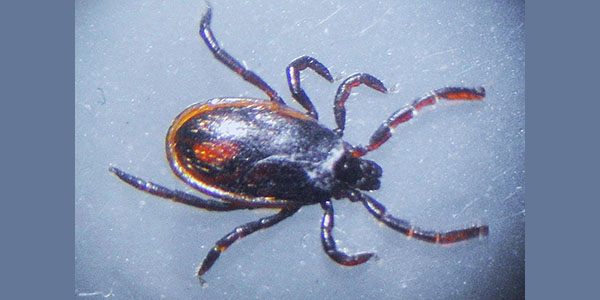
Tick season is here! In the San Juan Islands, ticks go “questing” for new hosts from January through June, usually peaking in March and April. While ticks are still relatively uncommon here, compared to the East Coast, hundreds of island residents and visitors each year discover ticks on themselves, or more frequently on their dogs. While fewer than 10 percent of island ticks carry some kind of bacteria or microparasite that can infect, and produce symptoms in people or dogs, it’s best to do a body check after hiking or dog-walking on local trails. The longer a tick is attached, the greater the risk of infection; and ticks can remain attached for up to 100 hours or longer.
You are most likely to encounter ticks in shrubby, overgrown areas, which is why dogs are so vulnerable if they go exploring off-leash. If you find an attached tick, use tweezers to pull out the animal, head and all, and disinfect the bite with rubbing alcohol or another disinfectant. Then mail your tick to us! Kwiaht, in collaboration with the state Department of Health entomologist and Lyme researchers at the Fred Hutchinson Cancer Center in Seattle, has been collecting and studying ticks in the islands for the past four years.
We can test ticks for infectious diseases, and use DNA from relatively fresh, intact ticks to learn more about when and how ticks originally arrived and spread in the islands; what kinds of animals individual ticks previously fed upon; and how they were originally infected. We depend on members of the public to help us continue to monitor the distribution of ticks in the San Juan Islands, and provide early warning of any new infectious risks that ticks may pose.
If you remove a tick, seal it into a small plastic bag (like a sandwich bag), place the bag in an envelope and mail it to: Kwiaht, PO Box 415, Lopez Island WA 98261 as soon as possible. Do not use sticky tape, plastic food wrap, alcohol or any, other liquid; they can interfere with our lab tests. Do not worry about killing the tick, either.
But be sure to include a note with three crucial pieces of information: (1) describe who was bitten, such as “a 45-year-old man,” or “a Labrador Retriever”; (2) your best guess as to where the tick was encountered, such as “Mount Finlayson trail” or “Eastsound dog park”; and (3) the full date the tick was discovered.
Include your name and an email address, or a phone number, if you would like us to contact you personally with the information we learn from your tick. Your name and contact details will never be made public, the same as with other health data.
For additional information, email: info@kwiaht.org

**If you are reading theOrcasonian for free, thank your fellow islanders. If you would like to support theOrcasonian CLICK HERE to set your modestly-priced, voluntary subscription. Otherwise, no worries; we’re happy to share with you.**