
Grassroots project guides updates to San Juan County’s comprehensive plan by creating space for neighbors to share lived experiences, priorities and ideas.
||| FROM SOPHIE CADRAN for SALISH CURRENT |||
The idea was born around a kitchen table. It started with questions like, “How would you do that?” and “If San Juan can’t do it, then who else can?”
It was 2023, and San Juan County was in the early stages of updating its comprehensive plan to include a new climate element — a blueprint for building climate resilience and reducing greenhouse gas emissions in the years ahead. Friends and residents of Lopez Island Chom Greacen and Faith Van De Putte wondered what they could do to make sure the process truly reflected community voices.
“We didn’t know exactly how the county’s engagement process would unfold, but knew we could more easily be nimble and innovative,” Greacen and Van De Putte wrote in an email. “We hoped to create more awareness and conversation about climate impacts and emissions in addition to providing input for the comp plan.”
From those conversations emerged the Comprehensive Plan Outreach for Meaningful Public Action and Sustainable Solutions — COMPASS — a program that surfaced the priorities and lived experiences residents wanted to see reflected in the plan. Chief among them are sustainable transportation measures and environmental protection.
Angela Broderick, climate and sustainability coordinator and project manager for the development of the climate element, noted that unless residents are already interested in climate resilience, it can be difficult to engage them in conversations about the comprehensive plan and its climate element. As a result, the County’s focus groups often draw a narrower set of perspectives. That’s where COMPASS’ targeted efforts proved valuable.

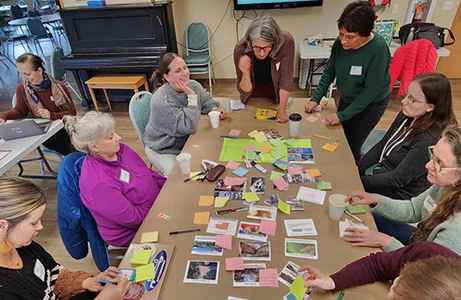
Residents at the Lopez Center for Community and the Arts on Feb. 21 sift through Climate COMPASS cards and discuss local climate crises, brainstorming ways to promote energy reduction and renewable transitions. Some ideas included removing barriers to solar power stations on agricultural land, subsidizing energy efficiency for low-income households, and expanding education on conservation and home retrofits. (COMPASS)
“What was important to us from the beginning was (engaging) the overburdened communities, so people who feel that climate impacts the most,” Broderick said. “So we had planned to target youth, the Latinx community and low-income folks, and COMPASS fell right in line with that, and that’s where we were able to get the best sort of diversity of perspectives.”
Greacen, an energy analyst, and Van De Putte, a regenerative farmer, decided to design a separate, community-driven engagement model — one they hoped would complement the county’s process and strengthen its findings. They believed that updating the comprehensive plan, and especially adding a climate element, was a moment when no voice could be left unheard.
Though the comprehensive plan won’t be finalized until December 2025, COMPASS is already leaving its mark, especially on transportation, economic development, housing and utilities.
As of the September draft, public comment generated by COMPASS sessions can be seen in Policy H 1.6, which addresses housing. The language reflects participants’ calls to reduce the number of second homes in the county, convert vacant homes into permanent residences and encourage smaller single-family dwellings.
‘Climate touches everything’
After 19 focus group sessions across the San Juan Islands, involving 258 participants, 960 ideas and 120 letters to the planning commission, one thing was clear: “Climate touches everything,” Van De Putte said.
By August 2025, COMPASS released its final report, shared with both the community and the county planning committee to help shape the comprehensive plan.
Participants’ feedback and priorities were shaped by San Juan County’s Greenhouse Gas report, which outlines the county’s sources of emissions. Transportation and maritime activities dominate the islands’ carbon footprint, accounting for 64% of total emissions. Ferries alone make up more than half of that, with recreational boating close behind.
Unsurprisingly, the COMPASS final report shows that the community’s top priority is making transportation and mobility more sustainable. Participants called for low-carbon, accessible transit, electric vehicle charging stations, expanded year-round bus and shuttle services, and a transition to electric or hydrogen ferries.
With maritime activities producing 68,914 metric tons of carbon dioxide equivalent annually — accounting for 39% of community emissions and 61% of transportation emissions — modernizing the ferry system alone could significantly reduce emissions.
The second priority focused on stewardship and environmental protection. Residents called for protecting and restoring forests, wetlands, shorelines and marine habitats, as well as better wildfire management, restrictions on clearcutting and honoring biodiversity through native planting and conservation easements.
Looking ahead
Working alongside the public engagement already led by the San Juan County Department of Community Development, COMPASS’ findings helped reaffirm and deepen residents’ priorities for the comprehensive plan.
“I think they brought more depth to the plan,” Broderick said. “Anytime we can actually have more individuals involved, the better. Even having more voices to support and reaffirm the same ideas is still good information and helpful information — and that also means that there’s a better chance that these folks may continue to track this work and continue to engage in the future.”
Community members will have more chances to weigh in on the comprehensive plan during county council public hearings ahead of final adoption. Afterward, the county will move on to drafting its Climate Action Plan, a five-year roadmap expected in mid-2026.
Broderick said the plan will address both islandwide priorities and island-specific needs, but limited funding and bandwidth mean not every idea from the comprehensive plan can be included.

Residents gather at the Shaw Community Building on March 3 for a COMPASS focus group session. Together, they examine the Climate COMPASS cards that outline the county’s greenhouse gas emissions. Discussing what measures could be taken to reduce emissions, the group emphasizes cultural shifts to support consumption reduction as well as housing and land use reform. (COMPASS)
“A big factor right now is that on a federal and state level, funding is not what it used to be,” Broderick said. “It’s not stable, and we can’t plan on it. So for (the climate action plan), we’re really going to have to say what are the lowest hanging fruit in terms of things that have multiple co-benefits, or things that are the easiest to implement, what’s the biggest bang for the buck?”
One aspect of the plan she’s especially excited about is building in different levels of action.
“Part of it is saying, here’s what the county needs to do, but then it’s also, here’s what homeowners can do, or just a resident can do,” Broderick said. “There are different levels of action we can take with the idea that we’re not going to single-handedly reverse climate change, but we can figure out what levers of influence we have to pull on here and where we can make a dent. And that makes the most sense here for us in our community.”
Underrepresented voices
To capture the full spectrum of San Juan County voices, COMPASS hosted focus groups for underrepresented residents, including low-income/disabled, Spanish-speaking and youth.
Thanks to COMPASS’ partnership with the resource centers on Lopez, San Juan and Orcas, low-income focus group participants received stipends or gifts to help offset lost wages from leaving work early, making the sessions more accessible. Each focus group also provided a meal, and some offered childcare.
Melissa Montalvo-Chavez, who facilitated the Spanish-speaking sessions, noticed a difference in how English and Spanish-speaking participants approached the conversations.
“The American participants were older, so they had either more freedom financially, time or they were way more flexible and more proactive about adopting new environment-friendly options — like changing their car for an electric car,” Montalvo-Chavez said.
For Spanish-speaking residents, the barriers looked different.
“Even though they wanted to be environmental, they would always try to choose either the cheapest option or the more accessible option,” Montalvo-Chavez said.
House cleaners, for example, wanted to use eco-friendly alternatives, but those products were often more expensive and harder to find, she said.
“Sure, I can go further and buy this one product, but am I going to actually take the ferry and pay for the ferry ticket just for getting an environmentally friendly alternative?” she asked.
Beyond cost, many participants were young parents juggling demanding schedules, making extra trips for sustainable products even less realistic.
Youth participants highlighted a different set of concerns.
Lopez Island resident Matilda Twigg, 18, who facilitated youth sessions, said many of her peers wondered how they could help with something as vast as the global climate crisis. She saw COMPASS as a way to make those conversations accessible to her peers.
“By sharing an avenue to contribute to local problems, it may give some students the tools they need to change those conversations,” Twigg said.
When Twigg introduced the COMPASS program in middle and high school classrooms, students quickly zeroed in on consumerism — food, clothing and daily necessities.
“If you live on an island, your consumer choices have magnified effects, because everything must be shipped to and from the mainland,” Twigg said.
The perspectives of all underrepresented groups are reflected in the final COMPASS report, with Sustainable Transportation and Mobility weighted the highest across the board.
More than climate
“A lot of times people feel like (climate action) is a luxury we can’t afford,” Greacen said. “Or people feel that, ‘I can barely put food on the table, why do I need to worry about the environment?’”
But the COMPASS project revealed that issues of climate touch everything. Therefore, the lack of climate action touches everything.

COMPASS cards helped inform discussions about San Juan County’s comprehensive plan.
“What really came out of the conversation was that the issue of environment, affordability and equity are very intertwined,” Greacen said.
For example, discussions about sustainable transportation weren’t only about lowering emissions.
“When people talk about sustainable transportation, it’s not about the environment necessarily; it’s actually about access,” Greacen said. “If we have public transportation that could be available — when some people can’t even afford a car — having transportation would really help address that access and equity issues.”
This was true for a participant that Van De Putte recalled at one of the low-income focus groups, who began the session angry and disengaged, convinced the government wouldn’t listen. By the end, she spoke powerfully about why public transportation should be the top priority.
“She said that, as an unhoused person who did not have a car, public transportation addressed both mitigation in reducing greenhouse gas emissions and equity,” Van De Putte said in an email.
This inequity is especially prevalent in San Juan County, which ranks the highest in income inequality among all Washington counties. The gap shows up in resource use as well: OPALCO reports that the 10 largest homes consume as much electricity as the lowest 2,300 households combined. That level of demand strains the power infrastructure and drives up costs for the entire county.
These intertwining conversations, Greacen says, are more important than ever right now.
“Particularly now that democracy is under attack, community members coming together and exercising that muscle of talking over difficult issues facing us, I feel like this is direct democracy in action,” Greacen said. “We need to exercise that muscle of participating directly in shaping the future of our own county, of our own government. So it’s really important for people to have a way to do that in an empowering way, and I feel this project was definitely focused on that.”
Per House Bill 1181, Skagit, Whatcom and San Juan counties submitted climate-related hazard assessments. In these reports earlier this year, drought and sea-level rise are some of the biggest natural dangers facing the region today. Among other concerns, San Juan especially noted water supply and limited roadways. Skagit noted reduced crop production, and Whatcom noted wildfire danger.
Skagit County finalized and adopted its updated comprehensive plan in June 2025. Residents listed their top priority as preserving agricultural land, followed by improving housing supply and affordability and environmental preservation. Similar to San Juan County, Whatcom County is slated to have its plan adopted by the end of the year.

**If you are reading theOrcasonian for free, thank your fellow islanders. If you would like to support theOrcasonian CLICK HERE to set your modestly-priced, voluntary subscription. Otherwise, no worries; we’re happy to share with you.**




Wow. Nothing about preserving wetland riparian habitats and nearshore and tidal habitats or mixed forest diversity, which make all of the rest of the seeming heartfelt aspirations possible . It seems such a ‘me first’ attitude.. While acknowledging that we are the settlers on Tribal lands, we still hurt the land and ourselves.
We need food and housing. AND! People should know this. The affordable housing mandates have hurt us since there are no mandates or oversight for what else is being built in our UGAs so luxury housing is taking up much of the lands and forcing development on undeveloped land Though we’re over 200 affordable housing units short in Eastsound UGA and must expand it to include 30 acres of forest and wind buffer to build another clustered housing project, we don’t mandate how many extra homes to allow for people with several, or prioritize the need for worker housing first above all other. The other stuff will keep being built, including VRBOs which will up the number we are short. It’s a broken system. No prioritization, and those housing mandates force us to continue to deforest in a watershed wetland basin. Does this makes sense to anyone who understands what happens in deforestation? Deforestation leads to desertification. Nothing about education, incentivizing doing right, or oversight on who profits, who are the investors, or at least some guidelines on how we grow? No water moratoriums? Really?
Please THINK this through so we can finally stop the runaway train that is hurting us all now, or a little later. You see it already. Number 1 in the state in highest level of income disparity. Who do you think will be building with these bloated market-driven real estate prices?
This is a subject nearest my heart – as it was for Dorothy Austin’s heart. She saw what was happening. Others of us see it, call out the reality of what that is doing. Well meaning folks – please listen to us. We have something for this government to consider and take seriously with more than lip service. I’m with the LatinX community and share their concerns. Who will do the jobs people want – AI robots? Please, think. Stop destroying families with things that will only cause them to have to leave or work 3 jobs and live in their car.
We were grateful to Salish Current for running this article and continuing to amplify the voices of the Climate COMPASS participants. However, they missed a very important point. Chom and I had tremendous support that was not reflected in the piece. Working under the umbrella of the Madrona Institute, we designed and facilitated Climate COMPASS as subcontractors for a Washington State Department of Commerce Public Participation Grant. Friends of the San Juans was the lead grantee, collaborating with Madrona Institute and the family resource centers on San Juan, Lopez, and Orcas islands.
It was this collaboration that truly made the project possible. We were dismayed to see that Madrona Institute, Friends of the San Juans, the Joyce Sobel Family Resource Center, the Orcas Community Resource Center, and the Lopez Island Family Resource Center were not acknowledged for their essential roles in this project.