
||| FROM ELISABETH BRITT |||
Water is a public trust, and on an island it is a lifeline. That is why the recent direction of the Eastsound Water Users Association should concern every member it serves.
In recent years, EWUA has shifted toward less transparency and more centralized control. Rates have risen, communication has narrowed, and decisions affecting public safety and affordability have been made with minimal explanation. This is not how a member-owned cooperative is meant to function.
A Policy That Treats Questions as a Problem
In December 2025, the Board adopted a “Good Neighbor Policy” that funnels all member questions through the Board President and discourages direct communication with individual directors. It even labels certain repeated questions as “disruptive.” In a cooperative, inquiry is not disruption — it is governance.
EWUA has also begun restricting public participation at its own meetings. Members who attempt to speak, raise concerns, or ask clarifying questions are told they are not permitted to address the Board. A cooperative that refuses to hear from its members is no longer practicing cooperative governance at all.
Costs Up, Information Down
Members have watched rates increase while the billing structure has become harder to decipher. EWUA does not publish historical rate schedules. The Association paid $5,030 in late fees after failing to submit a $10,000 waterrights lease payment to the Eastsound Sewer and Water District (ESWD) on time — a mistake members learned about only after the fact. Salaries and contract costs have climbed sharply, yet details about hours, responsibilities, and justification remain unclear.
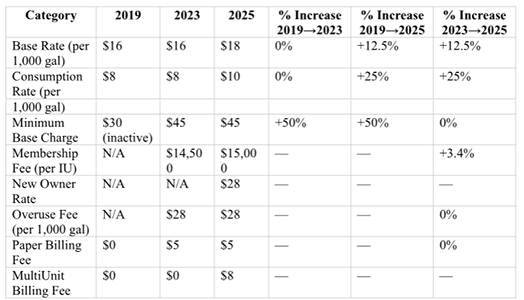
To understand how member costs have changed, the following table summarizes EWUA’s published rate increases since 2019:
EWUA Rate Changes and Percentage Increases (2019 → 2023 → 2025)
All figures from EWUA’s published schedules.
These are significant financial decisions made with member money, yet members are given little insight into how or why they are made.
A Fee Structure That Punishes Members
EWUA’s “new owner rate” charges anyone who purchases a home — including longtime members who downsize or move within the service area — $28 per thousand gallons for a full year or more, four times the standard consumption rate. A cooperative should not penalize members for normal life transitions or burden new residents with disproportionate costs. This structure raises significant questions about fairness, intent, and compliance with the cooperative’s obligation to operate “at cost.”
Emergency Readiness Without Operators on the Island
EWUA is now transitioning to offisland operators, a shift that introduces significant risk for an island community. With ferry delays common, this is not a staffing plan — it is a gamble. In a contamination event, pressure loss, or system failure, minutes matter. A certified operator stuck in Anacortes cannot protect a family whose tap water has suddenly turned unsafe. Members have asked for clarity about emergency protocols and staffing. They have not received it.
Housing, Affordability, and the Cost of Uncertainty
Orcas Island is already in a severe housing crisis. Water governance directly affects whether homes remain affordable, whether new housing can be built, and whether essential workers can stay. When EWUA raises rates without clear justification, restricts communication, or creates uncertainty about operational readiness, it becomes another barrier in a community already stretched thin.
A Cooperative Drifting Away From Its Mandate
As a 501(c)(12) cooperative, EWUA is legally required to operate “at cost.” Transparency is not optional — it is foundational. Yet recent decisions point toward higher costs, less information, and fewer avenues for member engagement. The Good Neighbor Policy did not start this trend. It codified it.
A Path Forward
Some members support exploring collaboration or consolidation with ESWD. Others want EWUA to remain independent but far more transparent. What unites them is concern about the cumulative effect of decisions that make it harder to understand how the system is run and how their money is being used. A structured, open conversation about the future of the system is overdue.
The author is an EWUA member and former general manager of a Group A water system. She has also worked in state policy on water rights and public safety.

**If you are reading theOrcasonian for free, thank your fellow islanders. If you would like to support theOrcasonian CLICK HERE to set your modestly-priced, voluntary subscription. Otherwise, no worries; we’re happy to share with you.**






A good example of what (my partner) Elisabeth Britt is writing about is the Clark Well Project, whose projected costs were recently estimated at $1.2 million by General Manager Dan Burke at the November 2025 annual EWUA membership meeting. That’s almost $1,000 per member and twice what I had heard previously, or $600,000. Such a major, expensive project should have been discussed with the membership and its feedback included in the decision-making process, but I for one had heard nothing about it in over a year until late 2025. Nor could I find much about it in the (rather sparse) monthly meeting minutes accessible on the EWUA website, which went back only to August 2025 when I last looked. There SHOULD have been a vote at a well-attended board meeting on whether to go ahead with the project at that cost level, but I could find nothing of the sort. All I could find, with the help of Treasurer Chris Madison was a figure of $289,000 approved by the Board in the 2021-2022 budget cycle — presumably for project design and engineering by HDR Engineering of Bellingham.
Chris also provided estimates of 2025 expenditures for the project, which total about $304K, including another $55,681 for HDR Engineering plus similar amounts for Island X Excavators, Bowerbird Builders and for chlorine generation. My guess is that at least another $500K will have to be spent in 2026 to complete the project on schedule. But that’s just my uneducated guess. It would be extremely helpful if he and the Board could level with the members on exactly what has been spent to date for the Clark Well Project and what they anticipate spending this year. It would also be helpful to know exactly who is responsible for day-to-day management of this very important project. Is it HDR Engineering?
Those who want to view the progress on the Clark Well project can easily drive by it on Mt. Baker Road, across from Island Health Clinic.
Michael’s comment highlights exactly why members are asking for clearer documentation around the Clark Well project.
Since the November 2025 meeting, I’ve reviewed the most recent Clark Well completion budget dated May 29, 2025. That budget shows a projected total cost of approximately $1.29 million, with less than half paid so far and more than $700,000 still remaining. The original project was widely understood to be closer to $600,000, and I have not been able to locate board minutes or member communications documenting approval of a budget increase of this scale.
I think there are several reasonable questions that follow from this:
• What was the original budget and timeline formally approved by the Board, and when?
• What is the current expected completion date compared to what was originally presented?
• What specific factors drove the cost increase (scope changes, delays, change orders), and where are those documented?
• Which portions of the project were competitively bid, and which were directly awarded?
• Are there board minutes showing review and approval of contracts and budget amendments before work proceeded?
For members who want to ask these questions directly, the next EWUA Board Meeting is Tuesday, January 20, from 5:00–7:00 pm at the OIFR Fire Hall. Members can also email questions in advance to the Board President at president@eastsoundwater.org
.
Given the size of this project and its impact on rates and future borrowing, these seem like questions any cooperative member should be able to answer by reading the public record. If those records exist, sharing them would go a long way toward restoring confidence.
Eastsound Water Users Association Regular Board Meeting
1/20/2026
5:30 – 7:30 PM
Eastsound Firehall
Committee Members: Teri Nigretto – President, Jim Nelson, Chris Madison, Vaughn Ploeger, Madeline Danielson , Mike Speece & Leith Templin
5:30 PM – Welcome and Introduction
Public Comment
Approve Minutes
Regular Board Meeting from December 16, 2025
OIPRD Draft Contract Update
Double Hill Road Update
GM Report
Policy Committee Update
Conflict of Interest Policy
7:30 Adjournment
Here’s the thing: Members own nothing in a private utility. So basically, as in all privately owned utilities, the members have no real voice.
I am concerned that we seem to know nothing about plans for a Clark Well – is that somebody’s name or a type of well, since i can find nothing about it with an internet search. I want to know what it is, what it does, why EWUA thinks they need it, and what EWUA hopes to achieve with it – both now and in the future.
I can find no information on ia Clark well, nor its environmental risks (pollution – including by chlorine, contamination of aquifers, ground and drinking water), and if it is dug, drilled, or driven. what are the benefits – the Whys of building it? How will it affect the water table from surrounding lands and waterways, – and to how far away? Will other lands dry up because of it? Were any environmentals factored in or required? I;ve been curious every time I drive by but know and understand nothing.
But what most concerns me the most, out of all of this – is offshoring the care, monitoring, and maintenance of our water system both here and in emergency situations, and letting good knowledgeable capable and trustworthy LOCAL people who understand our water system and our needs, go. Are their jobs being terminated? Please answer our questions.
ps. I know EWUA doesn’t ‘have to’ provide public comment periods, but as a good neighbor. it should. Both at the beginning and at the end of each meeting.
The new “good neighbor” policy sounds like a euphemism for a structure that only goes one way – please assuage our suspicions and build trust.
OK… so I went to tonight’s meeting. Things went along ok for awhile. Then, a frustrated Board member scolded new people (of which I will include myself, because I’ve tried to avoid the ongoing kerfuffle for the last two years) for asking some valid questions for clarification about a Conflict of Interest policy.
.
I had to leave early. because it was too much to watch this – what kind of message does this send to our new members to be chastised as if they are little children? I was so happy to see younger faces, since so many of us are older and tired. I hope they keep going to meetings. It’s their world too, and they will inherit decisions made now. This is the future of our watershed and drinking water.
So… as soon as I got home I went on the website, looked around, read some stuff. There was nothing from 2025 except minutes (Dec 2025 was approved tonight but not up yet) and the new “Good Neighbor” Policy from Dec. 2025, which basically says contact the President only.
Nothing about the Clark Tank anywhere except in the Annual Nov. meeting minutes. The last financials posted are from June 2024 about EWUA’s financial process -but the burden is on members to find more recent financials, both monthly and annual. There was nothing easy to find about the Clark Well where it would be easy to find if you didn’t know to look in the minutes. To his credit, the GM put up a presentation report on project work in 2025. Here’s the link for the 2025 annual meeting minutes and a presentation.
https://www.eastsoundwater.org/annual-meeting-and-vote-results-2025/
Clark well info starts on pg 23 but there is no information on why we need it, what environmental impacts it may have on the rest of the watershed and to surrounding neighbors, and if proper environmentals were done, which ones, and what use that water will have, other than to continue the disastrous route of unfettered unmanaged growth.-Our watersheds are not a golden cash cow. They are the veins and capillaries of the land. . I took a screenshot of page 43 and don’t think I can post it here but I can send it to the Editor to publish – it leads to a lot more questions for me. There was much enthusiasm from the GM about how much output – but I have some concerns and questions – and now with the good neighbor policy, I can’t contact the GM directly and talk to him about it. This is frustrating.
I left that meeting downhearted. I understand that EWUA has had a hard year in 2024. So have the membership. It all seemed so ugly on all parts. Trust was broken. Both sides were hurt. It’s going to take time and effort to repair that. I am sorry there was a recall. I did my best to keep out of that disaster. But now… it’s time we change whatever conditions in leadership that have created that mess so it doesn’t happen again. Part of the responsibility of PAID board members is to bring new people up to date. It’s part of the job description. But don’t scold the new people; be glad they are there. They may very well be future board members!
Here’s what disturbs me. most: Given OPALCO’s record, I don’t think EWUA should be modeling their policies exactly after the OPALCO board’s, and when a young man asked about whether a conflict of interest policy also protected board members from the rest of the board, if they should go against the biases of the board – he was shut down and that’s where the meeting really took a dive. It was a legitimate question, since OPALCO board has a closed=loop selection process which did, indeed, prevent a person from running because they deemed that person ‘not a team player.’ This is my opinion only. These are MY imperfect, opinionated minutes of tonight’s meeting. The membership wants transparency. Over communication isn’t the issue. Simple transparency is. If EWUA needs to hire someone specifically to do what the membership is asking, then do it. The lawsuits for recall were paid for by the membership! At least partially. We don’t want to repeat that scenario.
Sadie, thank you for showing up — both in your comments and at the meeting — with such honesty, curiosity, and care for this community. Your words carry weight because they come from someone who isn’t trying to score points or stir conflict, but someone who genuinely wants our water system, and our relationships around it, to be healthy.
What you describe about the meeting matters. When a cooperative makes people feel hesitant, chastised, or unwelcome for asking basic questions, something fundamental has gone off course. New members, younger members, long‑time members — everyone deserves to feel that their presence is valued and their questions are legitimate. Your instinct to protect that space is exactly what a cooperative needs to survive.
Your questions about the Clark Well are equally important. Wanting to understand what it is, why it’s needed, what environmental reviews were done, and how it affects the watershed isn’t obstruction — it’s stewardship. When information is scattered, incomplete, or hard to find, it puts an unfair burden on members and erodes trust, even when the intentions behind the project may be good.
And your point about off‑island operators goes straight to the heart of island life. Local knowledge isn’t a luxury here — it’s part of our resilience. When people who understand the system and the community are sidelined or let go, it raises real questions about readiness and priorities.
What stands out most in your comments is your desire for repair. You’re not calling for conflict; you’re calling for clarity, respect, and a culture where members and leadership can meet each other halfway. That’s the kind of leadership from the membership that makes a cooperative stronger, not weaker.
Thank you for speaking with both conviction and compassion. Your voice is helping shape a conversation that needs to happen, and I hope the Board recognizes the value of what you’re offering.