
||| FROM CENTER FOR WHALE RESEARCH |||
Full Encounter Report
ObservBegin: 12:29PM
ObservEnd: 14:04PM
Vessel: Mike 1
Staff: Mark Malleson, Joe Zelwietro
Other Observers: Austen Holland-Roy and Rachelle Hayden
Pods: Bigg’s killer whales
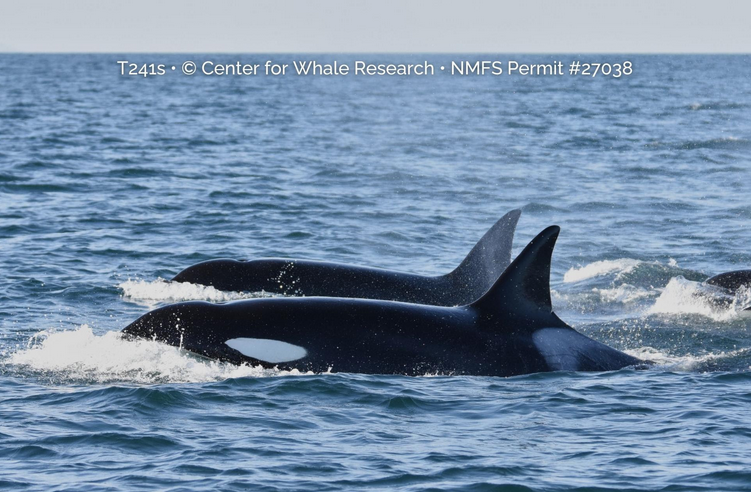
IDsEncountered: T241, T241A, T241B, T241A1, T241A2
LocationDescr: Sherringham
EncSummary: With the San Juan field team working with the entire Southern Resident clan in Puget Sound, the Victoria squad was thinking they had a chance at Bigg’s in the western strait, and pointed southwest, toward Race Rocks to begin their survey. After a brief pause to opportunistically document a couple of restful humpback whales near the VF buoy, they continued west toward Sheringham Point, stopping periodically for binocular scans and hydrophone drops. Turning north and east toward Vancouver Island, Mark spotted a small cluster of spouts a couple of miles to the southeast and stopped the boat to confirm what they hoped for: killer whales!
The tight group of five whales was traveling quickly east, making 6.5 knots against a moderate ebb current and outflow-driven surface chop. After a short dive, the whales appeared abeam Mike 1, and the team quickly recognized the matriarch as T241, a very rare visitor to the Salish Sea, along with her kin. The T241s are a part of the outer-coastal subset of Bigg’s killer whales that occur most often along or near the continental shelf of the Eastern North Pacific, first posited by researchers in the 1990s and later described by our colleagues at the Canadian Department of Fisheries and Oceans in 2013 (Ford et al. 2013). Criteria for the placement of the given
Bigg’s killer whales into either the inner- or outer-coastal subset has been developed in the years since (Towers et al. 2019) as more is understood. While whales from this subset occasionally venture into the Salish Sea, they typically only explore the western Juan de Fuca Strait, and are more often encountered along the outer coast of California, the canyons west of Vancouver Island, and Haida Gwaii in northern BC…though with relatively low research effort in those hard-to-reach locales, this half of the West Coast Bigg’s population are rare finds anywhere.
The team collected a series of right- and left-side identification photos of the tri-generational matriline and were excited to find a previously undocumented calf traveling alongside T241A. This group was last photographed over a year ago along the continental shelf west of Vancouver Island, and it was not present then. The calf appeared to be just over a year old, likely born sometime over the winter of 2024-25. We expect this youngster to be designated T241A2, as mom was also accompanied by her first-known offspring today, T241A1. The team also noted that T241B had grown significantly in the two years since the CWR last observed the line in late 2023. Mike 1 and crew then moved off to shadow the animals from a good distance as the matriline began to spread out, wondering if a predation event was perhaps imminent. Sure enough, after approximately 10 minutes, they regrouped and began milling. No prey species was observed, and the hunt itself was quite short, but within 5-7 minutes, both T241A and T241A1 were observed carrying flesh in their mouths as they broke the surface for breaths. The team ended their encounter there as the whales began to move on, wandering east-southeast.
Full Encounter Report
ObservBegin: 11:37 AM
ObservEnd: 01:16 PM
Vessel: KCB III
Staff: Michael Weiss
Other Observers: Monika Wieland Shields, Jason Shields, Sara Shimazu, Molly Henling, Rachel John
Pods: J, K, L
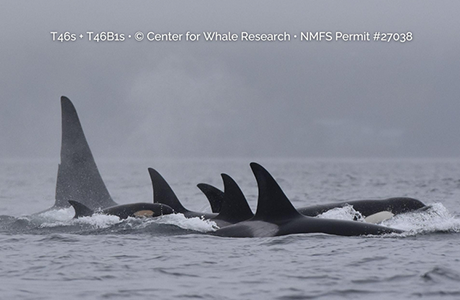
IDsEncountered: T46B1, T46B1A, T46B1C, T46B1D, T46E, T46F, T122
LocationDescr: Alki Point
EncSummary: The team had received reports of a large group of killer whales heading north out of southern Puget Sound, and got off the dock at 1055 to see if they could find them. They arrived on scene at 1137, about halfway between Alki Point and Blake Island.
The team first saw a small group of whales, including one large whale. This turned out to be T46E, T46F, and T122. The whales were moving north at a good clip, quickly moving in front of the mouth of Elliot Bay.
The team spotted another group of whales to the northwest. The team stayed with the T46s for a few minutes as they began to catch up to this northern group, before putting ahead to catch up with these other whales. This second group was the T46B1s, with their newest calf, T46B1D, travelling in echelon with older sister T46B1A.
These whales also moved north quickly, but eventually took a long, deep dive. When they next surfaced, they had stalled out just to the south of the research boat, moving slowly north. The team got the drone over them and was able to see they had nabbed a harbor porpoise. This porpoise turned out to still be alive: the whales dropped it briefly, at which point it made a break towards the research boat only to get caught again, for good this time.
The whales began processing and sharing their kill while the T46s continued to catch up. Soon the whole group was together in a tight formation, once again heading north. T46E briefly broke away from the group to quickly capture a seal, and the whales slowed to prey share briefly once again.
The conditions began to turn nasty, with rain and fog closing in. The team ended their encounter at 1316, with the whales a couple of miles northeast of Pt. Monroe.

**If you are reading theOrcasonian for free, thank your fellow islanders. If you would like to support theOrcasonian CLICK HERE to set your modestly-priced, voluntary subscription. Otherwise, no worries; we’re happy to share with you.**