

The strong relationship between state and local officials was on display as San Juan County’s Council, along with other community leaders, joined in an honest discussion of islanders’ transportation needs.
||| FROM SAN JUAN COUNTY COMMUNICATIONS |||
This week, the San Juan County Council attended a community meeting on Orcas Island, hosted by Governor Bob Ferguson, to address questions about Washington State Ferry (WSF) service in the San Juan Islands.
“It’s great to see so many folks show up to talk about the future of ferries here in Washington State,” began Governor Ferguson. “Our goal is to hear from all of you – the good, the bad, and what needs improvement.”
WA State officials, including WSF Deputy Assistant Secretary John Vezina, acknowledged the strong relationship between state and local officials was on display as San Juan County’s Council, along with community leaders from the Town of Friday Harbor, the school districts, local environmental groups, the Chambers of Commerce and Visitors Bureau, the Economic Development Council, OPALCO, Friends of the San Juans, and more joined in an honest discussion of islanders’ transportation needs.
“The Council–” said WSF Deputy Assistant Secretary John Vezina, “They are such strong advocates for you all and telling us what’s going on. It’s really important.”
Vezina, along with other WA State officials including WSDOT Transportation Secretary Julie Meredith and WSF Deputy Secretary Steve Nevey shared details of recent updates to the WSF system, including:

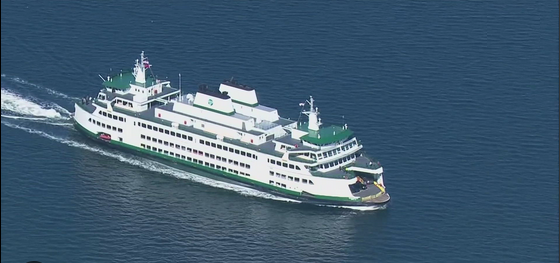
- The Wenatchee, one of WSF’s largest vessels, completed it hybrid-electric conversion and is back in service this summer.
- Other hybrid-electric conversions have been paused as the Governor is prioritizing “vessels in the water.”
- Governor Ferguson has selected Eastern Shipbuilding Group to fabricate three new 160-vehicle hybrid-electric ferries to replace the aging fleet.
- WSF Deputy Secretary Steve Nevey was added to the Governor’s cabinet, thus further emphasizing the Governor’s focus on prioritizing the ferry system.
WSF leadership also noted the updated ferry schedules developed by island residents, ongoing efforts to build a strong workforce through training opportunities and higher wages, and improvements to the reliability of the interisland route up to 98% from last year’s 95%.
“We understand that every route that is cancelled is a challenge for all of you and we need to do better,” said Vezina.
In keeping with the stated intent of the meeting, the majority of time was spent answering questions from the public. Community question topics included:
- The reservation system: Community members asked about ways to improve the reservation system. Some noted trouble securing reservations while others questioned the need for a reservation at all. WSF leadership shared that they are developing a new reservation system, served by the cloud, in an effort to improve capacity.
- Walk-on ferry / water taxi service: Several community members raised questions about the possibility of funding a water taxi or other foot-passenger option. WSF leadership shared that a recently conducted walk-on passenger survey revealed high interest in traveling without a vehicle. Councilmember Paulsen shared that part of the County’s marine transport project was analyzing the local need, and that a broader community conversation regarding support would be helpful.
- WSF crewing: Questions were raised about crew shortages – is there a floating engineer to address engine problems across multiple boats? Does WSF take crew from one boat to fill another? In both cases, WSF staff clarified that engineers are assigned to one boat and deck crews are assigned to routes. WSF is working to cross-train engineers whenever possible. Additionally, WSF staff clarified that crews are not pulled from other boats or routes to support a certain run.
- The impact of service disruptions on medical services: Several community members shared stories of service disruptions that hindered their ability to receive or provide medical care. They urged WSF staff to coordinate vessel space to accommodate stranded passengers and to improve service. “We know you deserve better service – we’re doing the best we can right now with the resources we have but it’s going to get better. When you talk about the impacts of not being able to get to your medical appointments, let alone work or other things, is something we feel deeply,” said Vezina.
The meeting ended with a message of teamwork. “Getting our ferry system where we want it – it’s a team effort,” said Governor Ferguson. “And part of that team effort is all of you.”
San Juan County Council reviewed the results of the County’s Marine Transportation Pilot Project during the July 15 Council meeting and will continue conversations regarding transportation throughout 2025.

**If you are reading theOrcasonian for free, thank your fellow islanders. If you would like to support theOrcasonian CLICK HERE to set your modestly-priced, voluntary subscription. Otherwise, no worries; we’re happy to share with you.**





Having been following issues raised at the Orcas Ferry Landing for over a year now, and having commented upon those issues in these pages, I am surprised (“shocked” might be a better word) that nothing is included above on this subject. I know for a fact that at least one Orcas Islander raised this question of equitable pay for equivalent work during the Q&A session and that Deputy Vezina replied to it with assurances. And I have discussed it many times with County Commissioner Justin Paulsen.
But as Elisabeth Britt just enlightened readers a few days ago in another Orcasonian article, there is the pressing issue of terminal worker safety, too:
https://theorcasonian.com/letter-to-editor-when-public-service-meets-public-fury/
The harrowing incident she describes was happening the very morning that the above ferry meeting was about to occur, to which Governor Ferguson and the WSDOT officials were probably oblivious at the time. Hopefully they will soon be informed of what happened and begin to take appropriate actions. Orcas Ferry Landing workers deserve the exact same protections as do those on the mainland and on the ferries, too.
It’s not just the wages and benefits.
There are many issues with the ferry system that need to be fixed, but people also need to remember that living out here is a choice. The article mentions one specific issue that underlines this. If you regularly need to go to the mainland for medical appointments, and you’re unable to receive that care, you might consider moving to the mainland. Island life inherently involves compromises. I would never blame “the system” for something that’s within my capacity to change, because it’s literally impossible for the system to function with 100% efficiency and I’d never bet my life or my health on that system.
David, I echo your comment…..Almost 3 years ago I did what you suggest; I sold my “forever” house in West Sound and moved in to Anacortes. Most medical appointments are now a 10 minute drive down the hill. Mt. Vernon, Burlington and Bellingham are under an hour’s drive, with no traffic crunch.
And, for those of you thinking to do the same, Anacortes is a super interesting place in which to live: an island itself, a great variety of festivals, learning opportunities, and a great Senior Center, under city management (takes the pressure off its non-profit Foundation).
I have to admit, however that Orcas will always be in my heart; I still keep tabs on goings-on….and the OICMF!