
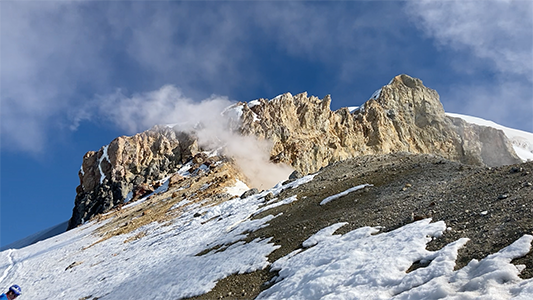
State officials and clean energy developers investigate the potential of tapping into the nearby volcano.
||| FROM THE SALISH CURRENT |||
Seen from afar, Mount Baker appears to be a sleeping giant, a glacier-armored peak lying in repose. Mountaineers who have reached the summit know that the stratovolcano is very much awake.
Climbers who approach the summit from the east skirt past the Sherman Crater, where sulfurous steam billows skyward — evidence of the vast energy roiling beneath the peak.
Now, officials with the Washington state departments of Ecology and Natural Resources, the Whatcom Public Utility District and clean energy developers are accelerating long-simmering efforts to tap into the heat beneath Mount Baker for geothermal energy. Last month, the Whatcom PUD and the Nooksack Indian Tribe held a meeting in Deming for county, state, tribal and federal stakeholders to discuss the geothermal potential surrounding the 10,000-foot peak. And last month state officials held two virtual public listening sessions for Washington residents to learn more about geothermal resources in the Evergreen State.
Spurred by AI
The heightened interest in plumbing Mount Baker is part of a bigger rush. Spurred by increasing electricity demands from the AI sector and enabled by recent technological innovations, geothermal energy is experiencing a surge of enthusiasm not seen since the 1970s.
“I’ve been in geothermal myself for 17 years, and this is by the most exciting, biggest boom that I’ve seen,” said Trenton Cladouhos, vice president for geothermal resource development at Quaise, a developer specializing in next-generation drilling technologies for geothermal.
It’s no secret among geologists that the area surrounding Mount Baker has significant geothermal energy potential. In the 1980s, DNR drilled some test wells near Baker Hot Springs, located between Baker Lake and the summits of Mount Baker and Mount Shuksan. In the 1990s, Seattle City Light leased some of the area from the U.S. Forest Service for possible geothermal development.
‘Enhanced geothermal’
Then things went quiet — until recent advances in drilling technologies reignited interest.
Geothermal energy works by tapping into the heat within Earth’s crust — which in much of the Mountain West, including volcano-pocked Cascadia, is relatively close to the surface. The first generation of geothermal plants built in the 1970s — like The Geysers facility in California, the world’s largest conventional geothermal facility — rely on steam coming straight from the ground to spin the turbines. Today, clean energy developers are using what’s called “enhanced geothermal,” 21st century drilling techniques perfected by the oil and gas industry to drill deeper into hotter areas.
These technological advances have made the Mount Baker area much more attractive for clean energy developers. While no company has yet submitted a proposal to site a geothermal plant in the area, the pieces are falling into place for a developer to eventually make a bid.
Investigating potential
In 2015, the U.S. Forest Service released an environmental impact assessment for geothermal energy development around the mountain, a first step in the leasing process. Separately, the Whatcom PUD and the Nooksack Indian Tribe in 2024 hired a Seattle firm, Hotrock Energy Research Organization, to investigate the energy potential of the mountain.
“Whatcom PUD believes that as a utility it is critical for us to be looking at the future needs of our community, even as far ahead as 50 years,” and agency spokesperson wrote in an email to Salish Current, noting that geothermal is cited an area of focus in the PUD’s most recent strategic plan. “Long-term solutions require long-term planning and foresight. We anticipate the number of people who call Whatcom County home will increase substantially over the next 50 years, making power supply more difficult. We believe we can play a large part in a power supply solution.”
According to Cladouhos, who served as a consultant on the feasibility study commissioned by the PUD and the Nooksack Tribe, a geothermal plant using conventional techniques could generate about 40 megawatts of electricity. An enhanced geothermal plant could increase that figure more than tenfold, to about 435 megawatts. That’s enough electricity to supply more than 80,000 homes — roughly 80%of Whatcom County’s total current electricity demand.
“This is kind of theoretical at this point,” Cladouhos told Salish Current, “but that’s how much heat is under the ground in that area along the west side of Baker Lake.”
Energy and beauty
Geothermal energy now produces less than 1% of the globe’s electricity. Enhanced geothermal could boost that figure to about 15% of global energy growth demand in 2050, according to the International Energy Agency. For the most part, national environmental organizations have been supportive of geothermal energy, which doesn’t come with any carbon pollution. And unlike some renewable energy sources, geothermal plants run around the clock — supplying so-called “baseload power” much like a nuclear plant, only without the problem of waste disposal, since enhanced geothermal plants have no effluent.
But Cladouhos acknowledges that “the question is still up there whether (geothermal development near Mount Baker) would be feasible from an environmental standpoint, as far as protecting the scenic beauty of that area.” The Whatcom PUD-Nooksack Tribe feasibility study locates a future power plant not far from the popular campgrounds along the shores of Baker Lake. And while geothermal plants have a relatively small footprint compared to other power plants, there would be some forest clearing. Cladouhos estimates that a 400-megawatt plant would involve about 180 acres of “surface disturbance.”
To give Washington residents a chance to weigh the trade-offs of geothermal development, state officials have already launched a series of public information sessions, as mandated by a law the legislature passed in 2024 to investigate geothermal resources in the state. In addition to the areas around Mount Baker, the state-led process is also looking at the geothermal potential near Mount St. Helens and the Wind River Valley off the Columbia River
The first meeting was held in August and two others in early in November. All were well attended, according to staff from Ecology. Additional sessions will be scheduled for early 2026. Ecology staffers say that so far they’ve heard few concerns about geothermal development in the state — just a curiosity about the technology and its potential.
“We really are trying to hear from people as early as in the process as we can,” Diane Butorac, a clean energy coordination manager at Ecology, told Salish Current. “We are trying to say, ‘Here’s what we know about the technologies. Here’s what we know about our resources. What are your concerns? Where do you see risks? Where do you see opportunities?’ And then use that as a starting point for further discussions. This is really the first stage.” The fact-finding process is scheduled to run through June 2027, at which point Ecology will submit its findings to the state legislature.

**If you are reading theOrcasonian for free, thank your fellow islanders. If you would like to support theOrcasonian CLICK HERE to set your modestly-priced, voluntary subscription. Otherwise, no worries; we’re happy to share with you.**





Salish Current doesn’t allow comments, so I’ll comment here. I find it truly distasteful that an outlet like the Salish Current that purports to report with “integrity” on “public health issues affecting people, wildlife, land, water and air” (from their mission statement) and yet writes such a biased, one-sided article about geothermal mining.
The article mentions Mt. Baker’s “beauty” as a concern but doesn’t mention all the problems with “enhanced geothermal”.
“Enhanced” geothermal is like fracking, only for hot water instead of oil. It works by drilling deep into hot rock, injecting water under pressure to fracture it (similar to fracking), creating pathways for water to circulate, absorb heat, and then be brought to the surface as steam to power turbines.
Problems with enhanced geothermal include high costs, induced seismicity, reservoir creation challenges (like creating sufficient fractures and preventing thermal breakthrough), and managing geochemical issues (corrosion, scaling) and water use, all while requiring building industrial plants and infrastructure for advanced drilling in hard rock in remote locations.
Sounds fantastic right? No, it’s a frickin’ boondoggle.
The article makes not a single mention of the massive disruption to the wildlife and ecosystems where it would take place, or that continually finding new ways to power this ecocidal way of life, including massive AI data centers, is not environmentally sound even if you can somehow fudge the numbers to make it look like geothermal is so-called “clean” energy.
I am sick to my upper teeth of those who claim to care about public health and the environment making excuses for, or worse, getting excited about, as in this article, doing more destruction to ecosystems like Mt. Baker in the name of so-called “clean” energy. There is nothing “clean” about it, and nothing “clean” about what the energy will be used to power.
I call on the Salish Current and all journalists to tell the truth, the whole truth.
While I agree with Elizabeth that the best answers to our regional energy problem are conservation and rationing, pragmatically speaking, geothermal energy is significantly less environmentally damaging overall than any existing fossil fuel energy system or SMR (Small Modular Reactor) systems. How much ongoing damage does a hydro-electric dam cause to an entire watershed? How many PV panels would it take to produce as much power as a Baker Lake geothermal well? Creating, shipping and eventually replacing those panels has a significant carbon footprint as well. The sad reality is that every single energy source causes SOME environmental damage. Even a coppiced woodlot feeding a high efficiency woodstove has a negative impact on the planet… The simple fact of our existence has a huge impact on the planet, mostly negative, particularly when you consider how many H. sapiens are currently drawing breath!
The low hanging fruit regarding energy is, of course, conservation. But until the price of energy is high enough to motivate investing in high efficiency appliances, vehicles, heating systems, insulation, etc., most people will simply do whatever leaves the most money in their pocket at the end of the month. In 1976, Jimmy Carter asked us all to drive 55 mph and turn our thermostats down to 68F but apparently those simple conservation measures were unacceptable to Reagan era Republicans. Yet that kind of conservative thinking is precisely what we need now (and should have done then)!
OPALCO is ideally situated to encourage conservation among the membership (I know we have already been trying, but without much observable success other than a lot of PV panels on roofs that don’t even point south.) Therefore, I propose we adopt a FAIR SHARE policy, wherein each member pays a base fee each month that includes the right to purchase electricity at the lowest feasible rate, up to the amount of each member’s ‘share’. Any electricity use after your ‘share’ will be charged at a significantly higher rate that continues to ramp up the more you use. That rate would be both punitive, in order to encourage conservation, and strategic, in order to raise capital for upcoming expenses (submarine cables). A membership advisory work group should probably be convened to figure out the fairest way to determine ‘shares’, as no matter what figures come from management, it will be deemed unfair by someone whose electric bill is going up. And some of us are going to see higher monthly bills, that is about the only thing that is certain!
While contemplating that unsavory point, bear in mind that for some islanders a couple hundred dollars extra expense every month is chicken feed, but to some others, retirees on fixed incomes for example, the same amount might be a budget buster. Trying to be ‘fair’ about electric bills when extreme economic disparity is already present will undoubtedly be challenging but I think there is enough discretionary wealth at the top of the economic pyramid to insure that everyone can access their FAIR SHARE of imported electricity.
What do YOU think?
I think that’s an interesting idea that should be considered, Ken. It resembles what EWUA once did on water rates. You got 5000 gallons a month for the base rate, something like $45 I recall, but paid through the nose for added 1000s of gallons. Under the scheme that replaced it, which is something like OPALCO’s pricing scheme, we often pay $100 a month despite keeping our monthly water usage well below 5000 gallons. Two EWUA members complained about those costs at last Tuesday’s board meeting.
The simple facts of the matter are that if we here in the County and in Washington State care mostly about cost, we’d fire up the coal and gas power plants and invest in better cables from the mainland. If we care mostly about the environment, we’d conserve and reduce like nobody’s business. If we care only about CO2 emissions, we’d conserve and reduce like nobody’s business because so-called “renewables” do little to nothing about CO2 emissions.
Our current plan of increasing electricity supply by whatever means at our disposal, while at the same time increasing electricity demand, means we are sticking to business-as-usual: the ecocidal and suicidal plan for infinite growth on a finite planet, that has nothing to do with either cost or the environment.
I’d support ANY attempt at conservation given we have none whatsoever at the moment, whether it’s your FAIR SHARE idea Ken, or something else. Ultimately, however, I think we need to find a way to get more people to care. Most people in the County simply aren’t aware of any of this. Either they gasp every time they open their electricity bill and see it’s gone up yet again and start factoring in whether they’ll be able to afford food for the month, or they don’t even bother opening the bill because it’s on autopay and money doesn’t matter to them at all.
In the meantime, I really hope no one tries fracking Mt. Baker for hot water. I will personally go and stand in the way of the bulldozers if they do.
The art of magic is distraction. The magician draws our attention to the left hand while hiding the coin in his right. Today, though most of the energy used in the county is fossil, the fossil-fuel industry focuses us on “kWh” so we ignore “GHGs.”
They don’t want us to know that roughly 70% of our county’s pollution comes from just two things: fossil-fueled transportation and heating.
A typical fossil-fueled county home is very inefficient, requiring 4x more energy per year for driving and heating than an electrified one, while costing 4.5x more and spewing roughly 60x more toxic pollution (GHG, sulfur, and particulates).
They don’t want us to know that 93% of global warming heat has been absorbed by our oceans—acidifying our waters and heating the Salish Sea to a point where as many as 30% of plant and animal species face extinction in the next 50 years—a mere microsecond in Earth time.
They don’t want us to know that our home insurance rates have surged as climate-driven wildfire and flood risks accelerate. Or that we pay an average of $2,200 per person annually in hidden subsidies for fossil fuels—costs that fall hardest on the most vulnerable among us. They offer no energy efficiency rebates or programs, and no energy assistance to vulnerable households.
Washington State and most nations are focused on stopping the burn.
Related:
• https://ecology.wa.gov/air-climate/climate-commitment-act
• The Petroleum Papers by Geoff Dembicki
• Merchants of Doubt by Naomi Oreskes
• Fire Weather by John Vaillant
I like Ken Woods’ Fair Share proposal:
“Therefore, I propose we adopt a FAIR SHARE policy, wherein each member pays a base fee each month that includes the right to purchase electricity at the lowest feasible rate, up to the amount of each member’s ‘share’. Any electricity use after your ‘share’ will be charged at a significantly higher rate that continues to ramp up the more you use. That rate would be both punitive, in order to encourage conservation, and strategic, in order to raise capital for upcoming expenses (submarine cables). A membership advisory work group should probably be convened to figure out the fairest way to determine ‘shares’, as no matter what figures come from management, it will be deemed unfair by someone whose electric bill is going up.”
PS My thermostat is set at 65F. I wear sweaters indoors these days.
When I was younger, I set it at 55F. Getting soft in my old age.
I agree with Elisabeth that the biggest challenge is to get a critical mass of people to care enough to learn the truth and respond appropriately.
I had the same reaction to the article in Salish Current about it being biased and blatantly ignoring the reality of the true costs of pursuing geothermal energy. Thanks, Beth, for giving the details.
I agree with the idea of charging more per Kwh for higher levels of use, but am also concerned that the base fee is too high, as Elisabeth pointed out in her previous article, https://theorcasonian.com/running-on-empty-what-copper-teaches-us-about-the-limits-of-clean-energy/
“A high base charge is one of the most regressive pricing structures a utility can adopt. It shifts the financial burden away from high-consuming, high-income households and onto those who use the least electricity, often because they cannot afford to use more. Someone who keeps their usage low, who heats with wood or limits appliances, or who simply lives in a small home or ADU, must still pay the same fixed fee as someone whose electricity use is several times higher. A family using 150 kilowatt-hours each month pays the same base charge as a household burning through 2,000. The less you use, the higher your effective price per unit becomes.”
I also challenge Jay to also produce statistics that include the impact of all the upstream use of fossil fuels to produce and maintain the mechanisms for mass electrification. We cannot afford to look only at point of use emissions as “the” measure of “clean” or “renewable” energy while ignoring all the upstream emissions. We cannot afford to look only at carbon emissions while ignoring all the other substances we are releasing into our air, soil, and water. We cannot afford to look only at “beauty” as a measure of impact on the earth while ignoring ecology. We cannot afford to consider only climate change as a measure of our impact on our planet while ignoring all the other planetary boundaries that have been crossed as a result of human activity. (See https://www.stockholmresilience.org/news–events/general-news/2025-09-24-seven-of-nine-planetary-boundaries-now-breached.html )
We can’t effectively solve a problem of the actual magnitude we face, as Jay said, by distracting ourselves– by focusing and acting only the part on which people can make money. That is, inventing more things to manufacture and sell. And now, the big distraction is AI.
Thanks, Alexandra. The numbers I provided include the upstream use of fossil fuels. This is known as a Lifecycle Assessment (LCA), which accounts for the “cradle-to-grave” impact: mining, manufacturing, construction, transporting materials, and decommissioning.
Here are the median lifecycle emissions measured in grams of CO2 equivalent per kilowatt-hour (gCO2 eq/kWh):
••••••••••••••••••••••••••••••••••••••••• Coal (1,001)
•••••••••••••••••••••••••••••••••• Oil (840)
••••••••••••••••••• Natural Gas / Propane (486)
•• Solar (Utility) (48)
•• Solar (Rooftop) (41)
•• Geothermal (37)
• Hydro (lifecycle) (21)
• Nuclear(13)
• Wind (Onshore) (13)
• Ocean (Tidal/Wave) (8)
• Hydro (ongoing emissions) (2)
When the fossil-fuel industry and opponents of renewable energy say solar is “dirty” because of mining, they are looking only at the ~40 grams of initial solar manufacturing emissions. They conveniently ignore coal’s 980+ grams of combustion emissions that a coal plant spews for every single kWh it generates throughout its entire life.
Source: NREL; Life Cycle Greenhouse Gas Emissions from Electricity Generation: Update, 2021.
Typically, both the cost and EROEI of solar and wind (and probably others) is vastly underestimated because the lifecycle analysis is so limited and often doesn’t include the other infrastructure that must be included (batteries, back-up power plants, grid lines, dealing with waste, etc.)
Two recent articles addressing these points:
* https://www.artberman.com/blog/the-sunset-of-the-renewable-dream/
* https://un-denial.com/2025/07/12/by-hideaway-eroei/
The lack of full lifecycle analysis on both cost and EROEI also means a lack of full analysis at both ends of the lifecycle regarding carbon emissions.
Another flaw in mining analysis is that the waste rock is usually ignored when comparing materials. Waste rock in oil and gas extraction is minimal compared to waste rock in mining for things like coal, lithium, copper, etc. (Note: I’m NOT arguing for fossil fuels!)
And ALL of it ignores that main point which is that continuing to add more available energy/materials perpetuates growth and thus destruction of the natural world. We know that new energy/materials is *added* to total energy/materials supply, leading to growth, leading to higher demand. At a global level (which is what matters here), it is *not* replacing existing forms of energy/materials. That is why conservation and reduction, while impossible in our current global economy (which requires infinite growth in order to not collapse, and therefore ever increasing energy/materials), are the only path to any sort of future.
Like all other animals on Earth, humans require flourishing and functioning ecosystems to survive. Our way of life destroys ecosystems at all levels. The two are therefore incompatible. How long we have until our way of life destroys enough of the web of life to make life no longer possible for large mammals on Earth remains to be seen. It seems as though the path we as a species are on is to FAFO.