With a bottlenose population threatened by fishing gear, boats and pollution, campaigners on South Korea’s Jeju island are lobbying to extend legal status to the vulnerable cetaceans
||| FROM THE GUARDIAN |||
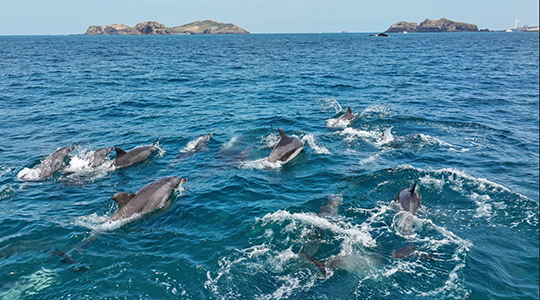
It is a beautiful sunny day on the island of Jeju in South Korea and as the boat cuts through the water all seems calm and clear. Then they start to appear – one telltale fin and then another. Soon, a pod of eight or nine dolphins can be seen moving through the sea, seemingly following the path of the boat.
But as they start to jump and dive, fins cutting through the air, it becomes apparent that one dolphin is missing the appendage, his body breaking the surface but without the telltale profile of his companions. His name, given to him by a local environmental group, is Orae, which literally translates as “long”, but in this context means “wishing him a long life”.
Orae is one of about 130 Indo-Pacific bottlenose dolphins living in the waters surrounding Jeju. Many display scars of the increasingly dangerous lives they lead after coming into contact with discarded fishing gear that entangles and cuts into them, or through close encounters with boats or jetskis operating around the island.
Piloting the boat is someone known on the island as “Dolphin Man”, AKA Jeongjoon Lee, a Korean director known for his work on documenting and helping the bottlenose population.
“Because the dolphins cannot cut the fishing lines themselves, we decided to cut them for them,” he says. “In one case, we had to cut wire from two different places, one was going in through the dolphin’s face to its body, and another from around its tail where it had become tangled.”
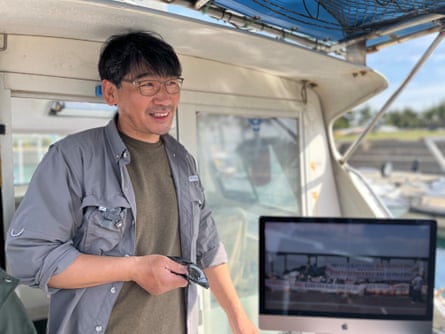
Jeongjoon Lee, who is known on Jeju as ‘Dolphin Man’. The director has made several documentaries about the local bottlenose population. Photograph: Young Nam Kim/KOEM
Now, a coalition of campaigners and environmentalists want to take things further. They are hoping to have the bottlenose population recognised as a “legal person”, which would give them additional rights and make it easier to protect them.
The idea is part of a growing movement to recognise rights in law of nonhuman species and places, and is the first attempt in Korea to give such status to an animal.
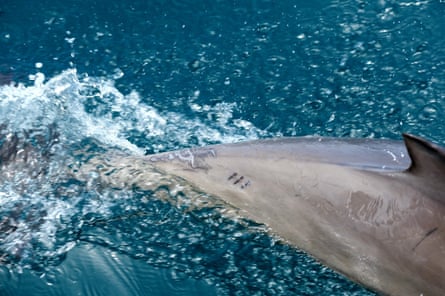
Jeju’s dolphins bear scars from fishing lines and boat propellers. Photograph: YN Kim/KOEM
“The idea is that if an individual or a company threatens their livelihood, then we could act on behalf of the dolphins to sue them or to take action in another way,” says Miyeon Kim, who works at Marine Animal Research and Conservation (Marc), the local NGO responsible for naming the dolphins.
“Different organisations that work with the dolphins have been pushing for this for two years now, but it’s very complicated and you have to get the Korean government, as well as the citizens of Jeju, to back such a move.”
The dolphins are officially listed by the International Union for Conservation of Nature (IUCN) as “near threatened” rather than threatened, but the IUCN states that a lack of data on the dolphins makes it difficult to assess whether this status is accurate.
Some subpopulations – there are pods throughout the Indian Ocean, south-east Asia and Australia – probably face much greater threats, it says, particularly those that live close to islands.
Around Jeju these threats come from discarded fishing gear, dive and tourist boats that get too close, construction noise that affects the dolphin’s use of sonar, and pollution and runoff from the island’s many fish farms. The latest concern is the construction of the largest windfarm in Korea, and one of the biggest in the world, off the coast of Jeju.

**If you are reading theOrcasonian for free, thank your fellow islanders. If you would like to support theOrcasonian CLICK HERE to set your modestly-priced, voluntary subscription. Otherwise, no worries; we’re happy to share with you.**