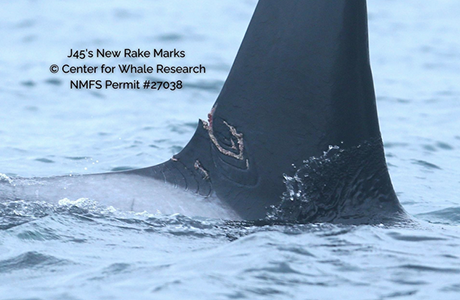
EncSummary: At 0945, Mark received a call from George that he was seeing over a dozen killer whales spread out off Victoria’s waterfront. Mark felt it was likely J pod, as they were recently spotted around the Gulf Islands, but knew it would be good to confirm, so he mobilized Mike 1 in Victoria and headed out with George. Mark hoped to find 16-year-old male J45, who had recently been photographed by onlookers in Active Pass sporting a new wound at the base of his dorsal fin. It was reported as possible propeller marks, which Mark and CWR staff thought was unlikely; more likely, the injury was caused by rake marks from one of the other members of his pod. A better photograph was needed to prove this.
As they headed southwest from the harbour, Mark and George could see humpback blows and a large aggregation of birds just beyond Constance Bank. After reaching the area and spending several minutes scanning with binoculars, George spotted a dorsal fin to the west of them, toward William Head. They worked their way there and came across a trio of whales, whom Mark immediately confirmed were three of the four J16s: J16 and her two daughters, J36 and J42. They were traveling north toward Victoria.
Over the next couple of hours, they came across more members of J pod, all quite multi-directional in their movements to indicate foraging. The whales were spread from the northwest side of Constance Bank all the way to just northeast of Race Rocks. The guys on Mike 1 worked hard to locate J45, but with this huge spread and long foraging dives, it felt like this was going to be a tall order. Mark was about to give up and call it a day after finding close to two-thirds of the 27 members and was starting to see repeats when he noticed several members of the pod beginning to group loosely together back to the west of the boat. He eased toward them with hopes some new whales had shown up, and as luck would have it, the first whale Mark spotted was J45!
They spent the next few minutes photographing the 16-year-old sprouting male’s new battle scars on both his right and left sides before ending the encounter. It was clear that the scarring was not from a propeller and indeed fresh killer whale teeth rake marks. These “rakes” from the teeth of other killer whales scraping and sometimes piercing the skin are commonplace in the Southern Resident Community, and throughout killer whale populations around the globe. When they appear on saddle patches or eyepatches or cause nicks and notches to form along the dorsal fin, researchers can use the unique scarring patterns to aid in the identification of individuals. Males, particularly sub-adult males like J45, tend to accumulate these at a higher rate than females and older males; read more about rake marks in our August 2023 blog post and associated research. The blog can be read HERE