||| FROM MINOR LILE |||
Last year I happened to be in Washington DC, for an affordable housing conference that began in late May, just after the Memorial Day weekend.
On the Friday after the conference, I got together with a college friend who is a docent and exhibit designer at Arlington House, which is located in the center of Arlington National Cemetery. Arlington House was the former home of Confederate General Robert E Lee and is sometimes referred to as the Custis/Lee mansion.
The Custis family was a prominent slave holding family that is part of my ancestry. My friend Steve is descended from the Syphax family, many of whom lived in servitude for generations as slaves owned by the Custis family. So while we haven’t yet traced it back fully, it’s quite possible that we are distant cousins.
Steve had invited me to join him for a Dedication Day ceremony at the National Cemetery. The first Dedication Day was held on May 30, 1868, to honor the Civil War dead and is the precursor to what we now celebrate as Memorial Day.
One of the speakers at the ceremony was a retired Army officer whose military career began as a helicopter side gunner during Vietnam. His remarks focused on the United States Colored Troops (as they were known at the time) and the role that they had played in the Civil War, including being among the Union troops that arrived in Galveston, Texas, on June 19, 1865.
On the same day as they landed in Galveston, approximately two months after the surrender at Appomattox, a general order was issued by the commanding general ‘advising the people of Texas that all slaves are free in accordance with the Emancipation Proclamation’ that President Lincoln had issued in January 1863.
The Emancipation Proclamation was a war time document that declared “that all persons held as slaves”within the Confederate states “are, and henceforward shall be free.” However, the proclamation only applied to the States in rebellion and did not free slaves held in the border states along the line between the Union and the Confederacy or in the few
northern states that still allowed slavery.
It is a little remembered fact that until the ratification of the 13th Amendment, somewhere between 65,000 to 100,000 people remained in slavery in Union States, primarily in the states of Delaware and Kentucky.
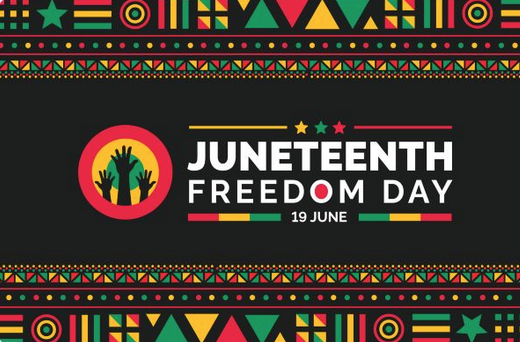
June 19 became known as Emancipation Day in Texas, and eventually as Juneteenth, and annual celebrations began the next year (1866) in Texas and gradually spread around the country. Juneteenth was officially recognized as a national holiday in 2021.
The full end of slavery in the United States did not come until six months later with the ratification of the 13 th amendment to the Constitution on December 6, 1865.
Nevertheless, Juneteenth has come to be seen as a holiday set aside to mark the end of slavery in the United States.
In this spirit, I’d like to share excerpts from a poem by Langston Hughes.
Langston Hughes was born in Joplin, Missouri, of mixed race parentage in the year 1902. He lived much of his life in NY City, which is where he died in 1967. Hughes was deeply influential in shaping American literature and culture in the 20 th century and was a key figure in what has come to be known as the Harlem Renaissance.
His poem “Let America Be America Again,” was originally published in Esquire magazine in 1936. It speaks to both the promise and the failings of the American journey and has often been read at Juneteenth celebrations throughout the years. It seems especially meaningful in light of recent national events and the approach of our nation’s 250th anniversary celebration.
LET AMERICA BE AMERICA AGAIN – Langston Hughes
Let America be America again.
Let it be the dream it used to be.
(America never was America to me.)
Let America be the dream the dreamers dreamed—
Let it be that great strong land of love
Where never kings connive nor tyrants scheme
That any man be crushed by one above.
(It never was America to me.)
O, let my land be a land where Liberty
Is crowned with no false patriotic wreath,
But opportunity is real, and life is free,
Equality is in the air we breathe.
(There’s never been equality for me,
Nor freedom in this “homeland of the free.”)
Say, who are you that mumbles in the dark?
And who are you that draws your veil across the stars?
I am the poor white, fooled and pushed apart,
I am the Negro bearing slavery’s scars.
I am the red man driven from the land,
I am the immigrant clutching the hope I seek—
And finding only the same old stupid plan
Of dog eat dog, of mighty crush the weak. …
Yet I’m the one who dreamt our basic dream
In the Old World while still a serf of kings,
Who dreamt a dream so strong, so brave, so true,
That even yet its mighty daring sings
In every brick and stone, in every furrow turned
That’s made America the land it has become.
O, I’m the man who sailed those early seas
In search of what I meant to be my home—
For I’m the one who left dark Ireland’s shore,
And Poland’s plain, and England’s grassy lea,
And torn from Black Africa’s strand I came
To build a “homeland of the free.”
The free?
Who said the free? Not me?
Surely not me? …
O, let America be America again—
The land that never has been yet—
And yet must be—the land where everyone is free.
The land that’s mine—the poor man’s, Indian’s, Negro’s, ME—
Who made America,
Whose sweat and blood, whose faith and pain,
Whose hand at the foundry, whose plow in the rain,
Must bring back our mighty dream again. …
America!
O, yes,
I say it plain,
America never was America to me,
And yet I swear this oath—
America will be! …
Minor Lile has lived on Orcas Island since the mid-1990’s. He is the chair of the Board of Trustees of the Orcas Island Community Foundation.

**If you are reading theOrcasonian for free, thank your fellow islanders. If you would like to support theOrcasonian CLICK HERE to set your modestly-priced, voluntary subscription. Otherwise, no worries; we’re happy to share with you.**