| A Transportation System Rooted in Stewardship
Public transportation might not sound like an ecological, social, or cultural issue at first. But the more you listen, the clearer it becomes:
- Elders are isolated. Teens can’t get to work.
- Roads are clogged, trails eroding, ferry lines full.
- Low-income neighbors spend scarce money and time keeping old cars running—or give up opportunities entirely.
- Meanwhile, federal and state transit funds go untouched because no one has asked the right island-shaped question.
This isn’t about building more pavement. It’s about using what we already know—and what we’ve already built—to serve each other better.
About the Project
Common Ground Transit is a collaborative, community-led effort to explore public transportation designed for—and by—the San Juan Islands. Built on shared values of stewardship, resilience, and care, it asks how better connections—between people, islands, and services—can reduce harm, increase access, and support a thriving future.
What Transit Can Really Do
Done right, a community-led transportation system could:
- Preserve rural character by reducing congestion and the push to expand roads
- Give elders, youth, and low-income workers access to daily life
- Lower emissions and protect fragile ecosystems
- Reduce toxic runoff—tire wear is now a major source of microplastics in our soil and water
- Boost local business by connecting customers to town and workers to jobs
- Support housing affordability by making outlying areas more viable
- Strengthen resilience during emergencies and ferry outages
- Support local farms by connecting people to farm stands, markets, and CSAs
- Rebuild connection in a community that’s felt increasingly atomized
We don’t need to become a city to move like a community—we just need shared vision, smart routes, and neighbors willing to help steer.
About That Tax Thing…
This isn’t about raising local taxes. It’s about capturing transportation dollars already sitting unused—federal, state, and private grants meant for projects exactly like this. Projects that prioritize resilience, climate response, and innovation.
What makes us strong candidates?
- We’re rural.
- We’re aging.
- We’re ferry-dependent.
- We’re organized.
That last point is where you come in!
Your Next Steps
- Sign the Petition – Show funders and leaders there’s interest:
Quick Petition
- Take a Survey – Local or visitor, your input matters:
Local Survey
Visitor Survey
- For Organizations & Agencies – Share your perspective:
Feasibility Survey
- Talk With Your Neighbors – Ideas spread faster face to face.
- Join Island Stewards and forpt.org Monday, August 18, 4:00 PM for our community meeting on Transportation.Meeting Link: meet.google.com/rej-cdoi-iih
- Speak Up at the County Council Meeting –
Tuesday, August 19, 9:00 AM in the Legislative Hearing Room, 55 Second Street, Friday Harbor, or join online via the County’s meeting portal. Transportation is on the agenda—your voice in “Public Access Time” will matter.
How to access Council meetings:
-
- +1 360-726-3293 , 853275322# United States, Seattle
- Phone Conference ID: 853 275 322#
- If you are watching or listening to the Council livestream, please turn it off when calling in for Public Comment.
|
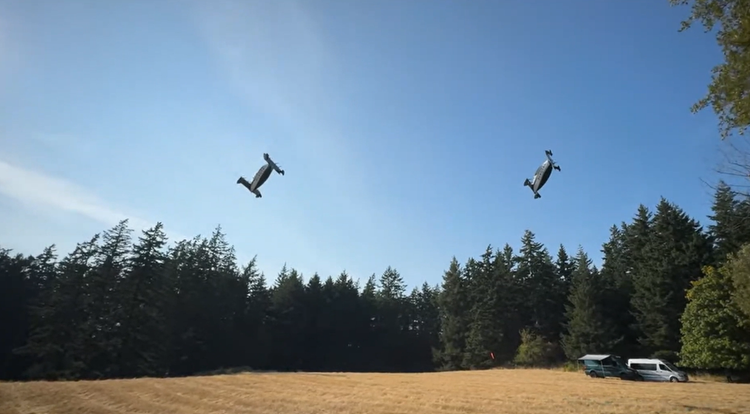
 Pivotal Experimental Flight – Orcas Island Watch here. |
|
Meanwhile, in the Sky…
Low over the treeline, human-piloted “Pivotal” aircraft—white, car-sized, and loud—crossed the island. Some saw a glimpse of the future; others heard only intrusion.On the ground, livestock scattered as the buzzing machines traced wide arcs overhead, arriving without the community process even the smallest local project requires.
And that’s the divide: we can host experimental aircraft over our heads, but many residents still can’t get a ride to work, to a doctor’s appointment, or to the ferry without leaning on a friend. Cars sit in driveways waiting for repairs that cost more than the vehicles themselves. Students turn down jobs they can’t reach. Elders miss gatherings for lack of a way home after dark.
We can launch futuristic flying machines over our homes, but we can’t yet build a basic, reliable way for neighbors to move across their own islands. Until we close that gap, the view from the ground will remain less about the marvels of tomorrow—and more about what’s missing today.
The future can fly over us, but the real test is whether it can pick us up on the way.
|
|







Cute, but pretentious and highly misleading. There are already successful and highly promising forms of public transportation on Orcas that address many of the issues raised here but are not even acknowledged, including Island Rides’ ride-share and Green CarShare programs. Ironically, it was Island Stewards that highly praised the EV CarShare program in the Orcasonian a few months back as a singular “bright spot” in the County’s Comprehensive Plan on Transportation.
To imply that there are sizeable amounts of state transportation funds going untouched “because no one has asked the right island-shaped question” is both inaccurate and highly disingenuous. Just over a year ago, we, as volunteers, secured the 2nd largest amount of project funding in the entire state for EV transportation for Orcas from the WS Department of Commerce.
If Island Stewards truly wants to help build a coalition in support of public transportation, then it needs to be truthful and acknowledge what is already going on – and going on successfully. And it should suggest ways of building on that success– rather than ignoring it entirely.
Unfortunately, this article fails to achieve its intention to contribute to coalition building for public transportation. instead, it leans toward the negative and divisive by failing to acknowledge the substantial, successful efforts already underway to build a public transportation system on Orcas to meet the needs of the underserved. True coalition building would acknowledge these efforts and suggest ways of building on the transportation successes to date.
I think twice before accusing anyone in the Orcasonian of being cute, pretentious, or highly misleading but I’m glad island stewards are trying to help find public transportation that does not involve providing everyone who needs it with a private car. I’d like to see a circulator bus/van (and pedestrian/bicycle space) and I’d like to see fair fares and local taxes shared equitably among residents and nonresidents pay for it. Existing and expanding car share and car charging infrastructure (many, many thanks to Bruce and his efforts) is important and necessary and valued for occasional personal needs but are they a solution to local commutes, daily errands and tourism requirements ?
People will adjust their schedules to use public transport only when that system is consistent, predictable and the rough edges have been smoothed off. The foot ferry trial was a bust because there were insufficient provisions for connecting transport on both ends and it was obviously temporary. We should learn from that lesson and not make the same mistake of rolling out systems before they are ready to actually function as intended. A fast foot ferry is a good idea but the execution was poor and as a result the whole concept is set back by years by this bad example of what is possible.
Rural public transport is a real challenge to make work and I suggest that part of the on-island transportation solution should be electric school buses. We already pay taxes for the existing fleet of buses and drivers, why don’t we utilize those assets all day, all week and all year for ALL the citizens, not just the little ones? Upgrading to electric buses when we can afford it and the charging facilities are in place would be nice but not essential to get the system going. Full time work for bus drivers, transportation for those who don’t, can’t, or prefer not to drive, less cars on the road, less cars in the parking lots in town and all we have to do is DECIDE to do it.
Ultimately I would love to see a fleet of ZOOX robo-taxis roaming around the island. https://zoox.com/ What about offering Orcas Island as a low speed, rural testing ground to the company?
The grant for the EV Charger Project has financed a fast-charging station at the airport intended to support an EV Shuttle System to run from the ferry landing around the Island. This is a planned Island Rides project to complement the ride-share and CarShare programs. It’s not “car-charging infrastructure”, it’s “electric-transportation charging infrastructure” that includes EV vans and, within a few years, short-haul battery-powered electric airplanes. The work currently underway is hardly limited to providing individual cars for “occasional personal needs.” It’s a “transportation system” providing: 1) free rides via EVs for people who can’t drive; 2) free access to shared EVs for those who don’t have a vehicle or can’t afford to drive one; and 3) an EV Shuttle at reasonable fare to provide transportation to locals and tourists from the ferry landing to frequented destinations around Orcas Island, with an interim stop at the Eastsound Airport to charge up and take on incoming passengers.
Last century when I was a transportation major at UW (1960’s), the minimum population density for a bus type primarily tax supported public transportation system was considered about 485 persons per square mile with a fare box recovery rate of 10%-15%. Today, it’s probably in the 2,500-3,000 persons per square mile range given the 2025 cost of buses, labor, operations and administration.
San Juan Islands current population density is about 105 per square mile. It’s a remote county.
Of course, with enough money, most ideas can be accomplished. That would almost certainly mean MAJOR new taxes.
A note about surveys. If a survey is to be used to understand the sentiment of a population, it needs to be designed with random sampling at its core. I don’t see any any evidence that the Island Steward surveys use random sampling. The problem is that the results of the survey can push a narrative that is highly misleading. Are these surveys designed to back a narrative or to capture the sentiment of a population? Perhaps Island Stewards can comment on this.