
||| AS THE PARADIGM SHIFTS by ROSIE KUHN |||
Yes, We Need a Little Christmas, and a little Hanukkah, and a little Solstice, and a little …
A few years ago, just days before Christmas, I came home from town after a lovely visit with friends. When I walked through the door, I noticed a package on my counter. A Christmas package. I had no idea who it was from.
As I opened it, I found the card. It was from the Orcas Island Lions Club. It broke me. Deep unexpected sobs rose up from somewhere I hadn’t realized was so raw.
Almost in shock and astonishment, in that moment I felt seen.
I’m not alone.
What surprised me most was not the gift itself—a mug for cocoa, coffee, or cider; some cookies and sweets; a pencil, a pad of paper, and a calendar. What surprised me most was the discovery of someone beneath my everyday competence, self-reliance, and resilience—a silenced me who knew herself alone, overlooked, forgotten. I felt like I was handling life just fine. But this small, anonymous act of generosity revealed how deeply the experience of being remembered really matters. I have no doubt this is true for every one of us.
That moment—the arrival of that experience—became a catalyst, one among many. It stirred my curiosity about this holiday time, about Santa Claus, about spiritual traditions of all kinds, about cultivating joy, peace, and generosity, and about why believing in any unseen, benevolent presence seems to matter. What seems to matter is not only believing, but allowing the experience of receiving to be truly felt—to be known.
It’s a big ask.
And it’s one we’re invited into at this time, every year.
I keep practicing this—opening to experience, to believing, to arrival.
The arrival of what?
Like many of us, I grew up believing in Santa. And like many of us, I eventually learned he wasn’t “real” in the way I once thought. Over the years, I questioned the value of the myth. Why create a story that eventually disappoints? Why set children up for heartbreak when the truth inevitably arrives?
But lately, I’ve been wondering if that question misses something essential.
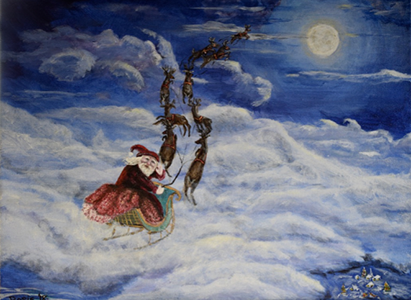
I ask myself midway through my 8th decade on the planet: Is Santa real? What’s the point of believing? And if I really believe in the presence of such a being, what might show up?
It has taken years of lived experience to recognize the results of believing—yes, even to know, in a deeper way, that Santa is real.
There is an experience being offered here—through this season, through this practice of believing. Could it be that something is being remembered, rehearsed, revealed? Through this remembering, this rehearsing, this revealing—what if knowing itself is being touched, maybe for the first time in a very long while?
Santa, at his core, isn’t about presents. He’s about the experience of that one precious moment of being seen, known, delighted in. The spirit of Santa is generosity without credit, love without proof, care that arrives quietly in the night. To “be Santa” is to agree to embody love anonymously—and to accept that one day, the illusion will fall away. But does the love fall away too? Too often, the myth of Santa is revealed in a startling, shattering way—as a lie, a betrayal. But when revealed for what and who it truly is, the love remains. The delight remains. The sanctity of the truth remains. Love is.
The heartbreak isn’t that Santa disappears.
The heartbreak is when love disappears with him.
Perhaps believing has always been a way of learning how to see.
And Then There is Hanukkah

And then there is Hanukkah—the story of oil meant to last one day, lasting eight. Not unlike the Santa myth, it’s a fantastical story told and retold for generations. Why? What’s the point?
Perhaps it isn’t about defying the laws of physics. Perhaps it’s about a people who feared they had been forgotten—only to discover that their devotion, their light, continued. They were seen—looked upon. They mattered.
And Then There was Solstice
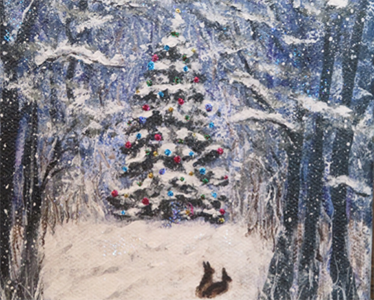
And then there is Solstice—the quietest of all these observances. No miracle. No drama. Just the acknowledgment that the darkness has reached its deepest point, and the light—almost imperceptibly—begins to return. Just a knowing. Just a turning.
Arrives Baby Jesus
And yes, there is also the story of Jesus’s birth. A story not of power, but of vulnerability. Of Love choosing to arrive without certainty, without protection, without assurance of being recognized or seen. Another fantastical story pointing to the arrival of a presence whose only mission was to express love.
Different traditions.
Different languages.
The same human ache.
Am I seen?
Am I remembered?
Is there a benevolent presence in the universe—or am I alone in the dark?
What I’m beginning to see is this: these stories aren’t promises that things will turn out the way we hope. They are gestures of orientation. They teach us how to turn toward Love when the evidence is thin.
The arrival of the gift from the Lions Club.
The arrival of Santa and presents under the tree.
The arrival of another candle lit on the Menorah.
The arrival of the morning after the longest night of the year.
It’s in the moment of arrival itself that meaning reorganizes.
Or so it seems.
Life believes in itself enough to keep coming back—returning. Perhaps this is why the birth of each new being feels sacred. With every birth, hope arrives again—not as an idea, but as a living presence ready to be received as a precious gift.
There is an arrival.
There is a gift.
Even in the thought itself, something unexpected arrives.
This alone ignites a knowing—what hope points toward, but cannot actualize on its own.
The Love That Arrives Because of You
To Christmases that don’t look the way we imagined.
To gifts that don’t arrive—or miss the mark.
To people who fail us.
To prayers that seem unanswered.
Man, we complicate things.
What if the measure of a life is not what it delivered on schedule, tied in the most beautiful bow?
What if the measure of a life is that it made room for Love to arrive—to be experienced, to be known—in ways that are unfathomable?
If that is the measure, then my own life—my choices, my losses, my waiting and wanting—are not judged by what they produced, but by the love that entered the world because of them. There is no doubt in my heart that each being—parent, teacher, Santa, a candle, a friend—carries an inherent intention to bring love through. That intention itself is an arrival. And sometimes the gift born of that intention appears decades—perhaps lifetimes—later. We never know.
Getting trapped in the story of rightness and wrongness, of getting it right and getting it right now, can blind us to this deeper truth. Because love is larger than what it looks like right now—or, for that matter, what it feels like.
This is big work.
For every single one of us.
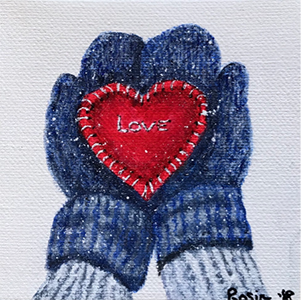
And maybe that’s why, even knowing how the stories end, we still light the candles. Still hang the stockings. Still mark the turning of the sun. Still sing, “Away in a manger, no crib for a bed.”
We keep practicing these traditions not because we’re naïve or sentimental.
We keep practicing them because, in their arrival and presence, we remember something essential.
Love is.
Or so it seems.

**If you are reading theOrcasonian for free, thank your fellow islanders. If you would like to support theOrcasonian CLICK HERE to set your modestly-priced, voluntary subscription. Otherwise, no worries; we’re happy to share with you.**





Simply beautiful. A classic to be published every year like the Wall Street Journal’s “Yes, Virginia, there is a Santa Claus.”