||| FROM NEW YORK TIMES |||
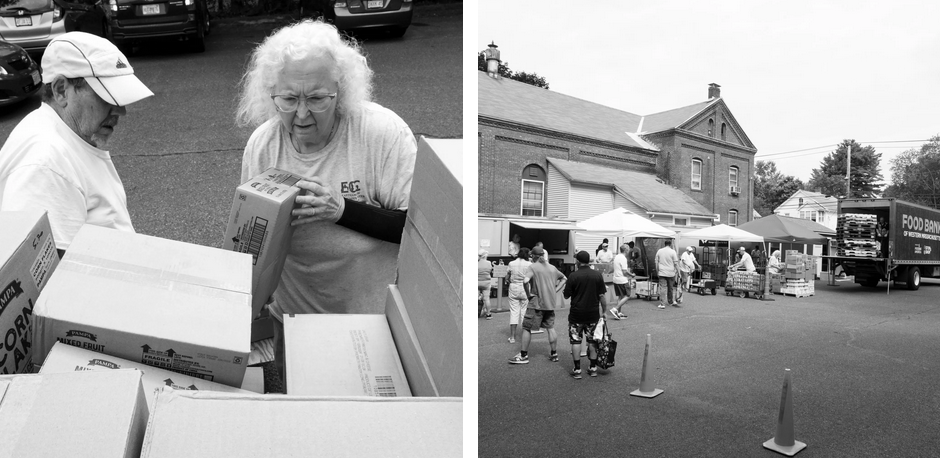
Parts of Easthampton, an old mill town in western Massachusetts, look like relics of industrial New England — the old workers’ rowhouses, for instance. In other parts, it seems like a place in renaissance, with converted factory buildings spruced up and reinhabited by art galleries, restaurants, shops. Pedestrians fill the sidewalks on Friday and Saturday nights, especially during monthly art walk evenings. But on Monday mornings, when the downtown feels shuttered, another sort of crowd, one in search of food, not art and entertainment, gathers on a side street outside a 19th-century brick building. A sign out front identifies it as the Easthampton Community Center and Food Pantry.
The center distributes free groceries on Mondays and Wednesdays, but Monday is usually busier, because many people it serves have run out of food by then. By 9 a.m. on a Monday in June, a line of people with shopping bags extended from the sidewalk across the parking lot to the first of the food stations alongside the old building. There, clients are greeted by volunteers with friendly faces and helpful voices, offering milk and eggs, a selection of breads and pastries, frozen meat, fruit and vegetables. Inside, another team of volunteers assembles bags of canned and packaged food, some for adults, others for children.
The director of the well-organized commotion is Robin Bialecki, a white-haired woman of 71. Ms. Bialecki started as a volunteer 25 years ago and has managed the operation for the last 17. She’s the only paid employee; she works every day except Christmas and makes $32,400 a year. She had planned to retire, but has stayed on to help everyone through what now seems like the unraveling of the country’s defenses against unnecessary illness and hunger.
The number of families served by the center has risen to more than 5,000 from about 1,000 before the Covid-19 pandemic. Last year, Ms. Bialecki and her volunteers distributed 2.5 million pounds of food at the center and nearby places like a homeless encampment. Now, dozens of new families arrive every week, and Ms. Bialecki tries to calm panicky clients who ask her what President Trump’s domestic policy law will mean for them. Recently, one of the regulars, an older woman, grabbed Ms. Bialecki by the shoulders, shaking her, saying: “We depend on you! And you’re not going to have enough food!”
The woman had reason to worry, as do the roughly 50 million other Americans who use food bank pantries like Easthampton’s.
Mr. Trump’s law, signed on Independence Day, is the latest and largest of all the cyclical attempts to reduce the size and cost of America’s so-called safety net — to winnow the various social programs established by President Lyndon Johnson’s “Great Society” program. Among other things, the law begins to dismember the federal program once known as food stamps, now known, in an age of prolixity, as the Supplemental Nutrition Assistance Program, or SNAP. The program distributes money for food — an average of $187 a month per person. About 42 million Americans rely on it, including 85 percent of Ms. Bialecki’s clients.
This New York Times article comes from Rick Rhoads. board president of Orcas Island Food Bank, and it echoes our experience at the Food Bank.

**If you are reading theOrcasonian for free, thank your fellow islanders. If you would like to support theOrcasonian CLICK HERE to set your modestly-priced, voluntary subscription. Otherwise, no worries; we’re happy to share with you.**




This NYT article really hits me in the gut. I was born in Springfield, MA, just south of Easthampton, and raised in Enfield, CT, just south of Springfield. Some of these folks could be my aunts and uncles and cousins.
Lin–Thank you, as always, for reprinting general interest articles like this that also, of course, touch on our lives here. I don’t know whether I feel more sad or outraged. Both. “No man is an island.”